The best castable fish finders help you scout depth, structure, and fish activity without committing to a permanently installed boat unit. They are especially useful from shore, docks, kayaks, and small boats where portability matters.
This roundup compares 10 popular options, including app-connected sonar devices, GPS-enabled models, handheld systems, and fish finders with dedicated displays.
Best 10 Castable Fish Finders Picks for 2026
Best All-Around Castable Sonar

- Streams sonar to Apple or Android devices
- Includes 2-D and ice-fishing flasher modes
- Provides 10+ hours of rechargeable battery life
Best For: Shore anglers and ice fishers wanting versatile app-based sonar
Best for Simple Fish Alerts

- Shows depth-tagged, color-coded fish icons
- Includes fish and strike alerts
- Works in freshwater, saltwater, and ice-fishing settings
Best For: Casual anglers wanting simple Bluetooth sonar and alerts
Best with GPS Mapping

- Creates custom maps with 1-foot contours
- Streams sonar from up to 200 feet away
- Supports 2-D and ice-fishing flasher modes
Best For: Anglers combining castable sonar with custom GPS mapping
Best for Sonar Fine-Tuning

- Provides four preset operating modes
- Includes FishEcho and BottomScan tools
- Adds a vertical flasher for ice fishing
Best For: Anglers wanting adjustable sonar and bottom-reading features
Advanced Mapping Pick
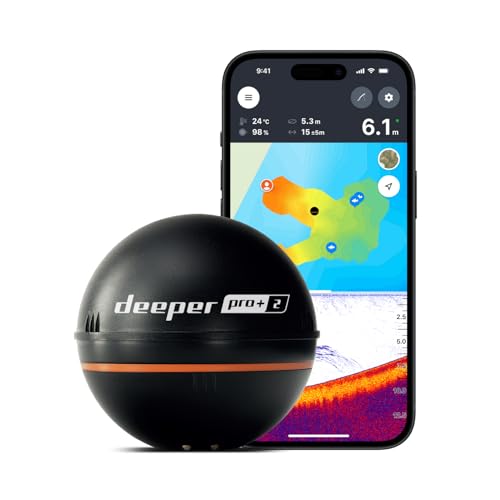
- Built-in GPS for bathymetric maps
- Three sonar beam options
- Up to 330-foot connectivity range
Best For: Experienced anglers seeking detailed mapping and precise sonar coverage
Standalone Display Pick
Venterior Portable Fish Finder

- Dedicated color TFT handheld display
- 262-foot wireless sensor range
- Reports depth, temperature, fish size, and bottom contour
Best For: Anglers wanting a phone-free display for varied fishing environments
Casual Shore-Fishing Pick

- 165-foot casting and depth range
- App shows fish, depth, contour, and vegetation
- Six-hour battery life after a 2.5-hour charge
Best For: Casual shore anglers and families using a phone-based fish finder
Depth-Reading Value
DANOPLUS DP-104 Portable Fish Finder

- Color LCD with 21 languages
- 147-foot detection and 90° coverage
- Fish alarms plus temperature and bottom data
Best For: Mobile anglers wanting a compact rechargeable fish finder
Deep-Water Range
LUCKY FFC1108 Handheld Fish Finder

- Up to 328 feet of depth detection
- Shows fish, weeds, sand, and rocks
- Five sensitivity levels and backlit display
Best For: Anglers targeting deeper water from boats, kayaks, or shore
Long-Range Wireless Pick
LUCKY MT-202 Castable Fish Finder
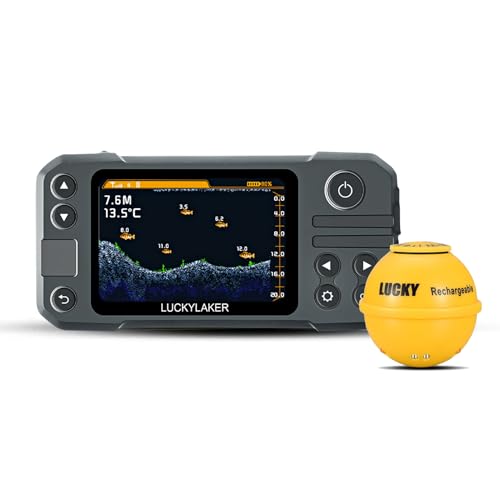
- 853-foot wireless operating distance
- 3.5-inch screen with scrolling sonar history
- Castable sensor scans 3–147 feet
Best For: Shore and boat anglers needing extended wireless reach
Best All-Around Castable Sonar – Garmin STRIKER Cast
The Garmin STRIKER Cast is a practical choice among castable fish finders for anglers who want sonar readings on a smartphone or tablet. It pairs with the free STRIKER Cast app, supports traditional 2-D and ice-fishing flasher modes, and streams from up to 200 feet away.
Best For: Shore anglers and ice fishers who want broad water coverage, app-based sonar, and straightforward setup.
Pros:
- Works with Apple and Android devices through the free STRIKER Cast app
- Supports 2-D sonar and ice-fishing flasher modes
- Offers 10+ hours of rechargeable battery life
- Can download maps with up to 1-foot contours from the Garmin Quickdraw Community
Cons:
- Requires a compatible smartphone or tablet for the display
- The listed version does not include built-in GPS mapping
Automatic power-on when floating helps conserve battery when the unit is out of the water. With shallow- and deep-water performance plus a rugged design, it is a versatile pick for mobile sonar users.
Best for Simple Fish Alerts – Reelsonar iBobber
The Reelsonar iBobber is one of the more approachable castable fish finders for anglers who prefer a compact wireless setup. Its iOS and Android apps show depth-tagged, color-coded fish icons, while fish and strike alarms provide additional notification options.
Best For: Casual anglers who want a simple Bluetooth fish finder for shore, dock, pier, freshwater, saltwater, or ice fishing.
Pros:
- Works with iOS and Android apps
- Measures depths down to 135 feet
- Offers 10+ hours of rechargeable battery life
- Includes fish and strike alert features
Cons:
- Has a shallower stated depth range than some alternatives
- Uses Bluetooth app connectivity rather than a dedicated display
Depth-tagged icons and configurable alerts make the iBobber easy to understand without a complex sonar display. It is a compact option for anglers who value convenience and broad fishing-location flexibility.
Best with GPS Mapping – Garmin STRIKER Cast GPS
The GPS-equipped Garmin STRIKER Cast adds custom mapping to the castable fish finder format. Through the STRIKER Cast app, anglers can create maps with 1-foot contours, stream 2-D or ice-flasher sonar from up to 200 feet away, and view results on an Apple or Android device.
Best For: Anglers who want castable sonar plus GPS-based custom maps for tracking fishing areas.
Pros:
- Built-in GPS supports custom maps with 1-foot contours
- Streams sonar wirelessly from up to 200 feet away
- Supports 2-D and ice-fishing flasher modes
- Has IPX6 and IPX7 water resistance and 10+ hours of battery life
Cons:
- Requires a compatible smartphone or tablet for viewing
- Mapping features require use of the app and Quickdraw software
Compared with the non-GPS version, this model is the stronger choice for anglers who want to build and revisit custom contour maps. Its water-resistant, lightweight housing also suits repeated casting with appropriate fishing line.
Best for Sonar Fine-Tuning – FishPod 5X
The FishPod 5X is a Bluetooth fish finder designed for anglers who want more control over how sonar information is presented. Its four preset operating modes adjust screen settings for fish size, depth, or schooling, while FishEcho and BottomScan help interpret targets and bottom conditions.
Best For: Anglers who want adjustable sonar modes, bottom-reading tools, and a vertical flasher for ice fishing.
Pros:
- Offers four preset operating modes for different fishing targets
- FishEcho helps distinguish fish size and depth from clutter
- BottomScan reads bottom contour and composition
- Vertical Flasher mode supports ice fishing
Cons:
- The supplied notes do not specify battery life
- Bluetooth operation requires a compatible connected device
- Mounting hardware may be needed because the unit uses a universal mount
With a stated maximum depth of 199 feet and multiple sonar interpretation tools, the FishPod 5X is aimed at anglers who prefer a more configurable experience. Its TraxNut system also supports attachment to compatible 1/4 x 20 brackets and fishing platforms.
Advanced Mapping Pick – Deeper PRO+ 2 Sonar
The Deeper PRO+ 2 is a strong choice among castable fish finders for anglers who want detailed sonar readings and GPS mapping from shore, a dock, kayak, boat, or while ice fishing. Its multiple beam options help you scan broadly or focus on specific targets.
Best For: Experienced anglers who want bathymetric mapping, precise target separation, and flexible sonar coverage.
Pros:
- Built-in GPS creates and saves bathymetric maps through the Fish Deeper app.
- Wide, mid, and narrow beams support both broad searches and pinpoint fishing.
- Provides accuracy up to 330 feet with target separation as fine as 0.4 inches using the narrow beam.
- Wireless, lightweight design includes its own Wi-Fi connection.
Cons:
- Its advanced mapping and beam features may be more than casual anglers need.
- Requires a compatible mobile device and the Fish Deeper app to view scan data.
Choose this model if mapping and detailed target identification matter more than keeping the setup as simple as possible. The included pouch, attachment bolts, and two-year limited warranty add practical value.
Standalone Display Pick – Venterior Portable Fish Finder
This Venterior model is one of the more self-contained castable fish finders, pairing a wireless sonar sensor with a color handheld display. It reports depth, water temperature, fish size, fish depth, and bottom contour without requiring a phone or hull installation.
Best For: Shore, kayak, boat, and ice anglers who prefer a dedicated color screen and straightforward sensor casting.
Pros:
- Wireless sensor works up to 262 feet from the handheld unit.
- Displays water depth, temperature, estimated fish size, fish depth, and bottom contour.
- Color TFT display offers selectable black and white backgrounds for different lighting conditions.
- Suitable for lakes, rivers, seas, shore fishing, kayaks, boats, and ice fishing.
Cons:
- Its maximum depth range is 164 feet, less than some deeper-reading models.
- The sensor battery indicator is only accurate when the sensor is floating in water.
The Venterior is a practical fit when you want sonar information on a dedicated screen rather than a smartphone app. Its broad 105-degree beam and two-year warranty make it a versatile option for varied fishing environments.
Casual Shore-Fishing Pick – Deeper START Fish Finder
The Deeper START keeps castable fish finders simple for recreational anglers. Pair its wireless sonar with the Fish Deeper app to view fish location and size, depth, bottom contour, and vegetation while fishing from shore, a dock, bank, or kayak.
Best For: Casual anglers and families who want an easy, phone-based fish finder for shore and kayak trips.
Pros:
- Casts and scans up to 165 feet, with a maximum depth of 165 feet.
- Automatically saves scans with time and location in the Fish Deeper app.
- Provides information on fish location and size, depth, bottom contour, and vegetation.
- Reaches a full charge in 2.5 hours and offers up to 6 hours of battery life.
Cons:
- Requires an iOS or Android phone and the Fish Deeper app for readings.
- Its 40-degree sonar beam is less broad than the Venterior’s listed 105-degree beam.
For straightforward recreational fishing, the START balances portable design, app-based scan history, and useful core readings. It is a sensible entry point for anglers who do not need the PRO+ 2’s GPS mapping or multiple beam modes.
Depth-Reading Value – DANOPLUS DP-104 Portable Fish Finder
For anglers comparing castable fish finders, the DANOPLUS DP-104 combines a compact color display with a rechargeable wireless sonar sensor. It reports fish icons and depth, water temperature, water depth, and bottom contour, with detection reaching up to 147 feet.
Best For: Kayak, shore, ice, river, lake, and sea anglers who want a handheld display with temperature and bottom information.
Pros:
- 2.4-inch color LCD supports 21 operating languages.
- Rechargeable sonar sensor detects depths up to 147 feet with a 90-degree coverage angle.
- Fish alarms indicate passing fish and display estimated size and depth.
- Wireless sensor lamp turns on when it contacts water.
Cons:
- Its 2.4-inch screen is smaller than the display on some handheld models.
- Maximum detection depth is lower than the 328-foot rating of the LUCKY FFC1108.
This is a practical option if you value readable fish and depth information in a lightweight, rechargeable setup. The built-in temperature and bottom readings add useful context for mobile fishing trips.
Deep-Water Range – LUCKY FFC1108 Handheld Fish Finder
The LUCKY FFC1108 stands out among castable fish finders for its stated 328-foot maximum depth range. Its sonar transducer can be cast or attached to a kayak or boat hull, while the handheld LCD shows fish location, depth, weeds, and bottom composition.
Best For: Boat, kayak, ice, and shore anglers who prioritize deeper water coverage and adjustable sensitivity.
Pros:
- Detects water depths from 3 to 328 feet when fully immersed.
- Displays approximate fish location, fish depth, weeds, sand, and rocks.
- Five sensitivity levels support use in clear or turbid water.
- Backlight improves visibility in darkness, and battery-save mode can extend operation beyond the stated 4–5 hours.
Cons:
- The 2-inch LCD is relatively compact.
- The included design uses a battery-powered handheld unit rather than a rechargeable display.
- The transducer may be attached to a hull or tossed into the water, but the product is less explicitly wireless than the other listed options.
Choose this model when maximum stated depth is more important than screen size. Its sensitivity controls and bottom-detail display make it a versatile choice for changing water conditions.
Long-Range Wireless Pick – LUCKY MT-202 Castable Fish Finder
For anglers seeking castable fish finders with more freedom from shore, the LUCKY MT-202 pairs a floating wireless sonar sensor with an 853-foot operating distance. Its 3.5-inch horizontal LCD shows fish icons with depth numbers and scrolls a history of what passed beneath the sensor.
Best For: Shore, kayak, canoe, boat, pontoon, and ice anglers who want long wireless operating range and a larger display.
Pros:
- 853-foot operating distance supports scouting water well away from the angler.
- 3.5-inch horizontal LCD displays fish icons, depth numbers, and scrolling sonar history.
- 90-degree beam scans depths from 3 to 147 feet.
- Portable sensor can be tied to a fishing line or included safety tether and cast like a bobber.
Cons:
- Its maximum depth rating is 147 feet, less than the LUCKY FFC1108’s 328 feet.
- At 0.7 kg, it is heavier than the DANOPLUS unit listed here.
The MT-202 is the most range-focused choice in this group. Its larger screen and sonar-history display are useful when casting across broad areas, while the portable design also suits seasonal and all-water fishing.
How We Picked the Best Castable Fish Finders
We focused on the features that matter most when choosing a portable sonar system: connection method, usable depth range, display or app quality, battery design, portability, and suitability for different fishing environments. We also considered whether each model is better suited to shore casting, kayak fishing, boat use, or ice fishing.
Because specifications and included accessories can vary by listing, confirm the current package contents, supported mobile operating system, water resistance, and claimed operating depth before buying.
Quick Comparison
| Type | Best For | Main Advantage | Potential Trade-Off |
|---|---|---|---|
| Bluetooth/app sonar | Shore and kayak anglers | Compact and easy to carry | Depends on phone battery and connection |
| GPS-enabled castable sonar | Mapping productive areas | Depth and location data | Usually costs more |
| Handheld display sonar | Anglers who want a dedicated screen | No smartphone required | Less convenient to store or cast |
| Ice-fishing or kayak-focused sonar | Specialized portable use | Designed for compact setups | May have fewer general-purpose features |
Key Buying Factors for Castable Fish Finders
Connection and Display
Phone-based units keep your gear light and can provide color charts, mapping, and saved data through an app. A dedicated LCD display is preferable if you fish in wet conditions, want a separate screen, or do not want to depend on a phone.
Depth Range and Sonar Detail
Consider the water you normally fish rather than choosing only by the largest advertised depth. A useful unit should show depth clearly and help distinguish bottom contours, vegetation, structure, and likely fish targets. Sonar readings can vary with water clarity, temperature, boat movement, and casting position.
Battery Life and Charging
Look for enough runtime for a full session, plus a straightforward charging method. Rechargeable designs reduce disposable-battery costs, while longer battery life is valuable for tournaments, remote trips, and cold-weather fishing.
Durability and Casting Practicality
The transducer should be rugged enough for repeated casting and retrieval, with a secure attachment point and appropriate water protection. Check its weight, shape, and recommended line or connection method so it works with your rod and target casting distance.
GPS, Mapping, and Extra Features
GPS can help mark productive locations and build a clearer picture of underwater terrain. Features such as fish-size estimates, alarms, temperature readings, bottom mapping, and AI-assisted interpretation can be useful, but they should supplement—not replace—basic sonar information and fishing judgment.
Who Should Buy Which Castable Fish Finders?
Choose a Bluetooth or app-connected model if you want the smallest setup for fishing from shore, a dock, or a kayak and already carry a smartphone.
Choose a GPS-enabled castable sonar if marking locations, studying contours, and returning to productive areas are priorities.
Choose a handheld-display model if you prefer dedicated controls and viewing without pairing a phone.
Choose a compact kayak or ice-fishing model if storage space is limited or you need equipment suited to a specialized portable setup. For occasional recreational fishing, prioritize simple operation and reliable battery life over advanced features you may not use.