Stable temperature is essential for fish, shrimp, and aquatic plants, but an in-tank heater can clutter the display or create uneven heating. External aquarium heaters place the heating element in the filter return line or use a remote controller, helping keep equipment out of sight while improving control.
This roundup compares 10 options across inline and submersible designs, wattages, tank sizes, controls, and safety features so you can choose a heater that matches your aquarium and filtration setup.
Best 10 External Aquarium Heaters Picks for 2026
Best Canister-Filter Fit
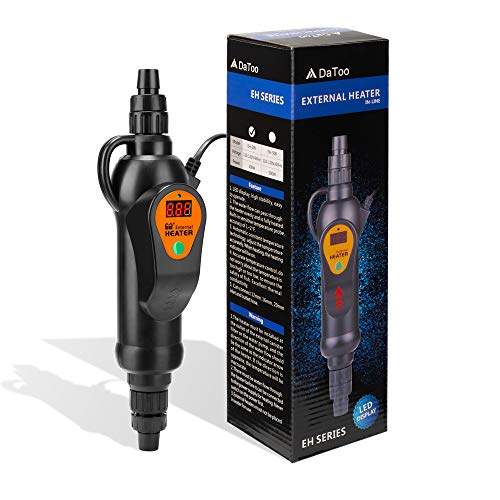
- 68°F–95°F temperature range
- Dual sensors with overheat protection
- Includes three adapter sizes
Best For: Canister-filter aquariums needing flexible inline installation
Best Large-Tank Option

- Rated for 25–160 US gallons
- External, clutter-reducing design
- Two-year warranty included
Best For: Larger aquariums needing external flow heating
Best Submersible Safety Features

- For 40–75 gallon tanks
- LED display with 63°F–94°F control
- Stops heating out of water
Best For: Freshwater or saltwater tanks using a guarded submersible heater
Best High-Wattage Inline Choice
500W Inline External Aquarium Heater

- 500W output with LCD display
- For freshwater and marine aquariums
- Includes 17mm and 22mm adapters
Best For: Higher-demand canister-filter or sump-style systems
Best Precision Pick
hygger 200W External Aquarium Heater

- Dual-probe monitoring with PRECISE and ECO modes
- External controller with child lock and memory
- Designed for 20–40 gallon freshwater or saltwater tanks
Best For: Sensitive fish and aquarists wanting precise external control
Best for Larger Tanks
hygger 300W Digital External Aquarium Heater

- Rated for 40–80 gallon freshwater and saltwater tanks
- Digital LED controller shows temperature and warnings
- Automatic high-temperature and low-water shutoff
Best For: Larger aquariums needing visible digital controls
Most Versatile Power
hygger Adjustable Titanium Aquarium Heater

- Switchable 50W, 100W, 150W, and 200W settings
- Titanium heating element for freshwater or saltwater
- Supports horizontal, low-water-level installations
Best For: Flexible setups including fish, turtles, frogs, and salamanders
Best Large-Tank Value
hygger 500W External-Controller Heater

- For 60–120 gallon aquariums
- 0.1°F LED display with external controller
- Overheat and dry-run protection
Best For: Large freshwater or marine tanks
Best Calibration Control
hygger Titanium Aquarium Heater

- 50W version fits 10–15 gallon tanks
- External probe and digital controller
- Temperature calibration function
Best For: Small freshwater or saltwater aquariums
Best for Extra-Large Tanks
hygger 800W External-Controller Heater
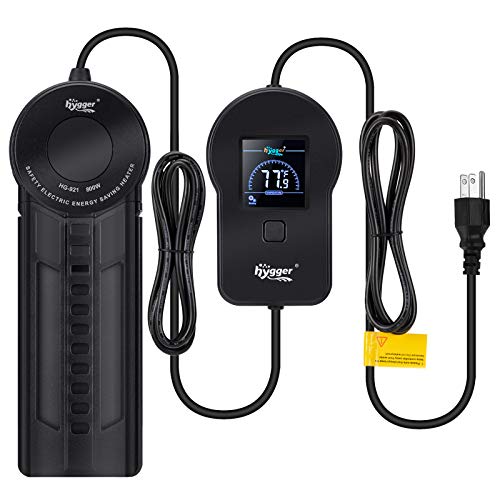
- Designed for 120–180 gallon tanks
- 800W titanium heating element
- External LED display and dry-run protection
Best For: Extra-large freshwater or marine aquariums
Best Canister-Filter Fit – DaToo 300W Inline Heater
DaToo Aquarium External Heater in-Line Fish Tank External Heater 300W for Canister Filter
Check Price On AmazonFor aquariums using a canister filter, the DaToo is a purpose-built external aquarium heater with adjustable control from 68°F to 95°F. Its large LED display, replaceable hose adapters, and dual temperature sensors make it practical for maintaining consistent water temperature without placing a heater inside the tank.
Best For: Canister-filter aquariums needing a 300W inline heater with broad hose compatibility.
Pros:
- Precise temperature control across a 68°F–95°F range.
- Dual sensors and automatic overheat protection.
- Includes 12mm, 16mm, and 20mm inlet/outlet heads plus a cleaning brush.
- Durable glass-ceramic heating tube and ABS housing.
Cons:
- Designed specifically around canister-filter installations.
- Requires selecting and fitting the appropriate hose adapters.
The DaToo combines useful installation accessories with detailed temperature monitoring, making it a strong choice when a canister-filter setup and inline mounting are priorities.
Best Large-Tank Option – Aquael 300W Flow Heater
The Aquael Inline Flow Heater is an external aquarium heater rated for tanks from 25 to 160 US gallons. Its external mounting design keeps equipment out of the display, while the high-efficiency heating element and precise temperature control are intended to support stable aquarium conditions.
Best For: Medium-to-large indoor aquariums where a clutter-free external installation is preferred.
Pros:
- Rated for a wide 25–160 US gallon tank range.
- External design keeps the heater out of the aquarium.
- High-efficiency element responds quickly to temperature changes.
- Includes a two-year warranty.
Cons:
- The supplied notes do not specify hose-adapter sizes or compatibility details.
- Installation directions must be checked on the product packaging.
With its unusually broad stated tank range and external mounting, the Aquael is a straightforward option for shoppers who want to reduce visible equipment in a larger aquarium.
Best Submersible Safety Features – HiTauing 300W Aquarium Heater
The HiTauing is a 300W submersible aquarium heater for 40–75 gallon freshwater or saltwater tanks. It combines a digital controller with real-time temperature display, an adjustable 63°F–94°F range, and automatic shutoff when the heater head is out of the water.
Best For: Freshwater or saltwater aquariums needing a guarded submersible heater with digital controls.
Pros:
- Suitable for 40–75 gallon aquariums.
- Displays current and set temperatures on an LED controller.
- Automatically stops heating when the heater head is out of water.
- Quartz tube and ABS guard are designed for durability and protection.
Cons:
- This is a submersible heater, not an external inline model.
- Installation requires the heater to remain fully submerged before plugging it in.
The HiTauing is a practical alternative when you want visible digital controls and built-in water-level protection, provided an in-tank heater suits your setup better than external aquarium heaters.
Best High-Wattage Inline Choice – 500W Inline External Aquarium Heater
This 500W inline external aquarium heater is designed for canister-filter and other circulating-water setups. It offers adjustable control from 20°C to 35°C, an LCD display, overheating protection, and an internal heat-pump system intended to reduce temperature variation.
Best For: Freshwater or marine aquariums requiring a higher-wattage inline heater for a canister filter or sump-style system.
Pros:
- 500W output for higher heating demands.
- Works with freshwater and marine aquariums.
- Includes 17mm and 22mm adapters for compatible hoses.
- Automatic shutoff helps protect against short dry-running periods.
Cons:
- Listed voltage is 220–240V, so buyers must verify electrical compatibility.
- Must be installed vertically and connected to the filter outflow.
- Temperature range is stated in Celsius rather than Fahrenheit.
The higher wattage and marine-water suitability make this a compelling inline option, but installation orientation, water-flow direction, hose sizing, and voltage should all be confirmed before purchase.
Best Precision Pick – hygger 200W External Aquarium Heater
If you want external aquarium heaters that are easy to adjust and designed for stable temperatures, this 200W hygger model is a strong fit for 20–40 gallon freshwater or saltwater tanks. Its external controller, dual probes, and selectable PRECISE or ECO modes make it practical for routine monitoring and sensitive aquatic species.
Best For: 20–40 gallon tanks, sensitive fish, shrimp, turtles, and aquarists who prefer out-of-water controls.
Pros:
- Dual probes provide real-time temperature monitoring and support stable heating.
- External controller offers 59–93°F adjustment, 0.5°F increments, and a child lock.
- Automatic shutoff, audible alarms, memory function, and dry-run protection add convenience.
- Smooth shell-free quartz design has a low-profile, fish-friendly appearance.
Cons:
- Its 200W capacity is intended for 20–40 gallon aquariums rather than larger tanks.
- The shell-free design may require extra care during installation and maintenance.
Choose this model when precise control and easy access to settings matter more than maximum tank capacity. The two-year warranty and safety alerts further support its role as a carefully monitored heating option.
Best for Larger Tanks – hygger 300W Digital External Aquarium Heater
For larger aquariums, this 300W hygger is one of the more practical external aquarium heaters in the lineup. It is rated for 40–80 gallon freshwater and saltwater tanks and pairs a digital LED controller with automatic overheating and out-of-water protection.
Best For: 40–80 gallon aquariums and users who want clear digital temperature and warning displays.
Pros:
- 300W output is specified for 40–80 gallon tanks.
- LED controller displays current temperature, preset temperature, power, and warning information.
- Automatic shutoff responds to temperatures above 94°F or insufficient water coverage.
- Includes a controller holder, hook, three suction cups, and a one-year warranty.
Cons:
- Temperature accuracy is listed as ±1°F, less precise than some smaller models.
- At 10.8 inches long and 2.2 pounds, it may be less convenient for compact setups.
This is a sensible choice when tank size and visible status information are priorities. Its quartz construction, protective guard, and multiple included mounting accessories make setup straightforward for appropriately sized tanks.
Most Versatile Power – hygger Adjustable Titanium Aquarium Heater
This hygger model stands out among external aquarium heaters because its power can be switched between 50W, 100W, 150W, and 200W. The adjustable design can accommodate changing seasonal needs, while its titanium element and external controller suit freshwater, saltwater, and low-water-level turtle or amphibian tanks.
Best For: Aquarists who want one adjustable heater for varied setups, including turtle, frog, and salamander tanks.
Pros:
- Selectable 50W, 100W, 150W, and 200W output adds flexibility.
- Titanium construction is described as corrosion-resistant, explosion-proof, and suitable for saltwater.
- Dual temperature controls and double-sided water-shortage protection help limit overheating and dry burning.
- Supports horizontal installation and includes strong suction cups plus an external controller.
Cons:
- The broad power range requires users to select the appropriate setting for their setup.
- Automatic shutoff is specified for temperatures exceeding 97°F, so normal monitoring is still important.
Consider this heater if flexibility is more valuable than choosing a single fixed wattage. Its adjustable output, titanium body, and low-water-level installation support make it especially adaptable for mixed aquatic environments.
Best Large-Tank Value – hygger 500W External-Controller Heater
For aquarists comparing external aquarium heaters for a 60- to 120-gallon tank, this 500W hygger model combines rapid heating with an external color LED controller. Its titanium-steel heating element, temperature monitoring, and dry-run protection provide practical everyday safeguards.
Best For: 60- to 120-gallon freshwater or marine aquariums needing high-output heating and easy external temperature control.
Pros:
- Three-digit LED display shows current or set temperature to 0.1°F.
- Rapid-heating titanium-steel element is corrosion resistant and designed to reduce power near the set temperature.
- Includes over-temperature, anti-dry, power-off memory, and automatic restart features.
- Comes with a strong suction-cup bracket and a two-year warranty.
Cons:
- The 500W output is intended for larger aquariums rather than nano tanks.
- Temperature accuracy is specified as ±1°F, despite the display’s 0.1°F resolution.
This is a strong choice when you want substantial heating capacity, a readable external controller, and multiple automatic safety features in one large-tank heater.
Best Calibration Control – hygger Titanium Aquarium Heater
This hygger titanium heater is one of the more flexible external aquarium heaters because it includes temperature calibration and a separate probe. The 50W version suits 10- to 15-gallon tanks, while the product line is also offered in 100W, 200W, 300W, and 500W options.
Best For: Small freshwater or saltwater aquariums where external adjustment and calibration are priorities.
Pros:
- External probe and digital controller let you adjust settings without reaching into the tank.
- Calibration can compensate when the controller differs from an external thermometer.
- TA2 aviation titanium construction is designed for freshwater and marine use.
- Provides overheating protection, automatic restart, and a 68°F–90°F adjustable range.
Cons:
- The listed 50W model is limited to 10- to 15-gallon tanks.
- Temperature accuracy is specified as ±1°F.
Choose this model if calibration matters as much as heating. Its external probe and controller make routine adjustments convenient, while the titanium construction supports both freshwater and saltwater setups.
Best for Extra-Large Tanks – hygger 800W External-Controller Heater
For 120- to 180-gallon aquariums, this 800W hygger is a high-output option among external aquarium heaters. It pairs rapid titanium heating with an external color LED controller, built-in temperature monitoring, and automatic shutdown protections.
Best For: Extra-large freshwater or marine aquariums requiring 800W heating capacity and external temperature visibility.
Pros:
- Designed for 120- to 180-gallon tanks.
- External three-digit display shows real-time or set temperature to 0.1°F.
- Titanium construction offers corrosion resistance and fast heating.
- Includes over-temperature, anti-dry, power-off memory, and automatic restart protection.
Cons:
- The 800W output is unsuitable for smaller aquariums.
- Temperature accuracy is specified as ±1°F.
This is the most powerful option in the lineup and makes sense for large-volume systems where a 500W heater may be undersized. Its external controller also keeps status information easy to read.
How We Picked These External Aquarium Heaters
We focused on heaters that cover common freshwater and marine aquarium setups, including inline models designed for canister-filter hoses and submersible units with external temperature controls. We considered power ratings, stated tank-size compatibility, temperature adjustment, display visibility, probe design, overheating protection, dry-run safeguards, and compatibility with continuous water flow.
Because heater performance depends on room temperature, water movement, insulation, and aquarium volume, wattage should be treated as a starting point rather than a guarantee. Always follow the manufacturer’s sizing guidance and installation instructions.
Quick Comparison
| Type | Best For | Main Advantage | Watch For |
|---|---|---|---|
| Inline external heater | Canister-filter aquariums | Minimal equipment inside the tank | Requires suitable hose size and flow |
| Submersible heater with external controller | Flexible aquarium setups | Simple placement with convenient controls | Heating element still occupies tank space |
| Titanium marine heater | Saltwater and demanding environments | Durable heating element and calibration features | Higher cost and careful controller setup |
| Compact adjustable heater | Small tanks and quarantine systems | Lower wattage and straightforward installation | Less suitable for large or poorly insulated tanks |
Key Buying Factors for External Aquarium Heaters
Inline Compatibility
For an external model, verify hose diameter, recommended flow rate, filter compatibility, and installation direction before buying. An inline heater should be installed where water flows continuously and should not run dry.
Correct Wattage
Choose wattage based on aquarium volume and the temperature difference between the room and the target water temperature. Larger tanks, cool rooms, open-top aquariums, and marine systems may require more heating capacity or multiple heaters for redundancy.
Temperature Accuracy and Controls
Digital displays, external controllers, dual probes, and calibration functions make it easier to monitor and adjust temperature without reaching into the aquarium. A clear display is especially useful when the heater is placed inside a cabinet.
Safety Protections
Look for overheating protection, automatic shutoff, dry-run detection, and reliable temperature sensing. These features reduce risk but do not replace routine checks of water flow, cables, probes, and actual aquarium temperature with a separate thermometer.
Freshwater or Marine Use
Confirm that the heater’s materials and controller are appropriate for saltwater if you maintain a marine aquarium. Titanium models are often selected for marine applications, while standard glass or plastic-bodied units may be intended primarily for freshwater use.
Who Should Buy Which External Aquarium Heaters?
Choose an inline model such as the DaToo or Aquael when you already use a compatible canister filter and want the cleanest-looking display. Consider a hygger heater with an external controller when you want accessible temperature adjustments without removing equipment from the tank.
For small aquariums, quarantine tanks, or gently heated setups, a lower-wattage adjustable model is usually easier to control. Larger aquariums may call for 300W to 1000W options, but check the manufacturer’s recommended volume and use reliable circulation to distribute heat evenly.
Marine hobbyists should prioritize corrosion-resistant construction, calibration, and saltwater compatibility. Regardless of model, place the sensor where it can measure representative water temperature, maintain adequate flow, and verify the reading with an independent aquarium thermometer.