Keeping water temperature stable is one of the easiest ways to protect fish, plants, and beneficial bacteria. The right controller can reduce stress, prevent dangerous swings, and make heater or fan management far more consistent.
In this roundup, we focus on aquarium temperature controllers that are practical, easy to configure, and suited to real-world home tanks, breeding setups, and mixed-use aquarium systems.
Best 10 Aquarium Temperature Controllers Picks for 2026
Dual Heating & Cooling Thermostat
Inkbird ITC-308 Digital Temperature Controller

- Heating and cooling dual relay control
- Dual display shows set and measured temp
- Buzzer alarm plus compressor delay settings
Best For: Aquarium keepers who want a straightforward controller with both heating and cooling support.
Safety-Focused Dual Sensor Controller
Aquarium Temperature Controller with Auto Calibration

- Dual sensors with automatic calibration
- Over-temperature protection on the load line
- Heating and cooling modes with adjustable display brightness
Best For: Users who want extra sensor redundancy and safety protections in a wired controller.
Heating-Only Day/Night Controller
Inkbird Digital Outlet Heat Temperature Controller

- Heating-only control with no cooling mode
- Day/night temperature cycling for 24 hours
- Dual displays plus over-temp and sensor-fault alarms
Best For: Heating-only aquarium, breeding, or reptile setups that benefit from day/night temperature changes.
Submersible Probe Aquarium Thermostat
Inkbird ITC308S for Heater and Fans
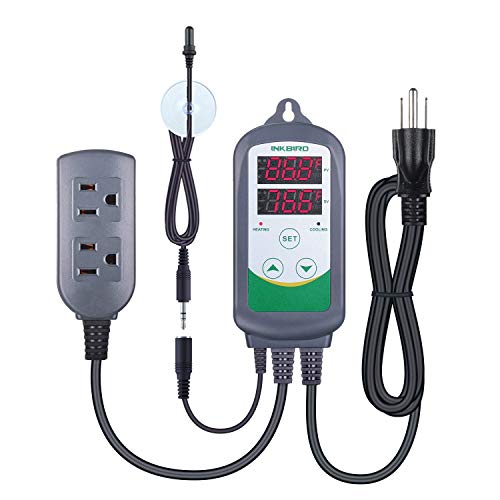
- Fully submersible probe designed for water use
- Heating and cooling outlets in one controller
- Dual display with calibration and safety alarms
Best For: Aquariums that need a water-safe probe and simple heating/cooling control.
Waterproof All-Rounder
DIGITEN Waterproof Digital Temperature Controller

- Waterproof probe with IP65 shell
- Wide range: -40~248ºF
- LED display plus temp alarms
Best For: Versatile heating control in humid or outdoor-style setups
Dual Outlet Protector
HiTauing Aquarium Heater Thermostat

- Controls heating and cooling separately
- Seawater-resistant probe
- Touch LED display with dual relays
Best For: Aquariums that need both heater and chiller protection
Simple Knob Controls
WH2408 Digital Thermostat Outlet

- Easy two-knob setup with memory after outages
- Heating and cooling modes in one plug switch
- Food-grade probe with Fahrenheit/Celsius support
Best For: Simple aquarium or terrarium temperature control without complex menus
Heat-Only Aquarium Controller
Inkbird ITC-306T Dual Heating Thermostat
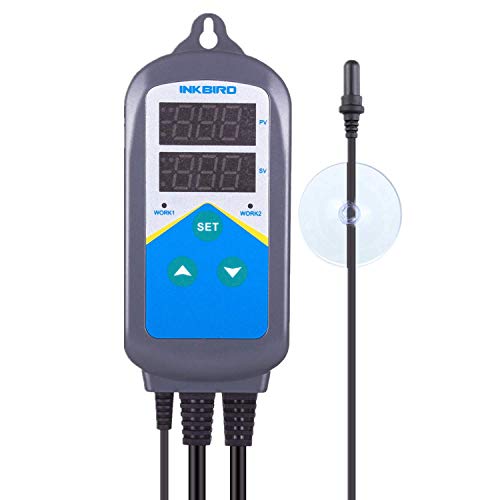
- Heat-only controller with two heating outlets
- Dual time cycles for day and night settings
- Dual display plus temperature calibration and alarms
Best For: Aquarium heating setups that do not need cooling control
Dual Heating & Cooling Thermostat – Inkbird ITC-308 Digital Temperature Controller
If you need one of the most flexible aquarium temperature controllers for basic heating and cooling automation, the Inkbird ITC-308 is built around a simple plug-and-play design. It offers dual relay control, a dual display window, and configurable compressor delay settings to help manage temperature more safely.
Best For: Aquarium keepers who want a straightforward controller with both heating and cooling support.
Pros:
- Supports both heating and cooling modes with dual relay output.
- Dual display shows measured and set temperature at the same time.
- Buzzer alarm alerts for high/low temperature or sensor malfunction.
- Supports °C/°F display and temperature/compressor delay customization.
Cons:
- Maximum output load is limited to 1100W at 110V.
- Uses a wired probe and corded power setup.
Overall, this is a practical all-around controller if you want a simple thermostat with both heating and cooling control plus basic safety features. It’s especially appealing when ease of use matters more than advanced programming.
Safety-Focused Dual Sensor Controller – Aquarium Temperature Controller with Auto Calibration
Among aquarium temperature controllers, this model stands out for its dual sensors and over-temperature protection. It is designed for aquaculture and other heated environments, with heating and cooling modes, adjustable display brightness, and simple temperature/unit setup.
Best For: Users who want extra sensor redundancy and safety protections in a wired controller.
Pros:
- Uses two temperature sensors with automatic calibration for more stable readings.
- Load line over-temperature protection adds an extra safety layer.
- Supports both heating and cooling modes.
- Sensor is bold and waterproof, with anti-bite protection noted in the description.
Cons:
- Only one mode can be selected for operation at a time.
- Product details are more limited than some name-brand alternatives.
For buyers who prioritize protection and sensor stability, this controller offers a useful set of safeguards. Its dual-sensor setup and over-temperature protection make it a strong pick for more cautious temperature management.
Heating-Only Day/Night Controller – Inkbird Digital Outlet Heat Temperature Controller
If your setup only needs heat management, this is one of the more specialized aquarium temperature controllers for that job. It’s a plug-and-play heating controller with day and night cycle settings, temperature calibration, and over-temperature alarms, but it does not offer cooling control.
Best For: Heating-only aquarium, breeding, or reptile setups that benefit from day/night temperature changes.
Pros:
- Plug-and-play design keeps setup simple.
- Supports day and night temperature cycles across 24 hours.
- Dual display windows show measured and set temperature.
- Includes over-temperature and sensor-fault alarms.
Cons:
- No cooling function is included.
- Maximum load is capped at 1200W at 110V.
This is a smart choice if your tank or habitat only needs heating automation and scheduled temperature changes. The day/night timing feature adds flexibility without complicating the setup.
Submersible Probe Aquarium Thermostat – Inkbird ITC308S for Heater and Fans
For aquarium temperature controllers that need a probe designed specifically for water use, the Inkbird ITC308S is worth a close look. It combines heating and cooling outlets with a fully submersible probe, making it better suited to aquarium conditions than a standard probe.
Best For: Aquariums that need a water-safe probe and simple heating/cooling control.
Pros:
- Fully submersible aquarium probe works better in water than a standard probe.
- Supports both heating and cooling control in one unit.
- Dual display shows measured and set temperature at the same time.
- Includes temperature calibration plus over-temperature and sensor-fault alarms.
Cons:
- Maximum output load is 1200W at 110V.
- Basic on/off control may be less advanced than programmable alternatives.
Overall, this model is a strong fit for aquarium users who want the convenience of an all-in-one thermostat and a probe built for submerged use. It keeps the control approach simple while addressing a common aquarium-specific need.
Waterproof All-Rounder – DIGITEN Waterproof Digital Temperature Controller
If you want aquarium temperature controllers that can also handle other heating jobs, this DIGITEN model is a flexible pick. It supports a wide control range and uses a waterproof probe, while the IP65 shell adds extra peace of mind for damp environments. The LED display is easy to read, and the built-in alarms and compressor delay features add practical protection.
Best For: Aquarium owners who want a versatile controller for heating setups, with waterproof construction and basic safety protections.
Pros:
- Wide temperature control range from -40~248ºF (-40℃~120℃)
- Waterproof sensor probe and IP65 waterproof shell
- Illuminated LED display is easy to read and program
- High/low temperature alarms plus compressor delay support
Cons:
- Designed as a heating-focused controller rather than a full dual-outlet aquarium system
- Best waterproof results depend on hanging the unit as recommended
This is a practical choice if you need a straightforward controller with broad temperature coverage and a durable build. It stands out more for flexibility and protection features than for advanced aquarium-specific automation.
Smart App Control – INKBIRD Bluetooth Temperature Controller
Among aquarium temperature controllers, this INKBIRD unit is aimed at users who want app-based convenience and more scheduling control. Bluetooth 5.0 lets you manage it through the INKBIRD app within range, and the controller supports multiple temperature periods per day. It also includes a waterproof probe, high/low alarms, and delay protection for more dependable everyday use.
Best For: Hobbyists who want Bluetooth app control and programmable temperature scheduling for aquarium or breeding setups.
Pros:
- Bluetooth 5.0 app control within 100 meters
- Supports up to 12 periodic temperature ranges per day
- IP67 waterproof probe with -40℉ to 212℉ range
- Includes high/low alarms, refrigeration delay protection, and calibration
Cons:
- Requires the app for the most convenient remote setup
- Max 1200W output is shared between two outlets
This controller is a strong fit if scheduling and remote monitoring matter as much as temperature accuracy. The offline data storage is also a useful backup if you want the system to keep records without relying on the cloud.
Dual Outlet Protector – HiTauing Aquarium Heater Thermostat
If you need aquarium temperature controllers that can manage both heating and cooling, this HiTauing thermostat is built for that job. It uses dual relays and separate heating/cooling outlets, so it can cut power when water goes above or below your set limits. The seawater-resistant probe and touch-control LED display make it practical for fish tanks and similar setups.
Best For: Aquarium keepers who want a dual-outlet controller for both heater and chiller protection.
Pros:
- Independent heating and cooling control with dual outlets
- Seawater-resistant probe suited to saltwater and freshwater tanks
- Touch-control LED display with easy temperature adjustment
- Wide control range from -22℉ to 230℉ (-30℃ to 110℃)
Cons:
- Setup involves learning the controller’s mode and button steps
- Suction cup is noted as small, so probe mounting may need a bit of care
This model is especially useful if you want one controller to help guard against heater failure and temperature swings in either direction. It is the most aquarium-focused option here for systems that need both heating and cooling support.
Dual Heating and Cooling Control – BN-LINK T10 Dual Thermostat Outlet
BN-LINK is built for aquarium temperature controllers setups that need both heating and cooling from one plug-in unit. With separate outlets for each mode, it can switch equipment on and off automatically to help hold a steadier temperature, while the waterproof metal probe and dual display make day-to-day monitoring straightforward.
Best For: Aquariums and other indoor setups that need a single controller with both heating and cooling output.
Pros:
- Separate heating and cooling outlets support two-stage control.
- Heavy-duty 15A/1875W resistive capacity with overload protection.
- Waterproof metal probe with a wide -58°F to 230°F measurement range.
- Dual-screen display shows current and set temperatures at the same time.
Cons:
- For indoor use only.
- More controller than you need if you only want heating support.
Overall, this is a flexible choice if you want one controller to manage both sides of temperature control. The compressor delay and audible alarm add helpful protection and monitoring features for everyday use.
Simple Knob Controls – WH2408 Digital Thermostat Outlet
For buyers comparing aquarium temperature controllers, the WH2408 keeps setup simple with two knobs instead of menu-heavy programming. It offers heating or cooling mode, remembers settings after power outages, and uses a probe rated for a wide temperature range, making it practical for straightforward temperature control tasks.
Best For: Users who want an easy-to-set thermostat plug for aquarium or similar indoor temperature control.
Pros:
- Two-knob design is easy to adjust without complicated menus.
- Supports both heating and cooling modes.
- Memorizes settings during power outages.
- Includes a food-grade probe and adjustable Fahrenheit/Celsius display.
Cons:
- 10A/1200W capacity is lower than some heavier-duty controllers.
- Shell is not waterproof, so the device itself must stay dry.
- The probe should not be used in salt water for extended periods.
This is a good pick if you want a simple, dependable controller for everyday use rather than advanced programming. The fire-retardant housing, resettable fuse, and ETL-certified cord add reassuring safety-oriented details.
Heat-Only Aquarium Controller – Inkbird ITC-306T Dual Heating Thermostat
If you only need heating support, this Inkbird model fits aquarium temperature controllers shopping well because it is a dedicated heat-only thermostat. It uses dual heating outlets, supports dual time cycles for day and night settings, and includes dual displays plus temperature calibration for more accurate control.
Best For: Aquarium keepers who only need a heating thermostat with dual outlets and day/night timing.
Pros:
- Two heating outlets for aquarium or reptile heating setups.
- Dual time cycle settings can handle day and night temperature needs.
- Dual display windows show measured and set temperatures together.
- Includes over-temperature and sensor fault alarms.
Cons:
- No cooling control.
- Best suited to heat-only applications rather than full temperature management.
This controller makes sense when cooling is unnecessary and you want a focused heating solution. The plug-and-play design and 0.1-degree resolution are useful extras for users who want simple but precise thermostat control.
How We Picked the Best Aquarium Temperature Controllers
We looked for models that offer dependable temperature control, clear settings, sensible safety protections, and enough capacity for common aquarium setups. We also favored controllers with useful features like heating and cooling modes, accurate probes, and easy outlet layout for heaters, chillers, or fans.
Since Aquarium Temperature Controllers often get used around water and saltwater, build quality, probe durability, and protection features mattered just as much as wattage.
Quick Comparison
Most buyers will fall into one of three groups: simple single-tank users who want basic heater control, hobbyists who need both heating and cooling automation, and advanced users who want app-based monitoring or dual-stage flexibility. Before you choose, match the controller’s load rating and outlet type to your equipment.
Key Buying Factors for Aquarium Temperature Controllers
Heating and Cooling Support
Some controllers only switch heating on and off, while others manage both heaters and cooling devices. If your tank runs warm in summer, a dual-stage unit can help prevent overheating without manual intervention.
Probe Type and Placement
A reliable probe is critical. Look for waterproof or submersible probes when possible, and place them where water flow is steady but not directly beside a heater or return outlet. Poor placement can cause inaccurate readings.
Power Rating and Safety Margin
Check the wattage and amperage rating carefully. Your controller should handle the full load of the connected device with a safety buffer, especially for larger heaters or combined equipment. Overloading a controller can shorten its life and create risk.
Alarm and Protection Features
Over-temperature protection, calibration options, and alarm functions can help catch problems early. These features are especially valuable for breeding tanks, saltwater systems, and any setup with sensitive livestock.
Ease of Use
Simple controls matter more than flashy extras for many aquarists. A clear display, straightforward programming, and visible on/off status make routine adjustments faster and reduce mistakes.
Who Should Buy Which Aquarium Temperature Controllers?
If you want a basic, dependable setup, choose a straightforward plug-in controller with heating control and a good probe. If you run a warm room, greenhouse-style system, or breeding tank, a heating-and-cooling controller is a better fit. Tech-minded buyers may prefer app-connected or Bluetooth-enabled Aquarium Temperature Controllers for remote monitoring and easier adjustments.
In general, pick the simplest controller that can safely support your equipment and environment. That approach usually delivers the best mix of stability, value, and peace of mind.