Choosing the right radar can make a big difference in low visibility, crowded waterways, and offshore travel. The best systems help you spot traffic, track weather, and navigate with more confidence.
Below, we focus on marine radar systems that balance target detection, range, installation fit, and compatibility with modern chartplotters.
Best 10 Marine Radar Systems Picks for 2026
Ultra-Fast Collision-Avoidance Pick
Simrad HALO20+ 20-inch pulse compression radar

- 60 RPM close-range operation
- VelocityTrack Doppler collision avoidance
- Simultaneous dual-range up to 36 NM
Best For: Boaters who need quick close-range updates and dual-range coverage
Networked Chartplotter Bundle
Garmin GPSMAP 943xsv with GMR 18 HD3 radome

- Bundle pairs chartplotter and radome
- Strong network connectivity and OneHelm support
- Preloaded Garmin Navionics+ charts
Best For: Boaters building a connected Garmin helm
Compact Color Radar Value
Furuno 1815 8.4-inch color LCD radar

- 8.4-inch color LCD display
- 19-inch radome with 4 kW output
- Fast Target Tracking for up to 10 targets
Best For: Small boats needing a compact standalone radar
Lightweight Doppler Dome
Raymarine Quantum 2 Doppler radar

- Doppler-enabled compact radar
- 18-inch array with 20W output
- Very lightweight, direct-wired design
Best For: Boat owners wanting a small-footprint Doppler radar
Safe Navigation Radar

- 18-inch 4kW magnetron dome radar
- Up to 36-nautical-mile detection range
- MARPA, radar overlay, and auto gain
Best For: Garmin boat owners needing a dependable radar dome for safer navigation
Fast Sweep Radar

- 25W pulse compression radar
- 60 RPM rotation with VelocityTrack Doppler
- Dual-range operation for near and far views
Best For: Lowrance boaters wanting fast target updates and Doppler motion cues
Smart Tracking Radar

- 18-inch 50-watt solid-state dome radar
- MotionScope and True echo trails for tracking
- Timed transmit and power save modes
Best For: Garmin captains wanting solid-state radar with motion tracking and power control
Compact Pulse-Compression Radar

- 24 nm range with 24 RPM antenna rotation
- Instant On startup for quick visibility
- 6W pulse compression with Lowrance HDS compatibility
Best For: Lowrance HDS users with smaller boats
Compact Dome Radar with MARPA
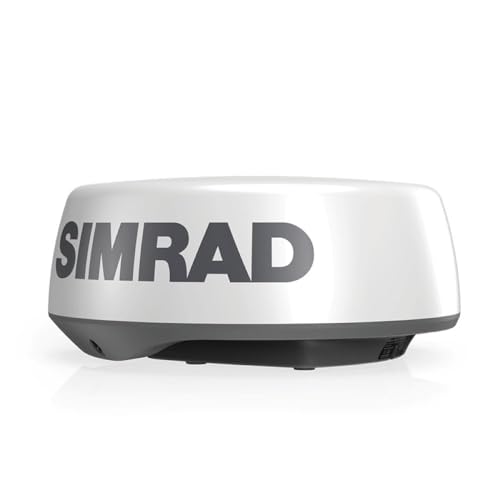
- 24 nm range in a compact 20-inch dome
- MARPA tracks up to 10 targets
- InstantOn plus harbor/offshore/weather modes
Best For: Simrad MFD owners with smaller boats
High-Definition Dual-Band Radar
- 4kW output with up to 48 nm detection
- High-definition overlay and dual radar support
- MARPA, guard zones, and clutter filtering
Best For: Garmin chartplotter users needing advanced radar features
Ultra-Fast Collision-Avoidance Pick – Simrad HALO20+ 20-inch pulse compression radar
If you’re comparing marine radar systems for fast response and clear close-range awareness, the Simrad HALO20+ is built for practical collision avoidance. Its 60 RPM operation, VelocityTrack Doppler, and simultaneous dual-range coverage make it a strong fit when you want near-real-time updates from a compact dome.
Best For: Boaters who want rapid close-range target updates plus simultaneous near and far coverage.
Pros:
- 60 RPM operation at close range for fast, near-real-time viewing.
- VelocityTrack Doppler helps identify hazards and support collision avoidance.
- Simultaneous dual-range operation covers both short and long distances up to 36 NM.
- Compact 20-inch dome antenna keeps the footprint manageable.
Cons:
- Requires compatibility with Simrad/Lowrance/B&G MFDs.
- Designed for 24V DC power, so installation depends on your boat setup.
This is a good choice if your priority is fast target refresh and Doppler-assisted awareness rather than a larger, more complex radar package.
Networked Chartplotter Bundle – Garmin GPSMAP 943xsv with GMR 18 HD3 radome
For buyers looking at marine radar systems as part of a larger helm upgrade, this Garmin bundle combines the GPSMAP 943xsv chartplotter with a GMR 18 HD3 radome. The supplied notes point to strong network connectivity, preloaded Garmin Navionics+ charts, and broad integration options for a more complete boating system.
Best For: Boaters building a connected helm around a chartplotter and radar bundle.
Pros:
- Bundle includes the GPSMAP 943xsv chartplotter and GMR 18 HD3 radome.
- Built for strong network connectivity and easier system expansion.
- Preloaded Garmin Navionics+ charts and mapping are included.
- Compatible with OneHelm digital switching and third-party devices.
Cons:
- The supplied notes do not list radar range or transmitter details.
- Best suited to users who want a broader Garmin ecosystem rather than a standalone radar.
This is the most system-oriented option here, making it appealing if you want radar as one part of an integrated navigation setup.
Compact Color Radar Value – Furuno 1815 8.4-inch color LCD radar
If you’re shopping marine radar systems for a compact boat setup, the Furuno 1815 keeps things straightforward. Its 8.4-inch color LCD, 19-inch radome, and 4 kW output are geared toward dependable everyday radar use, while Fast Target Tracking adds useful tracking support.
Best For: Small boats, workboats, and pleasure craft that need a straightforward color radar display.
Pros:
- 8.4-inch color LCD provides a clear radar view.
- 19-inch radome antenna offers compact coverage.
- 4 kW transmitter output supports radar performance in challenging conditions.
- Fast Target Tracking can manually or automatically track up to 10 targets.
Cons:
- Older model year listing may matter to buyers seeking newer hardware.
- Smaller display may feel limited compared with larger chartplotter-based systems.
This is a practical pick if you want a compact, color radar with useful tracking features and a more traditional standalone design.
Lightweight Doppler Dome – Raymarine Quantum 2 Doppler radar
Among marine radar systems, the Raymarine Quantum 2 stands out for its lightweight build and Doppler support. The supplied notes show a compact 18-inch array, 20W output, and direct-wired power, which makes it a simple radar option for marine vessels that need a small-footprint installation.
Best For: Boat owners who want a compact, lightweight Doppler radar setup.
Pros:
- Quantum 2 includes Doppler capability.
- Compact 18-inch array keeps the system small.
- Very lightweight at 0.06 kg.
- Direct-wired power simplifies the electrical connection approach.
Cons:
- Power output is listed at 20W, which is lower than some larger radar units.
- The notes do not include range or display bundle details.
This is a good fit if you value a minimal footprint and Doppler functionality more than a fully specified, high-output radar package.
Safe Navigation Radar – Garmin GMR 18 HD3 18" Dome
Garmin GMR™ 18 HD3 18" 4kW Radar Dome - Enhanced Target Detection for Safe Navigation
Check Price On AmazonIf you’re comparing marine radar systems for reliable offshore awareness, the Garmin GMR 18 HD3 is built around enhanced target detection, radar overlay, and automatic tuning features that help simplify navigation in changing conditions. It pairs with compatible Garmin chartplotters and MFDs through the Garmin Marine Network, making it a practical fit for boaters who want crisp radar data in low visibility.
Best For: Garmin boat owners who want a dependable dome radar with automatic gain and tracking tools
Pros:
- 18-inch 4kW magnetron dome with up to 36-nautical-mile range
- Dynamic auto gain and dynamic sea filter adjust performance automatically
- MARPA support and radar overlay help with tracking and collision awareness
- Low-noise drive motor and low power consumption suit extended use
Cons:
- Requires compatible Garmin chartplotters or MFDs
- Designed for Garmin Marine Network connections only
This is a strong choice if you want a proven Garmin dome radar with practical automation and clean integration. It is less about standalone flexibility and more about giving compatible Garmin systems a reliable radar upgrade for safer navigation.
Fast Sweep Radar – Lowrance Halo 20+ Black
Among marine radar systems focused on quick updates, the Lowrance Halo 20+ stands out for its 60 RPM rotation and VelocityTrack Doppler feedback, which help you see whether targets are closing in or moving away. It is designed for compatibility with Lowrance MFDs, so it makes the most sense for boaters already using that ecosystem.
Best For: Lowrance users who want rapid target updates and simple Doppler target feedback
Pros:
- 25W pulse compression radar with industry-leading 60 RPM rotation
- VelocityTrack shows target motion direction at a glance
- Dual-range operation reduces the tradeoff between near and far coverage
- Built for Lowrance MFD compatibility
Cons:
- Requires Lowrance MFDs to use as intended
- Range is listed up to 2 nautical miles for the 60 RPM sweep behavior
- Less suitable if you need broad brand compatibility
The Halo 20+ is a straightforward pick if fast refresh and motion awareness matter more than broad system flexibility. Its real value comes from giving compatible Lowrance setups a quick, responsive radar view for busy waterways.
Smart Tracking Radar – Garmin GMR Fantom 18x
If you’re shopping marine radar systems for moving-target awareness and flexible power management, the Garmin GMR Fantom 18x brings solid-state radar performance with MotionScope, True echo trails, and dual-range display support. It connects to compatible Garmin chartplotters and adds automatic gain adjustment for a more hands-off experience in varied conditions.
Best For: Garmin captains who want solid-state radar with motion tracking and power-saving controls
Pros:
- 18-inch 50-watt solid-state dome with long range
- MotionScope highlights moving targets using Doppler color cues
- True echo trails help identify target movement and collision threats
- Timed transmit and power save modes support lower power use
Cons:
- Requires compatible Garmin chartplotter integration
- Listed battery average life is only 1 hour in the supplied details
- More advanced features may be more than casual boaters need
The GMR Fantom 18x is a feature-rich radar dome for boaters who want more than basic detection. Its strength is combining solid-state hardware with motion tools and system-level flexibility for compatible Garmin setups.
Compact Pulse-Compression Radar – Lowrance Halo 20 Radar
If you’re comparing marine radar systems for a smaller helm setup, the Lowrance Halo 20 Radar focuses on quick response and practical range without adding unnecessary bulk. Its 24 nm range, 24 RPM antenna rotation, and 6W pulse compression design make it a straightforward fit for boaters who want fast target updates and dependable visibility on the water.
Best For: Lowrance HDS users who want a compact radar with instant-on convenience.
Pros:
- 24 nm range supports near- and mid-range navigation.
- Instant On and 24 RPM rotation help deliver fast situational updates.
- 6W pulse compression is designed for safe, efficient operation.
- Compatible with Lowrance HDS systems.
Cons:
- Built for Lowrance HDS compatibility rather than universal use.
- X-band support may not suit every multi-band system need.
Overall, this is a compact option for boaters who want quick startup, simple integration, and a clear view out to 24 nautical miles. It emphasizes practical performance over size, which makes it a sensible choice for smaller vessels and dayboats.
Compact Dome Radar with MARPA – Simrad HALO20 Radar System
Among marine radar systems for smaller boats and dayboats, the Simrad HALO20 Radar System is built around a compact 20-inch dome and dependable near- to mid-range awareness. Its 24 nm detection range, advanced pulse compression, and InstantOn readiness are aimed at giving you useful radar data quickly, especially when conditions change.
Best For: Simrad MFD owners who want a compact radar with target tracking and fast startup.
Pros:
- Compact 20-inch dome design suits smaller boats.
- 24 nm detection range supports near- and mid-range visibility.
- MARPA target tracking can track up to 10 targets simultaneously.
- InstantOn and preset modes help optimize quick use in changing conditions.
Cons:
- Designed for Simrad MFD compatibility rather than broad cross-brand use.
- The compact dome format may not suit buyers seeking a larger radar unit.
This radar is a solid fit if you want practical navigation help in a space-saving package. The combination of pulse compression, MARPA, and preset modes makes it a versatile choice for everyday boating where quick awareness matters.
High-Definition Dual-Band Radar – Garmin 18/24 xHD3 Radar
If you’re evaluating marine radar systems for detailed chartplotter integration, the Garmin 18/24 xHD3 Radar stands out with 4kW output and up to 48 nautical miles of detection. It also adds smooth scanning, vivid radar overlay, and dual radar system compatibility, making it a strong match for boaters who want more information layered into their navigation workflow.
Best For: Garmin chartplotter users who want high-definition radar with advanced tracking and overlay features.
Pros:
- Up to 48 nautical miles of detection with potent 4kW output.
- High-definition radar imaging and vivid overlay support clearer navigation.
- MARPA tracking, guard zone alerts, and range/bearing cues add awareness.
- Compatible with Garmin marine chartplotters and dual radar systems.
Cons:
- Built for Garmin systems, so compatibility is specialized.
- Feature depth may be more than needed for basic radar users.
This is the most feature-rich option in the group, especially if you want radar data integrated into a Garmin setup. The emphasis on overlay, clutter filtering, and target management makes it a strong choice for more demanding navigation needs.
How We Picked These Marine Radar Systems
We selected models based on practical boating needs: target clarity, usable range, scan speed, integration with major multifunction displays, and features that improve situational awareness in real-world conditions. We also favored options that suit different boat sizes and budgets, from compact domes to higher-performance units.
Quick Comparison
In general, compact radomes are a strong fit for smaller and mid-sized boats that want easy mounting and solid all-around performance. More advanced units with Doppler or pulse-compression technology are better for busy traffic areas, offshore use, and boaters who want faster target updates and stronger collision-avoidance support.
Key Buying Factors for Marine Radar Systems
Range and Beam Performance
Choose a radar whose practical range matches how you boat. Long range helps offshore operators and overnight cruisers, while shorter-range domes can be perfectly adequate for coastal runs, harbor approaches, and fishing trips.
Target Separation and Doppler Features
Better target separation makes it easier to distinguish boats, buoys, shorelines, and rain clutter. Doppler and velocity-based processing can be especially useful when tracking moving targets in high-traffic areas.
Scan Speed and Refresh Rate
A faster refresh rate helps the display keep up with quick course changes and closing targets. This matters most when maneuvering in tight quarters or operating at higher speeds.
Display Compatibility
Make sure the radar works cleanly with your chartplotter or MFD. Integration affects setup simplicity, overlay performance, and how easily you can interpret radar returns alongside charts and sonar.
Installation and Power
Check dome size, mounting space, cable length, and power demands before buying. The best choice is often the one that fits your boat cleanly and can be installed without major wiring or structural changes.
Who Should Buy Which Marine Radar Systems?
Offshore cruisers and captains who frequently boat in fog or heavy traffic should look for models with Doppler, pulse compression, or advanced target processing. Coastal boaters and anglers may prefer compact domes that offer dependable performance with simpler installation. If you already use a compatible chartplotter ecosystem, choosing a radar from the same brand can make setup and daily use much smoother.
For most buyers, the best Marine Radar Systems are the ones that match how and where you boat—not just the highest spec sheet numbers. Focus on clear returns, reliable integration, and a form factor that fits your vessel.