Choosing the right aquarium CO2 diffuser can make a noticeable difference in how efficiently carbon dioxide reaches your plants. The best option depends on your tank size, tubing setup, installation space, and whether you prefer glass, acrylic, stainless steel, or inline construction.
We compared ten diffuser styles and configurations to help you match bubble quality, durability, maintenance needs, and compatibility with your planted aquarium.
Best 10 Aquarium Co2 Diffusers Picks for 2026
Fine-Mist Pick

- Very fine mist from a customized ceramic disc
- Clear acrylic body resists breakage
- Available for three tank-size ranges
Best For: Planted tanks prioritizing fine diffusion and high CO2 saturation
Adjustable Steel Pick
DIY Stainless Steel CO2 Diffuser
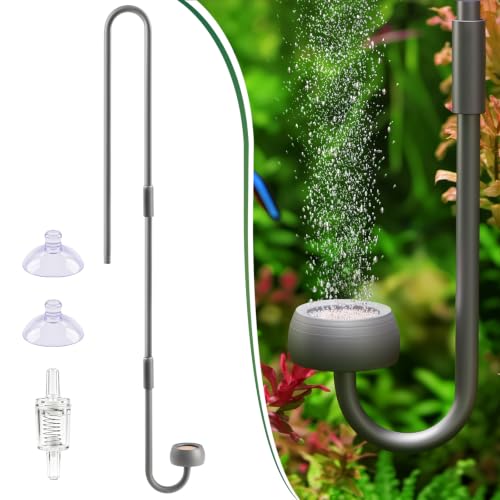
- Adjusts from 20 to 35 cm
- Durable stainless steel body
- Removable disc and built-in check valve
Best For: Tanks needing flexible reach and break-resistant construction
Easy-Setup Pick

- Ultra-fine bubbles for even distribution
- Built-in check valve and bubble counter
- Durable, clear acrylic construction
Best For: Larger planted tanks needing easy installation and monitoring
High-Pressure Pick

- Atomizes CO2 into super-fine bubbles
- Integrated check valve helps prevent backflow
- Durable 304 stainless steel body
Best For: High-pressure systems operating at 50–70 PSI
High-Capacity Fine Mist

- Ceramic membrane atomizes CO2 efficiently
- Sized for roughly 50-75 gallon tanks
- U-shaped tube helps avoid flow blockage
Best For: Larger planted aquariums needing a glass diffuser
Adjustable Fine-Mist Output

- Customized ceramic creates a fine CO2 mist
- Three sizes match different tank ranges
- Clear acrylic construction resists breakage
Best For: Planted tanks needing size and output flexibility
Wide-Range Glass Reactor
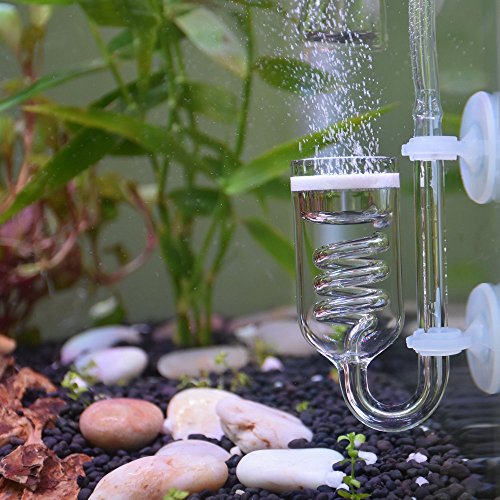
- Fine pores create slowly rising CO2 bubbles
- Designed for 15-50 gallon pressurized tanks
- Transparent glass blends into the aquarium
Best For: 15-50 gallon planted tanks using standard tubing
Best Inline Coverage

- External design keeps the tank less cluttered
- Fine mist supports efficient CO2 dissolution
- Three sizes fit common tubing diameters
Best For: Medium to large planted aquariums with compatible filter tubing
Best Rim Flexibility
SUS 304 Stainless Steel CO2 Diffuser

- Wide hook fits rims up to 3.9 cm
- Integrated check valve helps prevent backflow
- Fine bubbles support efficient absorption
Best For: Wide-rim aquariums with high-pressure CO2 systems
Best Simple Setup
Acrylic Low-Pressure CO2 Diffuser

- Creates small, dense CO2 bubbles
- Suction cup makes mounting straightforward
- Acrylic body resists corrosion
Best For: Smaller aquariums, home tanks, and hydroponic nutrient setups
Fine-Mist Pick – Fzone Neo CO2 Diffuser
For aquarists comparing aquarium co2 diffusers, the Fzone Neo emphasizes very fine bubble output and efficient CO2 saturation. Its ceramic disc is permanently bonded to an acrylic bubble counter, creating a compact diffuser designed for dependable placement and high-pressure use.
Best For: Planted tanks needing fine mist diffusion, with size options for tanks up to 13 gallons, 13–32 gallons, or 32 gallons and larger.
Pros:
- Customized South Korean ceramic produces very fine bubbles.
- Acrylic construction is clear and less prone to breaking than glass during maintenance.
- Includes a suction cup for secure corner placement.
- Works with CO2 systems, including DIY setups, at relatively low pressure.
Cons:
- Recommended pressure is higher than 25 PSI, despite the stated minimum of 20 PSI.
- The correct size must be selected according to tank volume and bubble rate.
The Neo is a practical choice when fine diffusion and a clear, sturdy body matter more than a built-in check valve.
Adjustable Steel Pick – DIY Stainless Steel CO2 Diffuser
This stainless steel option stands out among aquarium co2 diffusers for its adjustable 20–35 cm length. Its durable hanging design, removable ceramic disc, and built-in check valve make it flexible for different tank layouts and simpler to maintain.
Best For: Aquarium plants and water-grass tanks that need a durable diffuser with customizable reach.
Pros:
- Stainless steel construction resists bending, warping, and breakage.
- Included connectors adjust the length from 20 to 35 cm.
- Removable ceramic disc supports cleaning and replacement.
- Built-in check valve helps prevent backflow.
Cons:
- Exact dimensions should be checked before purchase to ensure a proper fit.
- Initial large bubbles around the edges may occur before the diffuser settles.
- A 24-hour soak is recommended before first use.
Choose this model when physical durability and adjustable placement are more important than a compact glass-style appearance.
Easy-Setup Pick – FZONE Acrylic CO2 Diffuser
Among aquarium co2 diffusers, this FZONE model combines ultra-fine bubbles with a built-in check valve and bubble counter. The crystal-clear acrylic body is shatter-resistant, while the included accessories make installation straightforward for planted aquarium setups.
Best For: Planted aquariums needing a clear, durable diffuser with integrated backflow protection and bubble monitoring.
Pros:
- Micro-pore ceramic disc produces fine, evenly dispersed bubbles.
- Built-in check valve helps prevent reverse water flow.
- Water-filled chamber functions as a bubble counter.
- Includes a syringe, suction cup, and tubing for installation.
Cons:
- The L-33mm version is intended for tanks 32 gallons or larger.
- Acrylic is clear and durable, but not the same material as glass.
This is a convenient all-in-one choice for larger planted tanks where clear operation monitoring and simple installation are useful.
High-Pressure Pick – SUS 304 CO2 Diffuser DC300-25
This stainless steel model is one of the high-pressure aquarium co2 diffusers, using an upgraded disc to atomize CO2 into super-fine bubbles. Its integrated check valve helps limit backflow, while the John Guest fitting supports quick connection to compatible tubing.
Best For: High-pressure CO2 systems using 4/6 mm tubing and operating within the recommended 50–70 PSI range.
Pros:
- 304 stainless steel body is durable and rust resistant.
- Built-in check valve acts immediately when gas flow stops.
- Produces super-fine bubbles intended to improve absorption efficiency.
- John Guest design makes compatible tubing easy to install and remove.
Cons:
- Requires at least 42 PSI to produce bubbles and performs best at 50–70 PSI.
- Cleaning requires removing and soaking only the diffuser disc.
- Not suited to lower-pressure CO2 systems that cannot reach the required pressure.
This diffuser is best reserved for established high-pressure setups; its pressure requirements are the main consideration before buying.
High-Capacity Fine Mist – Pollen Glass CO2 Diffuser
For larger planted aquariums, this aquarium CO2 diffuser uses a ceramic membrane to atomize carbon dioxide into the water. Its 2-inch format is designed for roughly 50-75 US gallon tanks, while the included U-shaped tube helps maintain a clear CO2 path.
Best For: Planted aquariums of approximately 50-75 US gallons needing a glass diffuser with a U-shaped connection.
Pros:
- Ceramic membrane produces efficient CO2 atomization.
- Designed for larger 50-75 gallon aquariums.
- U-shaped connecting tube can help avoid CO2-flow blockage.
- Includes two suction cups for installation.
Cons:
- The supplied size is intended for larger tanks rather than nano aquariums.
- Glass construction requires careful handling.
This is a straightforward choice when tank size and reliable routing of the CO2 line are priorities. Confirm that your aquarium falls within the recommended range before buying.
Adjustable Fine-Mist Output – Fzone Neo CO2 Diffuser
The Fzone Neo is an aquarium CO2 diffuser built around a customized ceramic disc designed to create a fine mist for thorough bubble diffusion. Available in three sizes, it supports different planted-tank requirements and uses a clear, durable acrylic bubble-counter construction.
Best For: Planted-tank keepers who want fine-mist diffusion and a size matched to their aquarium and bubble rate.
Pros:
- Microscopically small ceramic pores produce fine CO2 bubbles.
- Three models cover tanks from 13 gallons or less to 32 gallons and larger.
- Clear acrylic construction is less prone to breaking during maintenance than glass.
- Works with pressurized systems and DIY CO2 setups.
Cons:
- The recommended operating pressure is higher than 25 PSI, which may not suit every setup.
- Choosing the correct model requires matching both tank size and bubble rate.
Its main advantage is flexibility: the size range and fine ceramic output make it easier to match the diffuser to a particular aquarium. Check your system pressure and select the model appropriate for your tank.
Wide-Range Glass Reactor – 3 Spiro Glass CO2 Diffuser
This aquarium CO2 diffuser uses a ceramic disc with fine pores and a cylindrical three-spiro glass design to slow water movement and support CO2 dissolution. It is compatible with pressurized tanks from 15-50 gallons and standard 6 mm (1/4-inch) airline tubing.
Best For: Planted aquarium owners with 15-50 gallon pressurized systems who prefer a transparent glass diffuser.
Pros:
- Fine ceramic pores produce slowly rising bubbles for diffusion.
- Transparent glass blends discreetly into the aquarium.
- Includes a suction cup for positioning.
- Compatible with standard 6 mm (1/4-inch) airline tubing.
Cons:
- Fragile glass requires careful handling.
- Must be soaked for more than 48 hours before first use.
- The ceramic surface should not be brushed or wiped with cloth.
This diffuser suits buyers who value a subtle glass appearance and a reactor design intended to improve contact time. Its required pre-soak and careful cleaning routine are important considerations.
Best Inline Coverage – FZONE Inline CO2 Diffuser
For planted tanks where you want to keep equipment out of view, this inline aquarium CO2 diffuser connects to the filter outflow and creates a fine mist for broad CO2 distribution. It is available in three tubing sizes and is designed for higher-flow setups, but it requires at least 30 psi working pressure.
Best For: Medium to large planted aquariums using compatible filter tubing and a pressurized CO2 system.
Pros:
- External installation reduces clutter inside the aquarium.
- Fine bubbles smaller than 0.1 mm support efficient CO2 dissolution.
- Aluminum alloy construction offers corrosion resistance and durability.
- Three size options and tool-free push-fit connections simplify installation.
Cons:
- Requires at least 30 psi working pressure.
- Compatibility depends on matching the diffuser size to your tubing.
- Inline installation may be less suitable for simpler low-pressure setups.
This is a practical choice when even distribution and a clean aquascape matter more than the simplest in-tank installation. Verify your tubing diameter and regulator pressure before buying.
Best Rim Flexibility – SUS 304 Stainless Steel CO2 Diffuser
This stainless steel aquarium CO2 diffuser is a high-pressure in-tank option with an extra-wide hook that fits aquarium rims up to 3.9 cm. Its integrated check valve helps limit backflow when the gas is shut off, while the diffuser disc produces very fine bubbles for efficient absorption.
Best For: Aquariums with wider rims and pressurized CO2 systems capable of at least 42 psi.
Pros:
- Widened hook accommodates rims up to 3.9 cm.
- 304 stainless steel body is durable and rust resistant.
- Built-in check valve helps prevent backflow after shutdown.
- John Guest-style fitting supports easy 4/6 mm tubing installation and removal.
Cons:
- Requires at least 42 psi, with 50–70 psi recommended for optimal performance.
- The stainless steel body should not be soaked during cleaning.
- Cleaning requires removing and separately treating the diffuser disc.
Choose this model if rim compatibility and robust construction are priorities. Its pressure requirements make it a better match for established high-pressure CO2 equipment than entry-level systems.
Best Simple Setup – Acrylic Low-Pressure CO2 Diffuser
This acrylic aquarium CO2 diffuser is a straightforward in-tank option for producing small, dense bubbles in fish tanks, planted aquariums, and hydroponic nutrient tanks. A suction cup holds it in place, and the diffuser stone can be soaked and lightly brushed during routine cleaning.
Best For: Home, office, nano, and other smaller setups that need a simple low-pressure bubbler.
Pros:
- Produces small, dense bubbles to improve CO2 dissolution.
- Simple suction-cup mounting requires no complex installation.
- Acrylic construction is corrosion resistant and durable.
- Cleaning involves soaking, light brushing, and air drying.
Cons:
- Only one suction cup is included.
- The stone should be cleaned about monthly to help prevent clogging.
- It remains visible inside the aquarium rather than using an external design.
For shoppers prioritizing easy mounting and low-pressure operation, this diffuser offers a compact, uncomplicated approach. Plan on regular cleaning to maintain its bubble output.
How We Picked the Best Aquarium Co2 Diffusers
We focused on practical factors that affect everyday planted-tank performance: bubble fineness, material durability, installation method, tubing compatibility, tank-size range, and protection against backflow. The selection includes compact glass and acrylic models, stainless steel options for added toughness, adjustable designs, inline diffusers, and larger units intended for high-capacity aquariums.
Because diffuser performance also depends on pressure, regulator settings, water circulation, and ceramic-disc condition, no single model is ideal for every aquarium. The right choice should fit your equipment rather than simply promise the smallest visible bubbles.
Quick Comparison
| Diffuser type | Best suited for | Main advantage | Potential trade-off |
|---|---|---|---|
| Glass | Display-focused planted tanks | Clean appearance and fine mist | More fragile than metal or acrylic |
| Acrylic | Beginners and everyday setups | Lightweight and impact-resistant | May scratch or cloud over time |
| Stainless steel | Durability-focused aquarists | Strong construction and secure mounting | Less visually discreet |
| Inline | Canister-filter systems | Keeps equipment inside the cabinet | Requires matching hose size |
| Adjustable or reactor-style | Large or unusual installations | Flexible positioning and distribution | Usually needs more setup space |
Key Buying Factors for Aquarium Co2 Diffusers
Bubble Size and CO2 Distribution
Fine bubbles generally provide more contact time with the water, but bubble size alone does not guarantee better absorption. Position the diffuser near strong circulation, usually low in the tank, so dissolved CO2 spreads throughout the planted area.
Tank Size and Output
Check the manufacturer’s recommended aquarium volume and required operating pressure. A small diffuser may be suitable for a nano tank but restrictive on a large aquarium, while an oversized model can be unnecessarily difficult to hide or clean.
Materials and Maintenance
Glass offers a polished look but requires careful handling. Acrylic is more forgiving, and SUS 304 stainless steel is a strong choice for users who prioritize longevity. Ceramic discs need periodic cleaning or replacement when bubbles become noticeably larger or output falls.
Connections and Backflow Protection
Confirm tubing diameter before buying, especially with inline models. Built-in check valves or a separate reliable check valve help prevent aquarium water from traveling backward into the regulator and CO2 line.
Who Should Buy Which Aquarium Co2 Diffusers?
Choose a glass diffuser if appearance and fine mist matter most and you can handle delicate equipment. Acrylic is a practical option for beginners, crowded tanks, or households where accidental impacts are possible. Stainless steel suits aquarists who want a durable diffuser with a secure hook or wider rim fit.
An inline diffuser is best for canister-filter users who want a cleaner display and fewer visible components. Adjustable, reactor-style, or larger multi-disc designs make more sense for bigger planted aquariums or setups needing broader CO2 distribution. Whichever style you choose, pair it with a dependable regulator, monitor plant response and livestock behavior, and adjust CO2 gradually rather than chasing bubbles alone.