Choosing the right controller can make aquarium care easier, safer, and far more consistent. From basic heater thermostats to advanced smart monitoring hubs, the best options help protect fish, corals, and equipment.
This roundup highlights aquarium controllers for different tank setups, budgets, and automation needs so you can quickly narrow down the right fit.
Best 10 Aquarium Controllers Picks for 2026
Smart Monitoring Apex Jr
Neptune Systems A3 Apex Jr. Aquarium Controller

- Tracks temperature and pH in real time
- Adds leak detection and Wi‑Fi alerts
- Expandable with AquaBus ports and EB832
Best For: Smaller tanks that need monitoring now and expansion later
Timed Outlet Hub
Coralife 8-Outlet 24/7 Digital Power Center

- Eight outlets for scheduled aquarium gear
- 15-minute timer intervals with up to 7 cycles daily
- Safety covers protect unused outlets
Best For: Simple scheduled control of lights and other plug-in equipment
Remote Water Chemistry Control

- Measures pH, ORP, and temperature together
- Remote Tuya app monitoring on 2.4GHz WiFi
- Relay sockets can switch dosing and gas equipment
Best For: Aquariums and water systems needing chemistry monitoring and relay control
Heat and Chill Guard
Inkbird ITC-308S Aquarium Temperature Controller

- Controls both heating and cooling devices
- Dual display shows current and target temperature
- High/low and sensor-failure alarms
Best For: Tanks that need dependable dual-stage temperature control
Smart AI Climate Controller
AC Infinity Outlet AI WiFi Power Strip

- 4 independent smart outlets
- AI climate targeting and automation
- WiFi app with alerts and charts
Best For: Advanced aquariums with multiple climate-controlled devices
Dual Heat-Cool Thermostat
Inkbird ITC308S Aquarium Controller
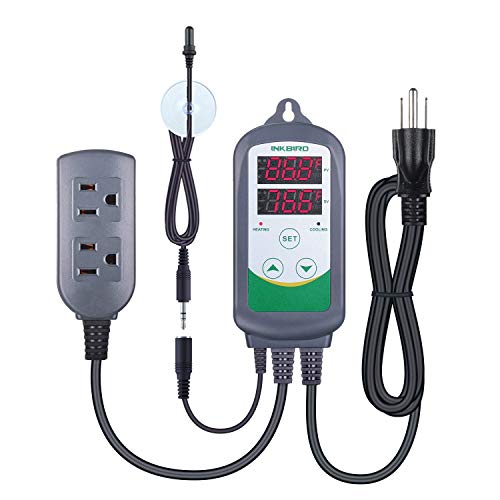
- Heating and cooling outlet control
- Fully submersible water probe
- Dual display with alarms and calibration
Best For: Simple all-in-one temperature control for heater and fan setups
Auto Fan Temp Switch

- Automatic start/stop fan control
- LCD temperature display with memory
- Designed for 12V DC plug-in fans
Best For: Small aquariums needing automatic fan cooling
WiFi Heater Safety Pick
Inkbird ITC-306A WiFi Aquarium Thermostat

- Dual probes help monitor temperature consistency.
- App alerts and heating-time alarms add oversight.
- Plug-and-play heater control with overheat protection.
Best For: Heater-only aquarium setups that benefit from WiFi alerts and dual-probe safety.
Day/Night Heating Control
Inkbird Aquarium Heater with Probe Thermostat

- Day and night temperature scheduling in a 24-hour cycle.
- Heating-only controller with dual displays and calibration.
- Alarm shuts outputs off when temperature goes out of range.
Best For: Aquariums that need automatic day/night heater scheduling.
Smart Monitoring Apex Jr – Neptune Systems A3 Apex Jr. Aquarium Controller
For aquarium controllers that focus on early warning and day-to-day stability, the Neptune Systems A3 Apex Jr. gives you core monitoring without a complicated setup. It tracks temperature and pH, adds leak detection, and connects to Apex Fusion so you can check conditions and receive alerts from anywhere.
Best For: Smaller freshwater or saltwater aquariums that need reliable monitoring, alerts, and room to expand.
Pros:
- Includes temperature and pH probes for real-time water monitoring.
- Leak detection sensor adds an extra layer of protection.
- Wi-Fi and Apex Fusion support let you monitor and manage remotely.
- Expandable with AquaBus ports and an EB832 Power Bar for added control.
Cons:
- Built around monitoring first, so it is not a full all-in-one control system out of the box.
- Expansion for pumps and lights depends on additional accessories.
This is a strong pick if you want a compact controller that prioritizes alerts, sensor-based oversight, and future growth. It keeps the essentials simple while still leaving room to build a more advanced system later.
Timed Outlet Hub – Coralife 8-Outlet 24/7 Digital Power Center
If you want aquarium controllers that mainly handle repeatable on/off scheduling, the Coralife 8-Outlet Power Center is a straightforward option. Its digital timer supports multiple cycle settings across the week, and the outlet layout makes it easy to organize aquarium gear that runs on a schedule.
Best For: Aquarists who need a simple multi-outlet timer for lights and other scheduled equipment.
Pros:
- 8 outlets give you plenty of room for multiple devices.
- 24/7 digital timer supports 15-minute interval settings.
- Up to seven time cycles per day and seven days per week.
- Safety covers help protect unused outlets.
Cons:
- It is a timer, not a monitoring controller with sensors or app alerts.
- No mention of remote connectivity or advanced automation.
This is best for keeping routine equipment on a consistent schedule without adding complexity. It is a practical utility piece for basic aquarium automation rather than a smart control system.
Remote Water Chemistry Control – Smart pH ORP Controller
Among aquarium controllers focused on water chemistry, this Smart pH ORP Controller stands out for combining remote app monitoring with relay-controlled dosing. It measures pH, ORP, and temperature at the same time, and its WiFi connection lets you check readings through the Tuya app on a 2.4GHz network.
Best For: Users who want remote monitoring and relay-based control for pH, ORP, and temperature.
Pros:
- Simultaneously measures pH, ORP, and temperature.
- Tuya app support enables remote monitoring over 2.4GHz WiFi.
- Relay output sockets can control devices like ozone generators, oxygen pumps, and solenoid valves.
- Detachable, replaceable BNC electrodes make maintenance easier.
Cons:
- App connection is limited to 2.4GHz WiFi.
- Its control focus is water chemistry devices rather than general aquarium equipment.
This is a useful choice if you want a controller that can both monitor key water values and switch compatible equipment based on those readings. It suits setups where chemistry control matters more than broad tank automation.
Heat and Chill Guard – Inkbird ITC-308S Aquarium Temperature Controller
For aquarium controllers centered on temperature stability, the Inkbird ITC-308S is built to manage both heating and cooling equipment. It shows the current and target temperature together, includes alarms for high, low, and sensor failure conditions, and is designed for freshwater, saltwater, coral, shrimp, and tropical fish setups.
Best For: Aquariums that need dual-stage temperature control for heating and cooling.
Pros:
- Controls both a heater and a cooling device at the same time.
- Dual display windows show measured and set temperature together.
- High/low temperature alarms and sensor failure alarm add protection.
- Suitable for freshwater, saltwater, coral, shrimp, and tropical fish tanks.
Cons:
- Focused on temperature control rather than broader monitoring features.
- No app connectivity or remote alerts are listed in the supplied details.
This is a strong fit if your main concern is keeping tank temperature in range with simple dual-stage automation. It is especially useful when you want dependable heating and cooling control without extra system complexity.
Smart AI Climate Controller – AC Infinity Outlet AI WiFi Power Strip
For aquarium controllers that manage more than one device, this AC Infinity unit brings smart outlet control, climate-based automation, and remote WiFi access into one setup. It can coordinate heaters, fans, pumps, lights, and other outlet-powered gear using temperature, humidity, VPD, schedules, timers, or AI targeting, making it a flexible option for dialed-in environmental control.
Best For: Aquarists who want app-based, multi-device environmental control with advanced monitoring.
Pros:
- Independent smart outlets let you control multiple devices separately.
- AI targeting and climate triggers can automate equipment around one environment.
- WiFi app access includes alerts, charts, guides, and AI-powered insights.
- Dual-zone temperature, humidity, and VPD tracking supports advanced setups.
Cons:
- Optional CO₂, hydro, and soil sensors are sold separately.
- May be more controller than needed for simple single-device cooling.
This is a strong pick if you want aquarium controllers that do more than basic on/off switching. Its real advantage is the combination of independent outlets, remote control, and broader climate logic for building a more automated system.
Dual Heat-Cool Thermostat – Inkbird ITC308S Aquarium Controller
If you want aquarium controllers that focus on straightforward temperature management, the Inkbird ITC308S is built around simple heating and cooling control. It uses an on/off control mode with a fully submersible probe, dual display window, temperature calibration, and alarms for over-temperature or sensor faults.
Best For: Hobbyists who want an easy all-in-one controller for heater and fan temperature management.
Pros:
- Controls both heating and cooling outlets in one unit.
- Fully submersible probe is designed to work better in water.
- Dual display shows current and set temperature at the same time.
- Includes calibration plus over-temperature and sensor fault alarms.
Cons:
- Uses simple on/off control rather than more advanced automation.
- Maximum output load is 1200W at 110V.
For buyers who want a practical temperature controller without extra complexity, this model covers the basics well. It is especially appealing if you need one box to manage both heating and cooling equipment around a stable setpoint.
Auto Fan Temp Switch – DaToo Aquarium Fan Controller
Among aquarium controllers focused on cooling, this DaToo unit is a simple temperature-triggered fan switch for 12V DC plug-in fans. It monitors water temperature in real time, automatically starts and stops the fan within its 68-86°F range, and adds an LCD display plus memory function for easy everyday use.
Best For: Aquarists who want automatic fan-based cooling for a small tank setup.
Pros:
- Automatically starts and stops a compatible 12V DC fan based on temperature.
- Real-time monitoring with an LCD display for current water temperature.
- Memory function helps retain settings after a power outage.
- Compact design includes hook holes and Velcro for easier mounting.
Cons:
- Works only with 12V DC plug-in fans using a 5.5×2.1mm barrel connector.
- Adapter is not included.
This controller is a good fit if your goal is simple, automatic fan cooling rather than full climate management. It keeps the feature set focused on temperature-based fan control, which makes it easy to set up and live with.
WiFi Heater Safety Pick – Inkbird ITC-306A WiFi Aquarium Thermostat
If you’re comparing aquarium controllers for a heater-only setup, the Inkbird ITC-306A focuses on temperature protection and simple plug-and-play use. It uses two probes, app notifications, and overheat safeguards to help keep a tank heater in check without a complicated install.
Best For: Hobbyists who want WiFi monitoring and dual-probe heater protection for aquariums, breeding tanks, or reptile enclosures.
Pros:
- Two probes help detect temperature differences and trigger an alert if they drift too far apart.
- App notifications add remote awareness when temperature or heating time is out of range.
- Built-in overheating protection and two relays are designed to shut the heater off when needed.
- Plug-and-play design keeps setup straightforward for most compatible heaters.
Cons:
- Heating-only controller, so it does not provide cooling control.
- Works within a defined temperature set range, so it is not meant for every application.
Overall, this is a practical pick for users who want a connected heater controller with redundancy and alerts. It stands out among aquarium controllers for combining remote monitoring with basic safety features rather than extra complexity.
Day/Night Heating Control – Inkbird Aquarium Heater with Probe Thermostat
For buyers shopping aquarium controllers with day and night scheduling, the Inkbird ITC-306T adds automatic temperature changes without getting overly complicated. It is a heating-only controller with dual displays, calibration support, and alarms that shut output down if temperatures go out of range.
Best For: Freshwater, saltwater, reef, shrimp, and tropical tank owners who want programmable day/night heating control.
Pros:
- Dual time cycles let you set different daytime and night temperatures within 24 hours.
- On/off heating control is plug-and-play and easy to deploy.
- Temperature calibration and sensor fault alarms add useful control and troubleshooting support.
- Over/under-temperature protection turns off outputs and sounds an alarm when limits are exceeded.
Cons:
- No cooling function, so it is limited to heater control.
- Over/under-temperature alarm is fixed rather than adjustable.
This model makes sense if you want a controller that can follow your tank’s daily rhythm instead of holding a single temperature all day. Among aquarium controllers, it’s a good fit for aquariums where heating behavior needs to change between day and night.
Bluetooth Dual-Stage Choice – INKBIRD Bluetooth Digital Temperature Controller
If you want aquarium controllers with both heating and cooling capability, the INKBIRD ITC-312 adds app-based Bluetooth control and two-stage outlet management. It supports flexible time modes, temperature calibration, and local data storage, making it a more feature-rich option for users who want remote access without relying on the cloud.
Best For: Users who want Bluetooth remote control plus both heating and cooling control for aquariums, breeding, or fermenting setups.
Pros:
- Bluetooth 5.0 app control works within about 100 meters for remote adjustments.
- Two-stage outlet design supports both heating and cooling control.
- Up to 12 periodic temperature ranges per day gives very flexible scheduling.
- Includes high/low temperature alarms, refrigeration delay protection, and temperature calibration.
- Offline data storage and app history reduce dependence on cloud storage.
Cons:
- Two outlets share the 1200W max output, so total load still needs attention.
- Bluetooth range is useful, but it is not WiFi remote access.
For users who need more than a basic heater controller, this model offers the widest control options in the group. It is the most versatile of these aquarium controllers when both heating and cooling management matter.
How We Picked the Best Aquarium Controllers
We focused on controller types that solve the most common tank-management problems: unstable temperature, equipment scheduling, water-level alerts, and remote oversight. Priority went to models with reliable sensors, clear control logic, useful safety features, and practical compatibility for freshwater, saltwater, reef, and specialty systems.
Quick Comparison of Aquarium Controllers
Some Aquarium Controllers are simple single-purpose thermostats, while others combine WiFi monitoring, app alerts, power-strip control, and multi-sensor support. If you only need stable heating, a dedicated temperature controller is usually enough. If you want leak detection, pH monitoring, or remote access, a smarter hub-style controller is the better long-term choice.
Key Buying Factors for Aquarium Controllers
Control Type
Decide whether you need temperature-only automation or a broader control system. Basic controllers are ideal for heaters and cooling fans. More advanced Aquarium Controllers can monitor multiple parameters and trigger alerts or outlets.
Probe Quality and Sensor Count
Accuracy depends heavily on sensor placement and probe quality. Dual-probe or multi-sensor designs can improve redundancy and give more stable readings, especially in larger tanks or systems with both heating and cooling equipment.
Compatibility with Your Equipment
Check the wattage limits, outlet count, and whether the controller supports heaters, fans, lights, dosing pumps, or chillers. A mismatch here is one of the most common buying mistakes.
Connectivity and Alerts
WiFi and Bluetooth features are useful if you travel often or manage a busy system. App alerts, remote monitoring, and scheduling can reduce risk, but only if the controller also performs reliably offline.
Safety Features
Look for fail-safes such as high/low temperature cutoffs, leak detection, and separate heating and cooling stages. These are especially important for reef tanks and expensive livestock.
Who Should Buy Which Aquarium Controllers?
If you want simple, dependable temperature stability, a basic plug-in thermostat is usually the best value. If you run a reef tank, keep sensitive species, or maintain multiple devices, a more advanced controller with alarms and app control is worth the upgrade. Beginners should prioritize ease of setup and clear displays, while experienced aquarists may prefer flexible automation and broader monitoring.
In short, the best Aquarium Controllers are the ones that match your tank size, equipment, and comfort level with automation. Start with the feature set you actually need, then choose the most reliable model in that category.