Keeping a betta’s feeding schedule consistent is easier when an automatic feeder handles small portions while you are working, traveling, or away for a weekend. The right model can reduce overfeeding and make daily care more predictable.
This roundup compares ten aquarium feeders with different capacities, timer systems, power options, and dispensing controls. Use the guide below to match the feeder’s design to your tank size, food type, and routine.
Best 10 Automatic Fish Feeders for Betta Tanks Picks for 2026
Best Moisture Protection

- 8-, 12-, and 24-hour interval modes
- Adjustable portions and 200ml capacity
- Moisture-proof lid and two mounting options
Best For: Betta owners wanting flexible setup and larger food storage
Best Simple Betta-Focused Pick

- Automatically feeds once daily
- Includes one AA battery and sample food
- Compact design for small setups
Best For: Betta keepers who prefer a simple daily routine
Best High-Frequency Scheduling

- Supports up to nine feedings daily
- 200ml capacity for varied aquarium sizes
- Includes clip and stand; refill without removal
Best For: Owners needing frequent, adjustable feeding schedules
Best Rechargeable Option

- USB rechargeable with extended stated runtime
- Four interval modes from 8 to 48 hours
- Up to four daily feeding times and adjustable spins
Best For: Betta owners wanting rechargeable power and detailed scheduling
Best Dual-Power Pick
DXOPHIEX Automatic Fish Feeder

- USB and two-AA battery power options
- Edge or hood mounting
- Two containers with adjustable portions
Best For: Betta tanks needing flexible mounting and backup power
Best for Vacation Simplicity
Freesea 200ML Automatic Fish Feeder
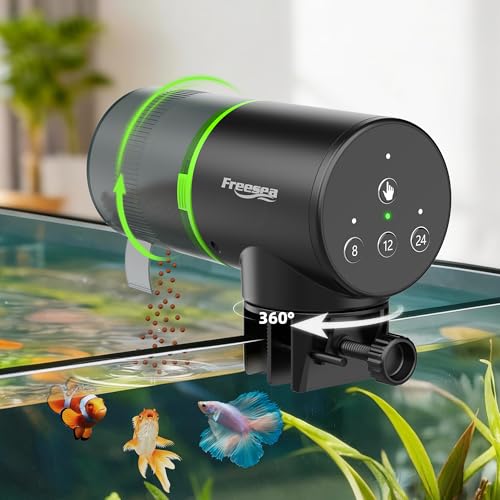
- One-touch setup with three timers
- 200 ml capacity for 7–14 days
- Adjustable slider and moisture-resistant lid
Best For: Battery-powered vacation feeding for betta owners
Best for Precise Scheduling
Papettly LCD Automatic Fish Feeder

- LCD scheduling for up to three feedings
- 15 compartments with measured portions
- Quiet, moisture-resistant dispensing
Best For: Pellet-food users wanting detailed schedules and portion control
Most Precise Portions
Petbank 16-Grid Rechargeable Feeder

- Stores up to 15 individual meals
- Moisture-resistant sealed outlet
- USB-C rechargeable with flexible scheduling
Best For: Precise betta feeding during routines or vacations
Best Large-Capacity Pick
FISHNOSH Model-ML Automatic Feeder

- 200 ml food capacity
- Supports flakes and pellets
- Up to three feedings daily
Best For: Simple feeding for small or large aquariums
Best Long-Battery Option

- 12-, 24-, or 48-hour intervals
- Three- to six-month battery life
- Adjustable portions and dual mounting
Best For: Simple, low-maintenance interval feeding
Best Moisture Protection – 200ml Automatic Feeder
For automatic fish feeders for betta tanks, this Aoyar model combines a generous 200ml capacity with adjustable portions and moisture-reducing storage. Its interval settings and flexible mounting options make it a practical choice for routine feeding or short trips away.
Best For: Betta owners who want large capacity, adjustable portions, and flexible installation.
Pros:
- Offers 8-, 12-, and 24-hour automatic feeding intervals.
- Adjustable slider helps control portions and reduce overfeeding.
- Moisture-proof lid is designed to reduce water vapor entering the food container.
- Supports flakes, granules, powder, and strips.
Cons:
- Uses batteries rather than USB charging.
- Its 200ml body may be larger than necessary for a single small betta tank.
This is a versatile feeder when capacity and food compatibility matter. The manual-feed button and two mounting methods add convenience, while the moisture-focused design is useful for keeping stored food fresher.
Best Simple Betta-Focused Pick – Zoo Med BettaMatic
Among automatic fish feeders for betta tanks, the Zoo Med BettaMatic stands out for its straightforward daily schedule. It automatically feeds a betta once per day and includes a sample of food, making it a focused option for owners who prefer simple operation.
Best For: Betta keepers seeking a compact, dedicated once-daily feeder.
Pros:
- Designed specifically for daily betta feeding.
- Uses one AA battery, which is included.
- Compact 3-by-1.6-by-4-inch design.
- Includes sample food.
Cons:
- Provides a once-daily schedule rather than multiple programmable feeding times.
- Its smaller, specialized design may be less suitable for varied feeding routines.
The BettaMatic is best viewed as a no-frills solution for maintaining a consistent daily feeding routine. Choose it when simplicity and betta-specific use are more important than large capacity or advanced scheduling.
Best High-Frequency Scheduling – FISHNOSH 200ml Feeder
This FISHNOSH model is a strong contender among automatic fish feeders for betta tanks when feeding flexibility is a priority. It supports up to nine feedings per day through three programmed times with up to three cup rotations per feeding, while its 200ml capacity suits small tanks, larger aquariums, and ponds.
Best For: Owners who need frequent, adjustable feeding schedules across different aquarium sizes.
Pros:
- Can be calibrated for up to nine feedings per day.
- 200ml capacity works with small and larger aquariums as well as ponds.
- Food can be refilled without removing the feeder.
- Includes a clip and stand for setup flexibility.
Cons:
- Its broader aquarium-and-pond design may offer more capacity and scheduling than a single betta needs.
- Operation depends on battery power.
For betta owners who want more control than a once-daily feeder provides, this is an adaptable choice. Its portion-control and timer features are especially useful when establishing a more frequent routine or feeding multiple aquatic pets.
Best Rechargeable Option – 200ml USB Feeder
For shoppers comparing automatic fish feeders for betta tanks, this rechargeable model offers both interval and customized scheduling. Its USB charging, LCD display, 200ml container, and adjustable mounting make it convenient for regular use and vacation feeding.
Best For: Betta owners who want rechargeable power and more detailed schedule control.
Pros:
- Offers 8-, 12-, 24-, and 48-hour interval modes.
- Supports up to four feeding times per day with one to three spins per session.
- USB rechargeable design can last more than 3–6 months per charge according to the supplied notes.
- Includes adjustable clamp and adhesive mounting options.
Cons:
- Requires access to USB power for recharging.
- Its multiple settings may be more than needed for a simple once-daily betta routine.
This feeder is a practical match for owners who want to avoid routine battery replacement while retaining portion and timing control. The 48-hour interval option is also useful for feeding schedules that do not require daily dispensing.
Best Dual-Power Pick – DXOPHIEX Automatic Fish Feeder
For betta keepers who want backup power, the DXOPHIEX is a practical choice among automatic fish feeders for betta tanks. It supports scheduled feeding every 8, 12, or 24 hours, plus manual feeding when needed.
Best For: Betta tanks where flexible mounting and power redundancy are priorities.
Pros:
- Runs on two AA batteries, USB power, or both for backup.
- Offers edge-of-tank and hood mounting options.
- Includes 100 ml and 200 ml containers plus a feeding ring.
- Adjustable volume works with flakes, crisps, pellets, and granules.
Cons:
- AA batteries are not included.
- The larger design may be more equipment than a small betta setup needs.
The dual-power setup is the standout feature for vacation feeding, while the two containers and adjustable output add everyday flexibility. It is a strong option if your tank configuration or power reliability varies.
Best for Vacation Simplicity – Freesea 200ML Automatic Fish Feeder
The Freesea focuses on simple scheduled feeding, making it a convenient candidate among automatic fish feeders for betta tanks. Its one-touch setup, three programmable timers, and 200 ml dispenser are designed for hands-free feeding during trips or busy routines.
Best For: Betta owners seeking straightforward battery-powered feeding for vacations and weekends away.
Pros:
- Provides three programmable timer options with one-touch setup.
- Holds up to 200 ml and is designed for 7–14 days of automatic feeding.
- Adjustable slider helps control portions and supports powder and pellet food.
- Includes a moisture-resistant lid and a 12-month warranty.
Cons:
- Runs on batteries rather than offering USB power.
- Its vacation capacity depends on portion size and feeding schedule.
With a large dispenser, adjustable slider, and simple programming, this model is geared toward reducing feeding concerns while traveling. It is especially suitable if you prefer a battery-powered unit with a moisture-resistant design.
Best for Precise Scheduling – Papettly LCD Automatic Fish Feeder
The Papettly uses an LCD display and compartment-based dispensing for more structured feeding. For automatic fish feeders for betta tanks, it suits owners who want up to three daily feedings, alternating-day scheduling, and measured portions.
Best For: Betta keepers who use pellet-style food and want detailed programming with quiet operation.
Pros:
- Offers up to three daily feedings with customizable and alternating-day schedules.
- Dispenses up to three portions per session, with up to 2 g per feeding.
- Uses 15 compartments and auto-closing ports to help keep food dry.
- Operates at less than 30 dB and includes a USB charging cable.
Cons:
- Not suitable for flake or shrimp food.
- Its 30 g capacity is smaller than the 200 ml models in this roundup.
The LCD controls and measured dispensing make this a useful choice when feeding precision matters more than bulk capacity. Confirm that your betta’s food is compatible before choosing this compartment-style design.
Most Precise Portions – Petbank 16-Grid Rechargeable Feeder
For betta owners comparing automatic fish feeders for betta tanks, the Petbank stands out for individually portioned meals and moisture control. Its 16-grid design stores up to 15 meals, with each grid holding up to 2 g, while the sealed outlet helps keep food dry.
Best For: Betta keepers who want precise, scheduled portions during daily routines or vacations.
Pros:
- Stores up to 15 individual meals for portion control.
- Supports up to three feedings per day with flexible timing.
- Moisture-resistant outlet closes after feeding.
- USB-C rechargeable battery can last up to one to two months.
Cons:
- Not designed for shrimp or flake food.
- Each feeding can use a maximum of three grids.
- Requires hand washing for care.
Choose this model if accurate serving sizes and dry food storage matter more than holding a large volume of food. The clamp and suction-cup mounting options also make it adaptable to different aquarium setups.
Best Large-Capacity Pick – FISHNOSH Model-ML Automatic Feeder
The FISHNOSH Model-ML is a straightforward option for shoppers seeking automatic fish feeders for betta tanks and larger aquariums. It offers up to three scheduled feedings per day, a 200 ml capacity, and compatibility with flakes and pellets.
Best For: Owners who want a simple, versatile feeder for small or large tanks and occasional vacation use.
Pros:
- 200 ml container provides more capacity than many small feeders.
- Works with flakes and pellets.
- Schedules up to three feedings per day.
- Includes a clip and stand for setup flexibility.
Cons:
- No display screen for programming feedback.
- Each scheduled feeding is limited to one round.
- Runs on batteries rather than USB-C recharging.
This feeder favors uncomplicated operation over advanced controls. It is a practical match for betta owners who value capacity and broad food compatibility, provided the lack of a display is not a concern.
Best Long-Battery Option – 200 ml USB-C Interval Feeder
For automatic fish feeders for betta tanks that prioritize long periods between charges, this 200 ml model uses selectable 12-, 24-, or 48-hour intervals. Its adjustable slider helps control portions, and it accepts flakes, pellets, granules, and powders.
Best For: Busy betta owners who prefer simple interval feeding and extended USB charging life.
Pros:
- Offers 12-, 24-, and 48-hour automatic intervals.
- Battery can last three to six months on one charge.
- 200 ml container holds a range of dry food types.
- Includes clamp and sticker mounting options.
Cons:
- Uses preset intervals rather than specific feeding times.
- Portion control relies on a manual slider.
- Mounting is described as suitable for most square tanks.
This is a good fit when you want minimal programming and fewer charging interruptions. Select it for interval-based feeding rather than a feeder with detailed daily time scheduling.
How We Picked These Automatic Fish Feeders for Betta Tanks
We focused on features that matter in a betta aquarium: reliable portion delivery, simple programming, compact installation, suitable capacity, and resistance to humidity. The selected models include dedicated betta feeders and versatile aquarium dispensers designed for flakes or pellets.
Because a betta tank usually needs very small meals, adjustability matters more than maximum capacity. We also considered whether each feeder uses replaceable batteries, USB power, or rechargeable charging, and whether the controls include a useful display or straightforward one-touch setup.
Quick Comparison
| Best For | Features to Prioritize | Good Fit |
|---|---|---|
| Basic daily feeding | Simple timer and dependable dispensing | Dedicated betta feeder |
| Short vacations | Large capacity and secure mounting | 200ml vacation feeder |
| Flexible schedules | Multiple feeding intervals and LCD controls | Programmable aquarium feeder |
| Easy maintenance | Rechargeable power and moisture protection | USB or USB-C model |
Key Buying Factors for Automatic Fish Feeders for Betta Tanks
Portion Control
Choose a dispenser that can release very small amounts and test it before relying on it. A large hopper does not guarantee accurate betta-sized portions. Flake food may dispense differently from uniform pellets, so run several test cycles and adjust the opening as needed.
Timer and Schedule Options
Look for a schedule that matches your routine. A single daily cycle may be enough for simple care, while multiple timers or interval settings provide more control. Confirm that the feeder retains its schedule after a battery change or power interruption.
Food Compatibility and Moisture Control
Most automatic feeders work best with dry pellets or small flakes. Damp food can clog the mechanism, particularly in open-top tanks. A sealed hopper, moisture-resistant design, and placement away from splash zones can improve consistency.
Power and Installation
Battery models are convenient for tanks away from outlets, while rechargeable USB and USB-C feeders reduce the need for disposable batteries. Check how the unit attaches to the aquarium and ensure it cannot slip into the water or block the lid.
Who Should Buy Which Automatic Fish Feeders for Betta Tanks?
Choose a dedicated betta feeder if you want the simplest setup for one small tank. A compact 200ml model is better for extended trips or households caring for several tanks, provided its minimum portion is small enough. Pick a rechargeable LCD model if you want visible settings and less battery maintenance. For flexible feeding routines, select a unit with multiple timers or interval choices.
Whichever feeder you choose, test it with your actual food for several days before leaving your betta unattended. Remove excess food, verify the schedule, and keep a backup feeding plan for longer trips.