The right onboard charger keeps your boat’s batteries ready without requiring constant manual monitoring. The best marine battery chargers for boats match your battery-bank layout, charging needs, and installation environment.
We compare 10 practical options for fishing boats, pontoons, bass boats, and larger multi-battery systems, with attention to bank count, output, waterproofing, maintenance charging, and everyday usability.
Best 10 Marine Battery Chargers for Boats Picks for 2026
Best Compact Two-Bank Charger
NOCO GEN5X2 10A Onboard Charger
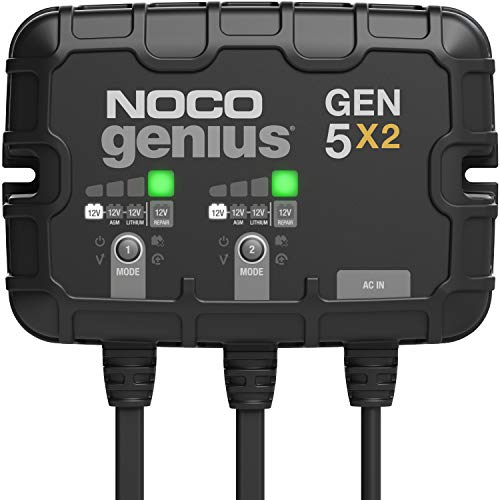
- Two independent 12V charging banks
- Supports lead-acid and LiFePO4 batteries
- IP68 waterproof, temperature-compensated design
Best For: Two-battery boats with limited installation space
Best Simple 12V Charger
Marinco ChargePro 6A On-Board Charger

- Single-bank 12V charging
- Automatic multi-stage charging
- IP68 sealed housing with 120/230V input
Best For: Single-bank flooded, AGM, or gel battery systems
Best High-Output Two-Bank Charger

- 20 amps total, or 10 amps per bank
- Independent lead-acid and LiFePO4 modes
- IP68 waterproof housing with thermal compensation
Best For: Two-bank systems needing faster charging
Best Four-Bank Charger
Minn Kota MK-440PCL Precision Charger

- Four independent 10-amp charging banks
- Supports AGM, flooded, gel, and LiFePO4
- Temperature compensation with status LEDs
Best For: Larger boats with four 12V battery banks
Best for Balanced Multi-Battery Charging

- 20 amps across three banks
- Supports lithium, AGM, gel, and flooded batteries
- IP67 waterproof with LED status display
Best For: Flexible three-bank charging with amp distribution
Best Budget-Friendly 5A-Per-Bank Option

- 5 amps per bank for three 12V batteries
- Supports lead-acid, lithium, and calcium modes
- IP68 waterproof with three-year warranty
Best For: Lower-output charging with independent bank controls
Best for High-Output Charging
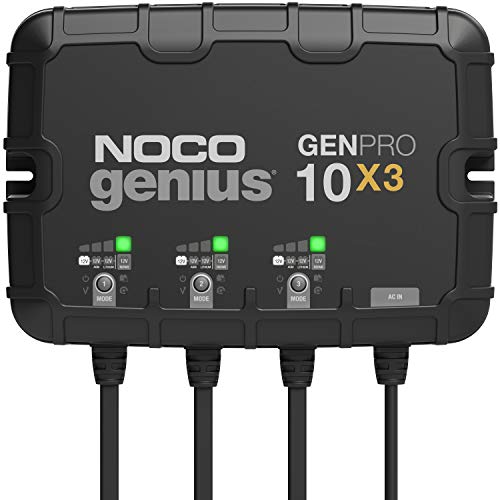
- 30 amps total across three banks
- Selectable lead-acid and lithium modes
- IP68 waterproof with Force Mode recovery
Best For: Higher-output charging for demanding three-bank systems
Best Multi-Battery Value
2 Bank 20A Marine Battery Charger
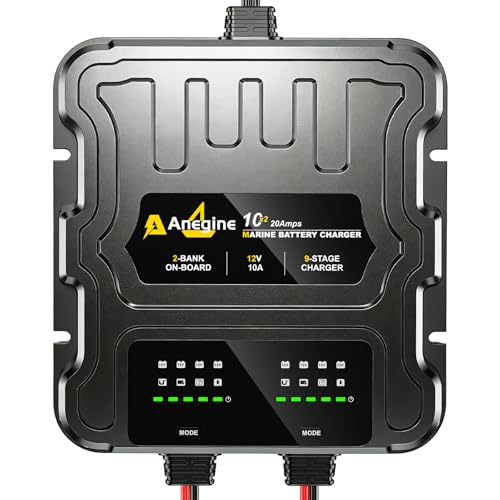
- 10A per bank for two 12V batteries
- Supports lead-acid and LiFePO4
- IP68 waterproof with repair mode
Best For: Two-battery boat systems needing versatile, higher-output charging
Best for Three-Battery Systems
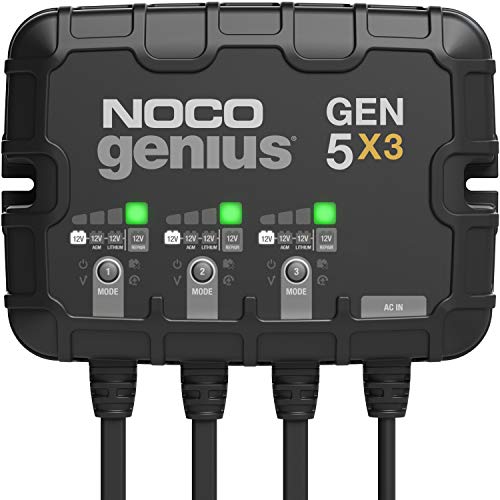
- Three independent 5A charging banks
- IP68 waterproof onboard design
- Supports lithium, AGM, and repair mode
Best For: Three-battery boats needing compact onboard maintenance
Best Single-Bank Option
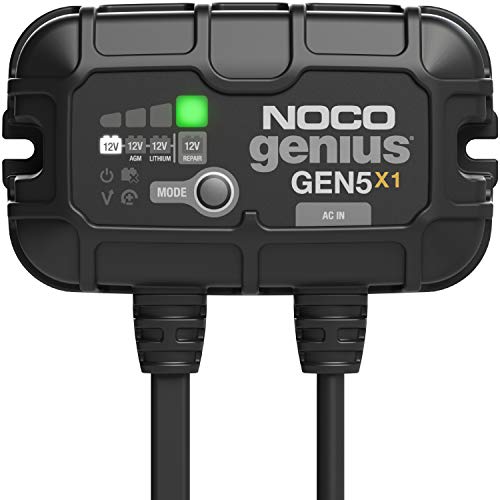
- 5A output for one 12V battery
- Supports lead-acid and LiFePO4
- IP68 waterproof with temperature sensing
Best For: Single-battery boats needing compact onboard charging
Best Compact Two-Bank Charger – NOCO GEN5X2 10A Onboard Charger
If you need marine battery chargers for boats that can handle mixed battery types without taking up much space, the NOCO GEN5X2 is a practical two-bank option. It delivers 5 amps per bank, supports lead-acid and LiFePO4 batteries, and uses selectable charging modes for independent battery maintenance.
Best For: Boats with two 12V batteries and limited installation space.
Pros:
- Independently charges two 12V batteries at 5 amps per bank.
- Supports wet, gel, MF, AGM, and LiFePO4 batteries with selectable modes.
- IP68 waterproof housing, temperature compensation, and flexible mounting.
- Force Mode can initiate charging on deeply discharged batteries down to zero volts.
Cons:
- Its 10-amp total output is less powerful than the 20-amp NOCO model.
- Designed for two banks rather than larger multi-battery systems.
The GEN5X2 is a strong fit when compact size, waterproof construction, and broad battery compatibility matter more than maximum charging speed. Its 3-year warranty adds useful ownership support.
Best Simple 12V Charger – Marinco ChargePro 6A On-Board Charger
The Marinco ChargePro is a straightforward choice among marine battery chargers for boats with a single 12V battery system. Its microprocessor-controlled, multi-stage charging is designed for flooded, AGM, and gel batteries, while universal 120/230V input supports use in different locations.
Best For: Single-bank 12V systems using compatible lead-acid batteries.
Pros:
- Automatic multi-stage charging for flooded, AGM, and gel batteries.
- Microprocessor control helps regulate charging accurately.
- Universal 120/230V input offers installation flexibility.
- IP68 sealed housing suits demanding marine environments.
Cons:
- Only one charging port is provided.
- It is rated at 6 amps, so larger batteries may charge more slowly.
- The supplied notes do not list lithium battery compatibility.
Choose the ChargePro when you want uncomplicated charging for one compatible 12V battery bank. It is less versatile than the lithium-ready models, but its sealed housing and automatic charging make it easy to maintain.
Best High-Output Two-Bank Charger – NOCO GENPRO10X2 20A
For boat owners comparing marine battery chargers for boats with higher charging demands, the NOCO GENPRO10X2 provides 20 amps total, split evenly between two banks. Each bank can be configured separately for lead-acid or LiFePO4 batteries, making it suitable for mixed 12V systems.
Best For: Two-bank boats that need faster 10-amp-per-bank charging.
Pros:
- Delivers 10 amps independently to each of two 12V batteries.
- Supports wet, gel, MF, AGM, and LiFePO4 battery types.
- IP68 waterproof construction with temperature compensation.
- Force Mode can start charging batteries discharged down to zero volts.
Cons:
- It is larger than the lower-output GEN5X2.
- Two banks may not be enough for boats with three or more battery groups.
The GENPRO10X2 is the more capable two-bank choice when charging speed is a priority. It combines higher output with the same useful waterproofing, selectable modes, and deep-discharge recovery features found in NOCO’s newer onboard design.
Best Four-Bank Charger – Minn Kota MK-440PCL Precision Charger
Minn Kota Precision MK-440PCL On-Board Marine Battery Charger – 4 Banks, 10 Amps Each
Check Price On AmazonThe Minn Kota MK-440PCL stands out among marine battery chargers for boats with multiple battery banks. It has four independently configurable 10-amp outputs, automatic multi-stage charging, and support for AGM, flooded lead-acid, gel, and LiFePO4 batteries.
Best For: Larger boats with four 12V battery banks.
Pros:
- Four charging banks provide 10 amps per bank.
- Each bank can be set for AGM, flooded, gel, or LiFePO4 batteries.
- Temperature compensation and low-line voltage adjustment support consistent charging.
- LED indicators show charging stage, maintenance status, errors, and completion.
Cons:
- Its four-bank design is heavier and bulkier than the two-bank options.
- Installation requires room for a 11.5-pound charger.
- It is intended for 120V input rather than the universal input listed for the Marinco model.
If your boat has several battery groups, the MK-440PCL can reduce installation complexity by charging all four banks from one onboard unit. Its battery-type selection and maintenance features make it especially useful for larger, mixed-battery setups.
Best for Balanced Multi-Battery Charging – ProSport HD 20A 3-Bank
For boat owners comparing marine battery chargers for boats, the ProMariner ProSport HD provides 20 amps across three banks and uses Distributed-On-Demand technology to direct unused charging capacity where it is needed. Its IP67 waterproof construction and compatibility with lithium, flooded, AGM, and gel batteries make it a flexible onboard option.
Best For: Boat owners who want a versatile three-bank charger with status monitoring and automatic amp distribution.
Pros:
- Charges three batteries with up to 20 amps available across the banks.
- Compatible with lithium, flooded, AGM, and gel batteries.
- IP67 waterproof design and expanded LED completion-status display.
Cons:
- Its 20-amp total output may be slower than higher-output three-bank models.
- Listed as IP67, rather than the IP68 rating offered by some alternatives.
The ProSport HD is a strong middle-ground choice when broad battery compatibility and clear charging feedback matter more than maximum output. Distributed-On-Demand charging is especially useful when multiple batteries have different charging needs.
Best Budget-Friendly 5A-Per-Bank Option – FirstPower Pro 3-Bank 15A
The FirstPower Pro 3-bank charger is a practical pick for boat owners seeking marine battery chargers for boats with independent 5-amp charging on each 12V bank. It supports lead-acid and lithium batteries, offers selectable charging modes, and is rated IP68 for sealed waterproof protection.
Best For: Owners of three 12V batteries who prefer independent mode selection, basic diagnostics, and lower per-bank charging current.
Pros:
- Charges three 12V batteries simultaneously at 5 amps per bank.
- Supports 12V SLA/AGM, lithium, and calcium battery modes.
- IP68 waterproof construction, thermal sensing, repair mode, and a three-year warranty.
Cons:
- Its 15-amp total output is lower than the other listed chargers.
- 5 amps per bank may mean longer charging times for larger battery banks.
- The notes warn that it should be used in a well-ventilated area.
This charger emphasizes straightforward, independent bank control rather than high charging speed. The repair mode, temperature protection, and included clips, connectors, and spare fuses add useful practicality for routine onboard maintenance.
Best for High-Output Charging – NOCO GENPRO10X3 30A
For faster multi-battery charging, the NOCO GENPRO10X3 delivers 30 amps total, or 10 amps per bank, across three independent 12V banks. Among marine battery chargers for boats, it stands out for IP68 waterproofing, selectable lead-acid and lithium modes, temperature compensation, and the ability to begin charging deeply discharged batteries.
Best For: Boat owners who need higher three-bank output and recovery features for lead-acid or lithium battery systems.
Pros:
- Provides 30 amps total, with 10 amps independently available per bank.
- Supports 12V, AGM, lithium, and repair modes for each bank.
- IP68 waterproof design with temperature compensation and Force Mode for deeply discharged batteries.
Cons:
- At 13.4 pounds, it is heavier than the ProMariner model listed here.
- Its higher-output design may be more charger than smaller systems require.
- The supplied details list eyelet terminals rather than battery clips.
The GENPRO10X3 is the performance-oriented choice in this group. Its higher output can reduce charging time, while the sealed housing, flexible mounting, and battery-recovery functions suit demanding marine installations.
Best Multi-Battery Value – 2 Bank 20A Marine Battery Charger
This two-bank charger is a flexible option for shoppers comparing marine battery chargers for boats. It delivers up to 10A per bank, supports 12V lead-acid and lithium batteries, and uses independent controls so each battery can receive the appropriate charging mode.
Best For: Boat owners who need to charge and maintain two 12V batteries with higher output and broad battery compatibility.
Pros:
- Independent two-bank charging with up to 10A per bank.
- Supports SLA, AGM, gel, calcium, and LiFePO4 batteries through selectable modes.
- IP68 waterproof construction, 9-stage charging, repair mode, and multiple safety protections.
- Thermal sensing adjusts charging for ambient temperature.
Cons:
- Only provides two banks, so it is less suitable for boats with three batteries.
- The feature-rich design may be more than needed for a simple single-battery setup.
With its 20A total rating, waterproof housing, repair function, and support for both lead-acid and lithium batteries, this is a strong choice when charging flexibility and faster two-battery charging matter.
Best for Three-Battery Systems – NOCO GEN5X3 3-Bank Charger
The NOCO GEN5X3 is built for boat owners who need three-bank charging in a compact, sealed package. Among marine battery chargers for boats, it stands out for independently charging three 12V batteries while offering selectable lead-acid, AGM, lithium, and repair modes.
Best For: Boats with three 12V marine, starter, or deep-cycle batteries that need onboard charging and maintenance.
Pros:
- Three independent banks provide 5A per bank.
- IP68 waterproof design with mounting options in any orientation.
- Supports lead-acid and LiFePO4 batteries, including deeply discharged batteries through Force Mode.
- Temperature compensation, anti-vibration backing, and a 3-year limited warranty.
Cons:
- The 15A total output is divided across three banks at 5A each.
- Its three-bank layout may be unnecessary for smaller or single-battery boats.
This is a well-rounded onboard solution when three-bank capability is the priority. Its waterproof construction, temperature sensing, recovery modes, and included cables make it particularly practical for permanent marine installation.
Best Single-Bank Option – NOCO GEN5X1 5A Marine Charger
The NOCO GEN5X1 keeps onboard charging simple with one 5A bank for a single 12V battery. It is a practical pick among marine battery chargers for boats when you want waterproof protection, selectable battery modes, and maintenance charging without paying for unused banks.
Best For: Small boats or single-battery setups using a 12V lead-acid or LiFePO4 battery.
Pros:
- Compact one-bank design supplies 5A to a single 12V battery.
- Compatible with wet, gel, MF, AGM, and LiFePO4 batteries.
- IP68 sealing, thermal compensation, and repair and Force Modes.
- Includes mounting hardware and carries a 3-year limited warranty.
Cons:
- Cannot charge multiple batteries simultaneously.
- Its 5A output is less suited to larger multi-battery systems or faster charging needs.
For a single 12V battery, the GEN5X1 offers a focused feature set and compact installation. It is especially appealing when waterproofing and battery-type flexibility matter more than multi-bank capacity.
How We Picked the Best Marine Battery Chargers for Boats
We focused on onboard chargers designed for marine use and compared the features that matter after installation: number of banks, charging output per bank, waterproof or water-resistant construction, battery compatibility, charging automation, protection features, and ease of monitoring. The selection includes compact single-bank units, balanced two-bank chargers, and higher-capacity three- and four-bank models.
Because charging requirements vary widely, wattage alone did not determine the ranking. A lower-output charger can be the better choice for a small boat or maintenance application, while a multi-bank charger with independent outputs is more practical for boats with separate trolling, starting, and accessory batteries.
Quick Comparison
- One battery: Choose a single-bank charger such as the NOCO GEN5X1 when space and simplicity matter most.
- Two batteries: Two-bank models suit many fishing boats, pontoons, and dual-battery starting or trolling setups.
- Three or four batteries: Multi-bank chargers reduce installation clutter and let each battery receive dedicated charging.
- Faster recovery: Higher total amperage is useful when larger batteries must be recharged between outings.
- Long-term storage: Automatic maintenance modes help keep batteries topped up without continuous supervision.
Key Buying Factors for Marine Battery Chargers for Boats
Bank Count and Battery Layout
Match the charger’s bank count to the number of batteries you want to charge independently. A bank is not simply an extra connection; it is a dedicated charging output. Confirm how your batteries are wired and whether a series-connected trolling motor requires a charger compatible with each individual battery.
Amperage and Recharge Speed
Check both total output and amps per bank. A 20-amp two-bank charger typically provides 10 amps to each bank, while a 15-amp three-bank model may provide 5 amps per bank. More amperage can shorten recharge time, but the charger must remain appropriate for the battery manufacturer’s recommended charging rate.
Marine Protection and Installation
Boats expose electronics to spray, humidity, vibration, and temperature changes. Look for sealed or waterproof construction, corrosion-resistant materials, protected connections, and a mounting location that follows the manufacturer’s ventilation and clearance instructions. Use properly sized wiring, fuses, and shore-power connections.
Battery Chemistry and Safety Features
Verify compatibility with your battery type, including flooded lead-acid, AGM, gel, or lithium where supported. Automatic shutoff, reverse-polarity protection, short-circuit protection, temperature compensation, and overcharge protection add useful safeguards, but they do not replace correct installation.
Who Should Buy Which Marine Battery Chargers for Boats?
Choose a single-bank charger for a small boat, one starting battery, or a simple winter-maintenance setup. Choose a two-bank model for the best general-purpose balance on many recreational boats. Choose a three-bank charger when your boat has a dedicated starting battery plus a two-battery trolling-motor system. Choose a four-bank charger for larger boats with multiple batteries and a preference for one centralized charging system.
If you frequently fish on consecutive days, prioritize adequate amperage per bank and clear charging indicators. If the boat spends weeks or months in storage, prioritize automatic maintenance charging, robust sealing, and dependable protection features. Before purchasing, confirm voltage, battery chemistry, bank configuration, connector requirements, and the charger’s installation rating for your boat.