Keeping aquarium fish on a consistent feeding schedule is easier with the right rechargeable automatic fish feeder. These models offer convenient timers, USB charging, portion control, and capacities suited to everything from betta tanks to larger aquariums and ponds.
We compared the selected feeders by scheduling flexibility, food compatibility, moisture protection, capacity, charging convenience, and ease of setup so you can choose a dependable match for your tank and routine.
Best 10 Rechargeable Automatic Fish Feeders Picks for 2026
Best for Extended Trips
Lychee 320ML USB Rechargeable Feeder
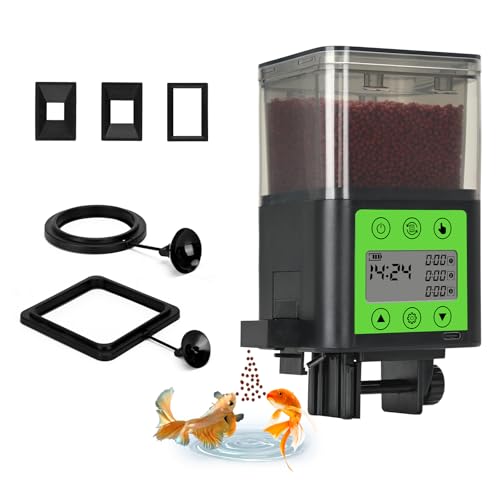
- Large 320 ml capacity
- Three daily feeding times with portion control
- Rechargeable battery and moisture-proof bin
Best For: Long vacations and varied fish or turtle feed
Best for Simple Vacation Setup
Freesea 200ML Automatic Feeder
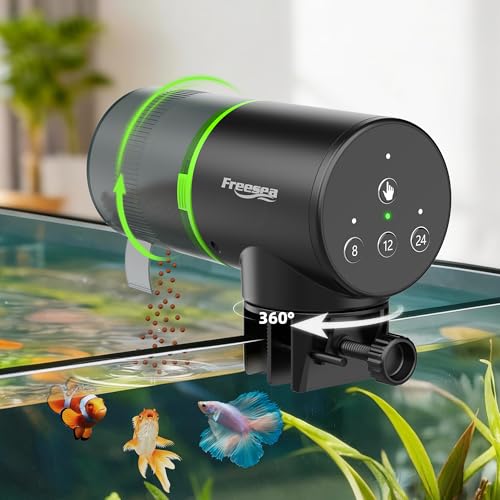
- One-touch setup with three timers
- Adjustable portion slider
- Seven- to 14-day feeding capacity
Best For: Weekend trips and short vacations
Best for Time Visibility
Lukovee 200ML USB Rechargeable Feeder

- Hour-and-minute feeding display
- USB rechargeable with a 700 mAh battery
- Adhesive or clamp mounting options
Best For: Owners who want schedule confirmation and flexible mounting
Best for Flexible Scheduling
FISHNOSH 200ML Automatic Feeder

- Up to three daily feedings with three rotations each
- Works with tanks and ponds
- Includes clip, stand, and two-year warranty
Best For: Busy owners managing varied aquarium or pond setups
Best Long-Lasting Rechargeable Feeder

- Three feeding modes with LCD controls
- 230 ml capacity for up to 200–300 feedings
- 800 mAh USB battery claims up to 120 days
Best For: Extended vacations and flexible aquarium setups
Best Portion-Control Rechargeable Feeder

- 16 grids provide up to 15 individual meals
- Sealed opening helps reduce moisture and clumping
- USB-C battery lasts about one to two months
Best For: Precise dry-food feeding in small tanks
Best Simple Interval Feeder
200 ml Moisture-Resistant Dispenser

- Feeds automatically every 8, 12, or 24 hours
- 200 ml reservoir for vacation feeding
- Moisture-proof lid and adjustable food volume
Best For: Simple scheduled feeding for fish or turtles
Best Smart-Connected Pick
WiFi Temperature-Monitoring Feeder

- App scheduling and feeding logs via USB
- Temperature monitoring with adjustable alerts
- USB power with battery backup
Best For: Remote aquarium oversight and vacation feeding
Best LCD Value

- Up to four daily feeding times
- 8- to 48-hour interval modes
- 200 ml capacity with adjustable slider
Best For: Simple scheduled feeding with LCD controls
Best Simple Interval Model

- Three automatic interval choices
- USB-C rechargeable battery
- Manual feeding and adjustable portions
Best For: Low-maintenance feeding during busy periods or vacations
Best for Extended Trips – Lychee 320ML USB Rechargeable Feeder
For shoppers comparing rechargeable automatic fish feeders, the Lychee model stands out with a 320 ml capacity, precise portion controls, and a rechargeable battery designed for longer periods away from home. Its moisture-conscious food compartment also helps keep feed fresh between dispensing cycles.
Best For: Long vacations, business trips, and owners feeding fish or turtles with different food types.
Pros:
- Large 320 ml food capacity for extended unattended feeding.
- Supports up to three feeding times per day with one to three dispensing rotations each time.
- Three outlet-hole sizes help adjust portions for different feeds.
- USB-rechargeable 700 mAh battery may operate for two to four months, depending on settings.
Cons:
- Requires a three- to four-hour charging period.
- Feeding requires both a scheduled time and a rotation setting; setting only the time will not dispense food.
This is a strong choice when capacity and reduced charging frequency matter most. The top-fill, moisture-proof design adds convenience, although buyers should carefully configure the rotation setting before relying on it during travel.
Best for Simple Vacation Setup – Freesea 200ML Automatic Feeder
The Freesea is a practical option among rechargeable automatic fish feeders for aquarium owners who prioritize quick setup and straightforward vacation feeding. It combines three programmable timers, adjustable portions, and a 200 ml dispenser for freshwater, saltwater, betta, goldfish, and turtle setups.
Best For: Weekend trips, short vacations, and users who want one-touch setup with adjustable food delivery.
Pros:
- One-touch setup and three programmable timers simplify scheduling.
- Adjustable slider provides control over food portions.
- 200 ml capacity is specified for approximately seven to fourteen days of automatic feeding.
- Moisture-proof lid is designed to block humidity, while ABS construction is salt-fog resistant.
Cons:
- Uses battery power rather than a USB-rechargeable system.
- Its 200 ml capacity is smaller than the Lychee feeder’s 320 ml capacity.
Freesea’s main advantage is ease of use: the controls and adjustable slider are suited to owners who want vacation coverage without a complicated programming process. Confirm the required battery setup before a trip, especially if the feeder will be used for longer absences.
Best for Time Visibility – Lukovee 200ML USB Rechargeable Feeder
The Lukovee combines the convenience of rechargeable automatic fish feeders with an accurate hour-and-minute display, making it easier to verify the programmed schedule. Its adjustable feed door, 200 ml capacity, and two mounting options make it suitable for many home aquarium configurations.
Best For: Aquarium owners who want visible schedule confirmation, adjustable portions, and flexible installation.
Pros:
- Displays the set feeding time in hour-and-minute format.
- USB-rechargeable 700 mAh battery may last three to six months depending on settings.
- Offers up to three feedings per day with one to three dispensing rotations each time.
- Mounts with double-sided adhesive or an adjustable clamp for tanks up to 24 mm thick.
Cons:
- Requires a mandatory four-hour initial charge before first use.
- Its 200 ml capacity may be less suitable for especially long trips than larger-capacity models.
- Users need to fine-tune the adjustable feed door to achieve the desired portion.
This model is a good fit when checking the programmed time is as important as automatic dispensing. The rechargeable design and flexible mounting help with everyday convenience, while the smaller capacity favors weekend travel or regularly monitored tanks.
Best for Flexible Scheduling – FISHNOSH 200ML Automatic Feeder
For buyers seeking rechargeable automatic fish feeders with flexible scheduling, the FISHNOSH feeder offers up to three programmed feeding times per day and up to three cup rotations per feeding. Its 200 ml capacity and included clip and stand support use with small tanks, larger aquariums, and ponds.
Best For: Busy fish owners who need a broad feeding schedule for different aquarium or pond setups.
Pros:
- Can be calibrated for up to three feeding times daily with up to three rounds each time.
- Suitable for different fish types, aquariums, and ponds according to the supplied product notes.
- Food can be refilled without removing the feeder.
- Includes portion control, a timer, clip, and stand, plus a two-year warranty.
Cons:
- Uses battery power rather than USB recharging.
- At 200 ml, its capacity is smaller than the 320 ml Lychee model.
- The notes describe broad compatibility but do not specify a battery runtime.
FISHNOSH is best suited to owners who value scheduling flexibility and easy refilling over rechargeable operation. It offers a useful combination of mounting accessories and programmable portions, but buyers seeking USB charging should consider another model in this roundup.
Best Long-Lasting Rechargeable Feeder – Large-Capacity LCD Model
For shoppers comparing rechargeable automatic fish feeders, this Fishkeeper model stands out for its 230 ml capacity, three feeding modes, and claimed battery life of up to 120 days. It is designed to handle pellets, flakes, and powder while giving you several mounting options.
Best For: Fish owners who want long battery life, a large food reservoir, and flexible feeding controls for home or vacation use.
Pros:
- Three modes: preset, self-timing, and manual feeding.
- 230 ml tank supports approximately 200–300 feedings.
- USB-rechargeable 800 mAh battery claims up to 120 days of operation.
- LCD screen, adjustable clamp, and suction-cup installation options.
Cons:
- The feeder is limited to tanks or lids up to 0.59 inches thick when using the clamp.
- The large feature set may take more setup than a basic timer feeder.
With its strong combination of capacity, charging convenience, and programming flexibility, this is a practical choice for routine feeding and extended trips. Its multiple food outlets and mounting options add useful versatility for different aquarium setups.
Best Portion-Control Rechargeable Feeder – Moisture-Proof Grid Dispenser
This Petbank model takes a different approach to rechargeable automatic fish feeders by using 16 food grids for up to 15 individual meals. Its sealed design helps protect stored food from moisture, while the timer supports scheduled and manual feeding.
Best For: Owners who prioritize precise portions, multiple preloaded meals, and moisture protection for a small aquarium.
Pros:
- Individual grid compartments hold up to 2 g each for portion control.
- Moisture-resistant opening closes after feeding to help keep food dry.
- Programmable for up to three feedings per day, with flexible interval settings.
- USB-C rechargeable 700 mAh battery lasts approximately one to two months.
Cons:
- It is not recommended for flakes or shrimp food.
- The 30 g total capacity is smaller than large-reservoir alternatives.
- Each feeding can dispense a maximum of three grids.
The grid-based layout makes this feeder especially useful when consistent meal sizes matter more than maximum capacity. It is best matched with compatible dry foods such as pellets, powders, and particle feed.
Best Simple Interval Feeder – 200 ml Moisture-Resistant Dispenser
For a straightforward option among rechargeable automatic fish feeders, this Aoyar dispenser offers three fixed interval modes, adjustable food volume, and a 200 ml reservoir. Its moisture-proof lid is designed to help keep stored food dry during routine feeding or travel.
Best For: Fish and turtle owners seeking simple interval scheduling, adjustable portions, and a roomy food container for vacations or weekends away.
Pros:
- Three automatic intervals feed every 8, 12, or 24 hours.
- Adjustable slider helps control food volume and reduce overfeeding.
- 200 ml capacity is suitable for extended trips.
- Supports flakes, granules, powder, and strips, with clamp or adhesive installation.
Cons:
- The supplied notes describe battery power but do not specify rechargeable operation or battery life.
- Fixed interval choices offer less scheduling flexibility than fully programmable timers.
- Adhesive mounting may be less versatile than clamp installation for some tanks.
This model is a good fit if you want uncomplicated interval feeding and a large reservoir rather than highly detailed scheduling. The moisture-resistant lid and adjustable dispenser are useful additions for keeping food fresh and portions controlled.
Best Smart-Connected Pick – WiFi Temperature-Monitoring Feeder
For shoppers comparing rechargeable automatic fish feeders, this WiFi model stands out for combining scheduled feeding with app control, feeding logs, and water-temperature monitoring. It supports up to six timers, has a 200 ml capacity, and dispenses flakes, pellets, powder, and small sticks.
Best For: Fish owners who want remote scheduling, temperature alerts, and backup power for vacations or busy routines.
Pros:
- App control, customizable schedules, and feeding logs when powered by USB.
- Built-in temperature probe with adjustable high- and low-temperature alerts.
- USB and built-in battery backup help keep preset feeding schedules active during outages.
- Adjustable food outlet, 360-degree rotating base, clamp, and adhesive mounting options.
Cons:
- App remote control is unavailable while operating in battery mode.
- Temperature monitoring requires positioning and using the included probe.
This is the most feature-rich choice of the three, especially if remote oversight and aquarium-condition alerts matter. Its extra functions may be unnecessary for buyers who only need basic interval feeding.
Best LCD Value – 4-Timer Rechargeable Feeder
This rechargeable automatic fish feeder is a straightforward option for small tanks, bettas, koi, and turtles. Its LCD controls support up to four daily feeding times, while interval mode offers 8-, 12-, 24-, or 48-hour cycles and the 200 ml container holds several dry-food types.
Best For: Owners seeking a simple, rechargeable feeder with flexible scheduling and an easy-to-read display.
Pros:
- Programs up to four feeding times per day with one to three spins per session.
- Offers 8-, 12-, 24-, and 48-hour interval settings plus manual feeding.
- Rechargeable USB design is specified to last more than three to six months per charge.
- Adjustable slider, clamp, adhesive sticker, and 200 ml capacity add setup flexibility.
Cons:
- No WiFi or app-based remote control is listed.
- It is designed for dry food such as flakes, pellets, granules, and powders.
Choose this model if you want more scheduling control than a basic interval feeder without adding app features. The LCD interface and manual button make everyday adjustments relatively direct.
Best Simple Interval Model – USB-C 12/24/48H Feeder
For a no-fuss approach to rechargeable automatic fish feeders, this USB-C model focuses on three interval choices: 12, 24, or 48 hours. It has a 200 ml container, an adjustable portion slider, manual feeding, and two mounting methods for suitable square aquarium setups.
Best For: Busy or vacationing fish owners who prefer simple interval feeding over multiple daily schedules or app features.
Pros:
- Selectable 12-, 24-, and 48-hour automatic feeding intervals.
- USB rechargeable battery is specified to last three to six months per charge.
- Manual button enables immediate feeding when needed.
- Adjustable slider, 200 ml capacity, clamp, and tank-lid sticker support flexible setup.
Cons:
- It does not list app connectivity or temperature monitoring.
- It offers fewer scheduling choices than a feeder with multiple daily timers.
- Mounting guidance specifies suitable square fish tanks.
This is the cleanest fit for owners who want long battery life and uncomplicated interval selection. Consider a different model if you need detailed daily programming, remote access, or water-temperature alerts.
How We Picked the Best Rechargeable Automatic Fish Feeders
We focused on practical features that affect daily reliability rather than judging feeders by capacity alone. The comparison considers timer options, portion consistency, battery and USB charging, hopper design, moisture resistance, display readability, and compatibility with common fish foods such as flakes, pellets, and powder.
We also considered different use cases, including short vacations, small aquariums, heavily stocked tanks, ponds, and owners who want app-based control or temperature information. A feeder should deliver the right amount at the right time without making setup unnecessarily complicated.
Quick Comparison
| Feature | What to look for | Best suited to |
|---|---|---|
| Capacity | About 200–320 ml or larger | Longer trips and multiple fish |
| Scheduling | Multiple daily timers or interval modes | Different feeding routines |
| Power | USB or USB-C rechargeable battery | Convenient maintenance and travel |
| Food support | Flakes, pellets, or powder compatibility | Species with different diets |
| Controls | LCD, one-touch setup, or Wi-Fi access | Simple adjustments or remote monitoring |
Key Buying Factors for Rechargeable Automatic Fish Feeders
Capacity and Portion Control
Choose a hopper large enough for the number of fish and the length of time you will be away, but do not assume a bigger container is automatically better. Precise portion adjustment helps prevent overfeeding, cloudy water, and excess waste. Test the smallest practical setting before relying on the feeder.
Timer Flexibility
Check how many feedings can be scheduled each day and whether the unit supports fixed intervals such as 12, 24, or 48 hours. More timers are useful for fish that require several small meals, while simpler schedules may be easier for occasional vacation use.
Rechargeable Power and Moisture Protection
USB or USB-C charging reduces the need for disposable batteries, but battery runtime still matters. Look for a clear charge indicator and keep the feeder securely positioned above the water. Moisture-resistant construction, a sealed hopper, and a suitable food outlet can help protect food from humidity, though no feeder should be exposed to splashing.
Food Compatibility and Installation
Confirm that the dispenser works with your preferred food. Flakes can bridge or crumble, while pellets usually feed more consistently. Mounting hardware should hold the unit level and stable, and an easy-to-read display or one-touch setup can save time during programming.
Who Should Buy Which Rechargeable Automatic Fish Feeders?
Choose a larger-capacity model if you have several fish, a larger aquarium, or need coverage for an extended trip. A compact 200 ml feeder is generally sufficient for a small tank, betta, or turtle setup when portion settings match the animal’s needs.
Prioritize multiple timers if your fish need structured meals throughout the day. Choose a simple interval-based model if your main goal is dependable vacation feeding with minimal programming. A Wi-Fi model is best for owners who want remote scheduling or temperature monitoring, while an LCD-equipped feeder suits anyone who prefers local controls and clear status information.
Whichever model you choose, run it for several days before leaving. Measure each serving, verify that the food stays dry, confirm the battery is charged, and watch the tank for signs of overfeeding or missed portions. These checks are essential for getting reliable results from Rechargeable Automatic Fish Feeders.