Tankless under-sink water filters deliver filtered drinking water without the bulky storage tank found in traditional reverse osmosis systems. Their compact designs and high flow rates make them a practical choice for kitchens with limited cabinet space.
This roundup compares 10 standout systems, including reverse osmosis and ultrafiltration models, with attention to filtration performance, certification claims, wastewater ratios, capacity, installation, and everyday convenience.
Best 10 Tankless Under Sink Water Filters Picks for 2026
High-Capacity Pick

- 600 GPD output with an approximately eight-second cup fill
- Seven-stage RO filtration with NSF/ANSI 372 certification
- 2:1 pure-to-drain ratio and tool-free filter replacement
Best For: Large households and offices needing fast RO water
Electric-Free Choice
- Water-powered, non-electric design with no operating noise
- 800 GPD rated output and five-stage RO filtration
- 3:1 pure-to-drain ratio with pull-out filter cartridge
Best For: Homes without an under-sink power outlet
Zero-Waste UF Option
- Three-stage 0.01-micron ultrafiltration with no wastewater
- Retains essential minerals and does not reduce TDS
- Compact design with 1.05 GPM maximum flow
Best For: Municipal-water users wanting mineral-retaining filtration
Premium Self-Cleaning Pick

- 600 GPD tankless RO system with TDS and lead reduction
- 2.3:1 pure-to-drain ratio and approximately 70% water recovery
- Self-flushing design, compact body, and two-year system warranty
Best For: Convenience-focused buyers wanting compact RO filtration
Best for Easy Setup
Waterdrop G5P500A Alkaline Tankless RO
- 8-stage RO filtration with alkaline mineralization
- 500 GPD flow fills a 6-ounce cup in about 8 seconds
- 2:1 pure-to-drain ratio and appliance connections
Best For: Busy households wanting fast, mineral-enhanced filtered water
Best Water-Saving Warranty Pick
Philips 400G Aquaporin Tankless RO

- 2.3:1 pure-to-drain ratio reduces water waste
- 400 GPD flow fills an 8-ounce cup in about 11 seconds
- Two-year warranty and stated two-year filter life
Best For: Water-conscious households wanting extended warranty coverage
Best Easy-Change Value Pick
Waterdrop G2 400 GPD Tankless RO

- Seven-stage RO filtration with a 1:1 drain ratio
- 400 GPD flow produces a cup in about 12 seconds
- Twist-and-pull filters designed for quick replacement
Best For: DIY users prioritizing simple maintenance and compact storage
Best Alkaline Remineralizing Pick

- 600 GPD output with fast dispensing
- Alkaline remineralization raises pH above 7.5
- Smart TDS and filter-life display
Best For: Families wanting fast, mineral-enhanced RO water
Best Certified High-Capacity Pick

- NSF/ANSI 42, 53, 58, and 372 listed
- 600 GPD output with a 2:1 drain ratio
- Smart faucet and tool-free filter changes
Best For: Buyers prioritizing certifications and easy monitoring
Best Dual-Water-Flow Pick
- Switches between RO and alkaline water
- 10-stage filtration with 450 GPD capacity
- Smart alerts for filter replacement
Best For: Households wanting standard and alkaline water options
High-Capacity Pick – Waterdrop G2P600
The Waterdrop G2P600 is a strong choice for shoppers comparing tankless under sink water filters for a busy household. Its seven-stage reverse-osmosis system delivers up to 600 gallons per day, fills a 200 ml cup in about eight seconds, and uses a 2:1 pure-to-drain ratio.
Best For: Large households, offices, and buyers who want fast RO filtration with reduced wastewater.
Pros:
- 600 GPD capacity and fast, stable water flow.
- Seven-stage filtration with NSF/ANSI 372 certification for lead-free materials.
- Tankless design, included replacement filters, and tool-free filter changes.
- 2:1 pure-to-drain ratio helps reduce water waste.
Cons:
- Requires a corded electrical connection.
- Installation may require space for the included faucet and tubing.
- Designed for source water up to 500 ppm TDS.
Choose this model if output speed and household capacity matter more than the smallest possible cabinet footprint. The 30-minute installation claim and filter-life indicators also make ongoing maintenance relatively straightforward.
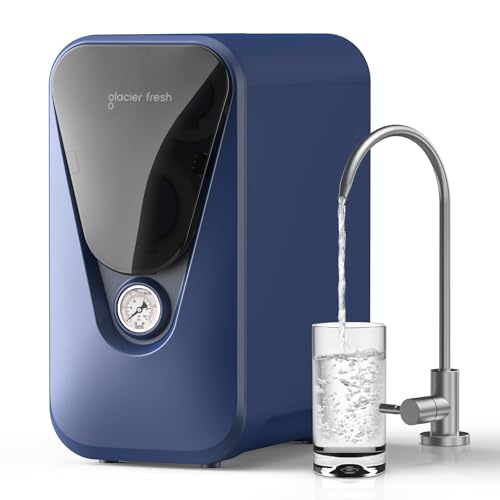
Electric-Free Choice – GLACIER FRESH GFU03
The GLACIER FRESH GFU03 stands out among tankless under sink water filters because it uses a water-powered design rather than electricity. It combines five-stage reverse-osmosis filtration with an 800 GPD rated capacity and a 3:1 pure-to-drain ratio.
Best For: Kitchens without a convenient under-sink outlet and households prioritizing low electrical use and water efficiency.
Pros:
- No electric drive and zero operating noise.
- 800 GPD rated flow, with an eight-second cup-fill claim under stated conditions.
- Five-stage filtration designed to reduce PFAS, lead, fluoride, chlorine, and other contaminants.
- 3:1 pure-to-drain ratio and pull-out filter replacement.
Cons:
- Performance depends on inlet pressure; at least 40 PSI is recommended for the stated flow.
- Faucet installation requires drilling a 1/2- to 1-inch sink hole.
- The 13.58-by-8.27-by-16.54-inch housing needs careful cabinet-space measurement.
This is an appealing option when avoiding electricity is a priority, but verify water pressure and cabinet clearance before buying. Its higher rated output and efficient drain ratio are particularly useful for larger households.
Zero-Waste UF Option – Waterdrop TSU
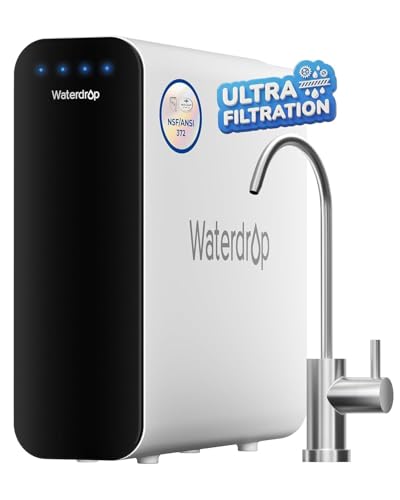
The Waterdrop TSU is a practical alternative to RO-based tankless under sink water filters. Its three-stage, 0.01-micron ultrafiltration system reduces chlorine, PFAS, taste, odor, and heavy metals while retaining essential minerals and producing no wastewater.
Best For: Municipal-water users who want compact, no-power filtration without lowering TDS.
Pros:
- Produces no wastewater and requires no electricity.
- 0.01-micron ultrafiltration reduces 30-plus substances while retaining minerals.
- Up to 1.05 GPM flow with a smart filter-life reminder panel.
- Slim housing fits cabinets with limited space, including kitchens with large disposals.
Cons:
- Does not reduce TDS, so it is not a substitute for reverse osmosis when TDS reduction is needed.
- Requires countertop or sink drilling for the separate faucet.
- Designed for municipal cold water, not hot water or well water.
Consider the TSU when mineral retention, simple maintenance, and zero wastewater are more important than RO-level TDS reduction. Its compact dimensions and long UF filter life make it well suited to smaller kitchens.
Premium Self-Cleaning Pick – Philips AUT9360
The Philips AUT9360 combines tankless reverse osmosis with self-flushing and a compact housing, making it a polished option among tankless under sink water filters. Its 600 GPD system reduces TDS and lead, supplies an approximately eight-second 8-ounce fill, and uses a 2.3:1 pure-to-drain ratio.
Best For: Buyers who want compact RO filtration, automated membrane flushing, and a longer system warranty.
Pros:
- 600 GPD rated capacity and on-demand purified water.
- Aquaporin Inside RO membrane technology filters down to 0.0001 micron and reduces TDS, chlorine, odors, and particulates.
- 2.3:1 pure-to-drain ratio with approximately 70% water recovery under stated conditions.
- Auto-cycle self-flushing, tool-free filter replacement, and a two-year limited system warranty.
Cons:
- Requires an under-sink power outlet.
- Faucet installation may require drilling, and a 3/8-inch connection may need an adapter.
- Replacement filters are covered separately from the system warranty.
The AUT9360 is a good fit for shoppers who value convenience features as much as filtration performance. Confirm outlet access, faucet-hole requirements, and connection sizing before installation.
Best for Easy Setup – Waterdrop G5P500A Alkaline Tankless RO
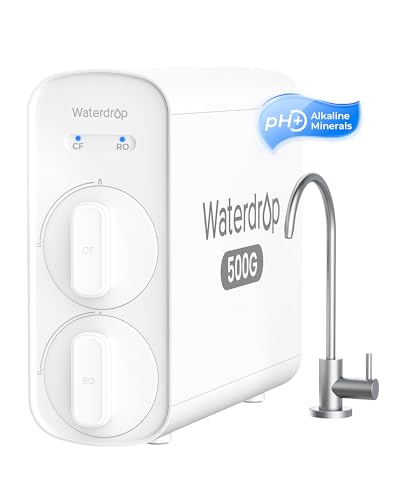
For shoppers comparing tankless under sink water filters, the Waterdrop G5P500A stands out with 8-stage reverse osmosis filtration, alkaline mineralization, and a 500 GPD capacity. Its slim, electric-powered design is intended to provide fast access to purified water while freeing under-sink space.
Best For: Busy households that want high flow, alkaline mineralization, and connections for appliances such as ice makers or refrigerators.
Pros:
- 8-stage filtration with a 0.0001 μm RO membrane helps reduce contaminants including lead, fluoride, PFAS, chlorine, and heavy metals.
- Alkaline mineralization adds calcium, magnesium, sodium, and potassium ions.
- 500 GPD capacity fills a 6-ounce cup in about 8 seconds.
- 2:1 pure-to-drain ratio helps limit wastewater compared with conventional RO systems.
Cons:
- Requires a corded electrical connection under the sink.
- Faucet installation requires drilling a countertop hole.
- Its 21.4-pound system may require careful space planning despite the tankless design.
The G5P500A is a feature-rich choice when speed, capacity, and mineral-enhanced water matter most. Confirm the available outlet, countertop space, and water conditions before installation.
Best Water-Saving Warranty Pick – Philips 400G Aquaporin Tankless RO
The Philips 400G is a practical option among tankless under sink water filters for buyers prioritizing water efficiency and longer warranty coverage. Its five-stage RO system uses Aquaporin Inside technology, delivers 400 GPD flow, and includes a two-year manufacturer warranty.
Best For: Households seeking a water-saving RO system with a two-year warranty and low-cost replacement filter options.
Pros:
- 2.3:1 pure-to-drain ratio produces 2.3 cups of filtered water per cup sent to drain.
- 400 GPD flow fills an 8-ounce cup in about 11 seconds.
- 0.0001-micron RO filtration helps reduce TDS, chlorine, particulates, taste and odor, lead, and chromium III.
- Two-year manufacturer warranty and a stated two-year filter life provide extended coverage.
Cons:
- Requires an electrical outlet under the sink for continuous powered flow.
- Drilling is required if there is no existing hole for the RO faucet.
- The included drain saddle is designed for standard drain pipes, and nonstandard connections may need an adapter.
Philips combines efficient water use with safety and electrical compliance testing, making this a strong fit for buyers who want a compact powered RO system with clear installation requirements and longer warranty protection.
Best Easy-Change Value Pick – Waterdrop G2 400 GPD Tankless RO
The Waterdrop G2 is a straightforward choice for shoppers comparing tankless under sink water filters. It combines seven-stage RO filtration, 400 GPD capacity, a 1:1 pure-to-drain ratio, and a compact tankless build designed to save more than 70% of under-sink storage space.
Best For: DIY-minded households that want quick filter changes, balanced water use, and a relatively fast under-sink installation.
Pros:
- 400 GPD flow delivers a cup of filtered water in about 12 seconds.
- 1:1 pure-to-drain ratio helps reduce water waste compared with ordinary RO systems.
- Twist-and-pull filters can be replaced in about three seconds, according to the supplied product notes.
- Integrated electrical and water circuits are designed to reduce leakage, while the airtight housing helps reduce noise.
Cons:
- Requires under-sink electricity and countertop drilling for the faucet.
- Maximum supported feed-water TDS is listed as 300 ppm.
- Includes a one-year manufacturer and seller combination warranty.
The G2 keeps the feature set focused on efficient filtration, compact storage, and simple maintenance. It is especially appealing if fast filter replacement and a 1:1 drain ratio matter more than alkaline remineralization.
Best Alkaline Remineralizing Pick – Frizzlife PD600 Tankless RO
For shoppers comparing tankless under sink water filters, the Frizzlife PD600 stands out for combining reverse osmosis with alkaline remineralization. Its 600 GPD output, tank-free design, and 2:1 pure-to-drain ratio make it practical for households that want fast, mineral-enhanced water without a storage tank.
Best For: Families seeking high-capacity RO water with alkaline remineralization and real-time TDS and filter-life monitoring.
Pros:
- Alkaline filter adjusts pH to more than 7.5 and restores minerals.
- 600 GPD capacity can fill a 330 ml cup in about 10 seconds.
- 2:1 pure-to-drain ratio helps reduce wastewater compared with conventional RO systems.
- Smart display tracks TDS and remaining filter life.
Cons:
- Requires an electrical connection.
- At 14.7 by 5.3 by 15.5 inches, it still requires careful cabinet-space planning.
The PD600 is a strong choice when alkaline output and high flow matter as much as contaminant reduction. Its compact tankless format and filter reminders add convenience for regular household use.
Best Certified High-Capacity Pick – Waterdrop G3P600 Tankless RO
The Waterdrop G3P600 is a well-equipped option among tankless under sink water filters, pairing 8-stage filtration with 600 GPD capacity. Its listed NSF/ANSI certifications, smart display faucet, and tool-free filter changes suit buyers who prioritize monitoring and straightforward maintenance.
Best For: Users who want certified TDS, chlorine, and lead-free-material performance with high output and convenient filter tracking.
Pros:
- Certified against NSF/ANSI 58, 42, and 372 for specified performance and materials.
- 8-stage filtration is designed to reduce TDS, PFAS, fluoride, arsenic, chlorine, and other listed substances.
- 600 GPD output fills an 8-ounce cup in about 8 seconds.
- Smart faucet displays TDS and filter life, while filters can be changed without tools.
Cons:
- Requires under-sink electricity.
- Its 18.12-inch length and 17.72-inch height may be challenging in smaller cabinets.
The G3P600 is a practical pick for households that value documented certifications and quick maintenance. Measure the cabinet before buying, since its footprint is larger than some compact tankless systems.
Best Dual-Water-Flow Pick – Waterdrop WD-T4-A Alkaline RO
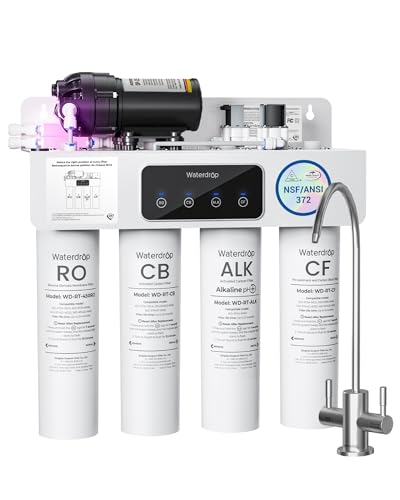
The Waterdrop WD-T4-A adds flexibility to the tankless under sink water filters category with separate standard RO and alkaline-mineralized water flows. Its 10-stage filtration, 450 GPD capacity, and filter alerts make it suited to buyers who want to switch water types while keeping the system compact.
Best For: Households that want both standard RO water and a mineral-enhanced alkaline option from one under-sink system.
Pros:
- Dual flow lets users choose between standard RO and alkaline-mineralized water.
- 10-stage filtration is designed to reduce PFOA, PFOS, chlorine, heavy metals, rust, and other impurities.
- 450 GPD output and a 2:1 pure-to-drain ratio support fast, efficient dispensing.
- LED indicators and buzzer alerts help track filter replacement timing.
Cons:
- Requires a plug-in electrical connection.
- Faucet installation requires drilling a countertop hole.
- Filter replacement intervals vary from six to 24 months depending on the component.
The WD-T4-A is a flexible choice for households with differing preferences about mineral content. Its dual-flow setup is the main differentiator, though installation and electrical requirements should be considered first.
How We Picked the Best Tankless Under Sink Water Filters
We focused on systems that combine useful filtration performance with a genuinely compact, tank-free design. The selected models include reverse osmosis systems for broad contaminant reduction and ultrafiltration options for buyers who want strong filtration without removing as many naturally occurring minerals.
We compared advertised daily production rates, filtration stages, certification information, pure-to-drain ratios, filter-monitoring features, mineral or alkaline stages, and installation considerations. Certification language matters: NSF/ANSI standards can apply to specific materials, components, or contaminant claims, so buyers should verify the manufacturer’s documentation for the exact model.
Quick Comparison
| Type | Best For | What to Check |
|---|---|---|
| Tankless reverse osmosis | Broad contaminant reduction and very clean-tasting water | Wastewater ratio, remineralization, power, and installation |
| Tankless ultrafiltration | Improved taste and particle filtration while retaining minerals | Membrane rating, compatible contaminants, and water pressure |
| Alkaline or remineralizing RO | Users who prefer added minerals and a less flat taste | Replacement cartridge cost and actual mineral claims |
| Electric-free RO | Areas or kitchens where power access is inconvenient | Required pressure, flow rate, drain setup, and operating limits |
Key Buying Factors for Tankless Under-Sink Water Filters
Filtration Method
Reverse osmosis is generally the most comprehensive option for dissolved solids and many common contaminants, but it produces wastewater and usually requires electricity. Ultrafiltration can be more water-efficient and preserve minerals, though it does not provide the same type of dissolved-contaminant reduction.
Capacity and Real-World Flow
Manufacturers often list production in gallons per day, but household performance also depends on incoming water pressure, temperature, and water quality. A higher rating can reduce waiting time, but it does not necessarily mean the faucet will deliver that rate continuously.
Water Efficiency
Compare the pure-to-drain ratio rather than looking only at filtration stages. A system with a more favorable ratio can reduce water waste over time. Electric-free models may require different pressure conditions, so check their specifications before installation.
Size, Power, and Installation
Measure the cabinet carefully, including room for tubing, a drain connection, filter changes, and an electrical adapter if required. Tankless units are smaller than tank-based RO systems, but they still need a dedicated faucet or compatible connection in many installations.
Maintenance and Certifications
Replacement filters, reset indicators, leak detection, and smart displays can make ownership easier. Confirm the expected filter life and annual replacement cost. Treat certification claims precisely and look for documentation covering the contaminants you specifically want to reduce.
Who Should Buy Which Tankless Under Sink Water Filters?
Choose a high-capacity tankless RO system if your household uses substantial amounts of drinking and cooking water or you want faster dispensing. Choose an alkaline or remineralizing model if you prefer a fuller taste after RO filtration. Choose ultrafiltration if retaining minerals and minimizing wastewater are higher priorities than maximum dissolved-solids reduction. Choose an electric-free system when avoiding an outlet is important, provided your home has adequate water pressure.
For most shoppers, the best choice is the system that matches the target contaminants, cabinet space, water pressure, daily demand, and ongoing filter budget—not simply the model with the most stages.