Large aquariums need more than a single thermostat. The right controller can stabilize temperature, manage evaporation, improve circulation, and simplify daily maintenance across freshwater or saltwater systems.
This roundup covers temperature controllers, auto top-off systems, pump and lighting controls, display monitors, and air pumps to help you build a safer, more consistent tank-management setup.
Best 10 Aquarium Controllers for Large Tanks Picks for 2026
Best Dual-Stage Temperature Control

- Controls heating and cooling together
- Temperature and sensor-failure alarms
- Supports freshwater and saltwater use
Best For: Large tanks needing automatic heating and cooling control
Best Flow-Management Controller
hygger HG330 1189GPH Water Pump

- 1,189 GPH flow and 13.8-foot lift
- 20 speeds with three smart modes
- Run-dry and blockage protection
Best For: Large aquariums and sumps needing adjustable circulation
Best WiFi Heater Controller

- Two probes for added temperature checking
- App alerts for probe differences
- Dual-relay overheating protection
Best For: Large heated tanks needing remote notifications
Best Simple Adjustable Thermostat
WILLHI WH2408 Temperature Controller

- Simple knob-based temperature adjustment
- Heating and cooling modes
- Rated for up to 1,200 watts
Best For: Large tanks needing uncomplicated thermostat control
Best Alarm-Ready ATO
Smart Automatic Top-Off System

- Integrated sensor, pump, and controller
- Alerts for refill and equipment faults
- 12V operation with pause function
Best For: Saltwater aquariums and sumps needing automated evaporation control
Best Temperature Controller
Inkbird ITC-308S Aquarium Thermostat
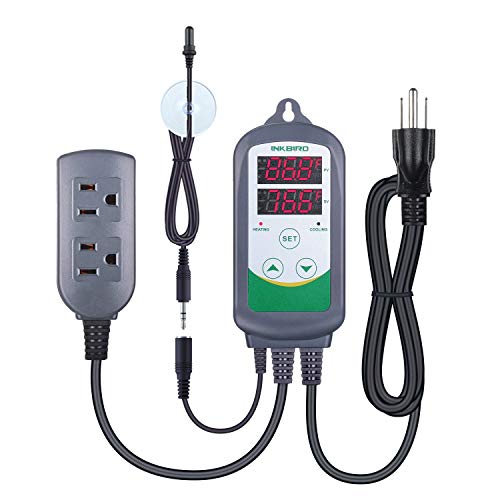
- Controls heating and cooling equipment
- Fully submersible aquarium probe
- Temperature and fault alarms
Best For: Large aquariums needing coordinated heater and cooling control
Best Compact Optical ATO
FZONE QST2.0 Auto Top-Off Controller

- Dual optical sensors for water-level monitoring
- Overfill protection with alarm
- Includes pump, tubing, magnets, and check valve
Best For: Freshwater or saltwater tanks with moderate wave movement
Environmental Insight

- Monitors ambient temperature
- Tracks humidity, CO2, and VOCs
- Designed for Neptune Apex setups
Best For: Neptune Apex users monitoring aquarium-room conditions
Lighting Control
Hygger Multi-Channel LED Light
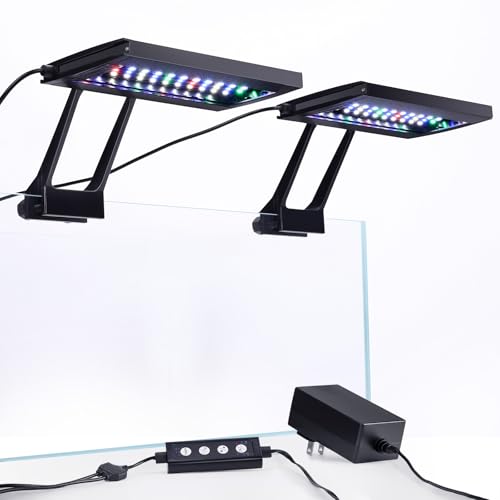
- Schedules sunrise, daylight, and moonlight
- Controls two or three lights together
- Includes adjustable color and brightness modes
Best For: Freshwater tanks needing coordinated lighting control
High-Capacity Aeration

- Supports tanks up to 600 gallons
- Provides nine airflow speeds
- Includes four outlets and aeration accessories
Best For: Large tanks and ponds needing adjustable aeration
Best Dual-Stage Temperature Control – Inkbird ITC-308S
For large tanks needing straightforward temperature management, the Inkbird ITC-308S is one of the more flexible aquarium controllers for large tanks. It can operate heating and cooling equipment simultaneously, displays both measured and set temperatures, and supports freshwater, saltwater, coral, shrimp, and tropical fish setups.
Best For: Large aquariums that need automatic heater and cooling-device control.
Pros:
- Controls heating and cooling devices at the same time.
- Includes high- and low-temperature alarms plus a sensor-failure alarm.
- Offers simultaneous measured/set temperature displays in Celsius or Fahrenheit.
- Supports loads up to 1,200 watts at 110 volts.
Cons:
- It is a temperature controller rather than a broader aquarium monitoring system.
- The listed maximum load is 1,200 watts, so higher-powered equipment may not be suitable.
The ITC-308S is a practical choice when reliable dual-stage temperature control matters more than app connectivity or multi-parameter monitoring. Its corrosion-protection design also makes it suitable for saltwater environments.
Best Flow-Management Controller – hygger HG330 1189GPH Water Pump
The hygger HG330 approaches aquarium controllers for large tanks from the circulation side. Its external LCD controller provides 20 speed levels and three operating modes, while the 1,189-GPH pump and 13.8-foot maximum lift suit large aquariums, sumps, ponds, and other water-circulation systems.
Best For: Large tanks and sump systems needing adjustable, high-lift water circulation.
Pros:
- Delivers up to 1,189 GPH with a 13.8-foot maximum lift.
- Provides 20 flow-speed settings and standard, wave, and feeding modes.
- Includes run-dry and blockage protection with automatic shutoff.
- Offers side or bottom suction and three outlet nozzle sizes.
Cons:
- This is a pump controller, not a temperature or water-parameter controller.
- Its 40-watt circulation capacity may not fit every high-flow installation.
Choose the HG330 when flow control is the main priority. Quiet operation, a ceramic shaft, flexible intake options, and a two-year manufacturer warranty add useful practicality for larger circulation setups.
Best WiFi Heater Controller – Inkbird ITC-306A
The Inkbird ITC-306A is a heater-focused option among aquarium controllers for large tanks. It uses two probes for added temperature checking, can send app notifications when probe readings differ significantly, and supports customized heating periods for compatible heaters up to 1,200 watts.
Best For: Large heated aquariums where remote alerts and probe redundancy are useful.
Pros:
- Two probes can identify temperature differences greater than 3°C or 5°F.
- App notifications provide alerts when the probe readings differ.
- Dual relays help shut off the connected heater if overheating is detected.
- Offers adjustable heating times from one to 72 hours.
Cons:
- It is designed only for heaters and does not control cooling equipment.
- The supplied notes do not specify the WiFi network or app setup requirements.
The ITC-306A is a strong fit for aquarists who want heater control with additional probe monitoring and phone alerts. Its temperature-setting range is 20–35°C, so confirm that range suits your livestock and operating plan.
Best Simple Adjustable Thermostat – WILLHI WH2408 Temperature Controller
The WILLHI WH2408 is a simple, knob-operated thermostat for aquarists comparing aquarium controllers for large tanks. It supports heating or cooling, offers 0.1°F control resolution, and is rated for equipment up to 1,200 watts at 120 volts, though the controller itself must be kept dry.
Best For: Large aquarium setups that prefer simple manual temperature adjustments.
Pros:
- Uses two knobs for straightforward on/off temperature settings.
- Supports both heating and cooling modes with Fahrenheit or Celsius display.
- Provides a broad probe range of -58°F to 230°F.
- Includes a resettable fuse, ETL-certified power cord, and power-outage setting memory.
Cons:
- The controller housing is not waterproof and must be kept dry.
- The included probe is not recommended for extended saltwater use.
- It is explicitly a control device, not a safety device; connected equipment needs its own protection.
The WH2408 suits users who want accessible controls instead of complicated menus. For saltwater tanks, plan on using a suitable replacement probe, and install independent thermal and overload protection as directed.
Best Alarm-Ready ATO – Smart Automatic Top-Off System
For aquarists comparing aquarium controllers for large tanks, this automatic top-off system focuses on maintaining water levels with an integrated pump, sensor, and controller. Its alarm system flags issues such as an empty reservoir, leaks, a stuck float, timeout, pump disconnection, or a short circuit.
Best For: Saltwater aquariums and sumps where straightforward automatic evaporation control and fault alerts are priorities.
Pros:
- Includes the sensor, submersible pump, and controller in one kit.
- Alarm notifications help identify several refill and equipment problems.
- 12V operation and a pause button add practical day-to-day convenience.
- Fits aquarium walls up to 5/8 inch thick and resists interference from duckweed and water plants.
Cons:
- Requires correct siphon-breaking-joint placement during installation.
- Designed for top-off control rather than temperature or broader equipment automation.
This is a practical controller for large-tank setups that need stable water levels without multiple floats. Confirm the tank or sump wall thickness and reservoir layout before buying.
Best Temperature Controller – Inkbird ITC-308S Aquarium Thermostat
Among aquarium controllers for large tanks, the Inkbird ITC-308S is designed for temperature management rather than water-level control. It provides separate heating and cooling outlets, a fully submersible probe, and simultaneous displays for measured and set temperatures.
Best For: Aquariums that need one controller to manage a heater and cooling fans or other compatible cooling equipment.
Pros:
- Controls both heating and cooling with on/off operation.
- Fully submersible probe is suited to aquarium water.
- Displays current and set temperatures at the same time.
- Includes temperature calibration plus over-temperature and sensor-fault alarms.
Cons:
- Maximum output load is 1200W at 110V, so connected equipment must stay within that limit.
- It does not provide automatic top-off or water-level monitoring.
The ITC-308S is a focused choice for large aquariums where temperature stability is the main concern. It is especially useful when both heating and cooling need to be coordinated through one unit.
Best Compact Optical ATO – FZONE QST2.0 Auto Top-Off Controller
For shoppers seeking aquarium controllers for large tanks, the FZONE QST2.0 offers automated water-level maintenance in a compact package. Its optical dual-sensor design, overfill protection, included check valve, and 74 GPH micro pump support routine top-off for freshwater and saltwater systems.
Best For: Rimmed, rimless, or sump tanks with modest wave movement and a reservoir that can accommodate the included pump and tubing.
Pros:
- Dual optical sensors monitor water levels with a stated 0.6 cm difference.
- Stops the pump and sounds an alarm if refilling exceeds three times the preset limit.
- Includes magnets for walls up to 0.78 inch thick, a check valve, and 6-foot tubing.
- Offers a 74 GPH flow rate and up to 2 meters of lift.
Cons:
- Recommended for wave fluctuations under 1 cm.
- The compact pump requires a reservoir neck larger than 1.97 inches.
- Supplied notes list both a two-year warranty offer and a one-year manufacturer-warranty detail, so coverage should be confirmed before purchase.
The QST2.0 is a convenient option when precise optical sensing and easy installation matter. Check wave conditions, reservoir opening, tank-wall thickness, and warranty terms to ensure it matches the setup.
Environmental Insight – AvidAqua Insight Pro Display
For aquarium controllers for large tanks, the AvidAqua Insight Pro is a monitoring-focused display designed for Neptune Apex setups. It tracks surrounding temperature, humidity, CO2, and VOC levels, giving you additional environmental information around the aquarium.
Best For: Neptune Apex users who want room-environment monitoring alongside their aquarium system.
Pros:
- Monitors ambient room temperature.
- Tracks humidity and detects CO2 levels.
- Measures volatile organic compounds.
Cons:
- Designed as a display for Neptune Apex rather than a complete standalone aquarium controller.
- The supplied details do not list automated dosing, lighting, or pump-control functions.
This is a specialized environmental-monitoring accessory, not an all-in-one control hub. It makes the most sense when you already use a Neptune Apex and want broader visibility into the room surrounding a large aquarium.
Lighting Control – Hygger Multi-Channel LED Light
Among aquarium controllers for large tanks, this Hygger system combines multi-channel lighting control with two clip-on LED lights. Its controller can synchronize two or three lights, schedule lighting periods, and adjust brightness and color for freshwater setups.
Best For: Medium to large freshwater aquariums, irregular-shaped tanks, or multiple smaller tanks needing coordinated lighting.
Pros:
- Offers 24/7 sunrise, daylight, and moonlight scheduling.
- Supports DIY time, brightness, and color adjustments.
- Synchronizes two or three lights through one controller.
- Includes clip-on brackets for tank walls under 0.9 inches thick.
Cons:
- The listed 24W configuration is specified for 20- to 30-gallon tanks, so it may not independently cover a very large aquarium.
- It is a lighting controller, not a full aquarium monitoring and automation system.
- Limited to freshwater applications according to the supplied product details.
This is a practical choice when coordinated lighting is the priority. For a genuinely large tank, confirm the coverage requirements and plan on using multiple lights, which the synchronized controller is designed to manage.
High-Capacity Aeration – AQQA 10W Aquarium Air Pump
For aquarium controllers for large tanks, the AQQA 10W air pump focuses on adjustable aeration rather than water-quality monitoring. It delivers airflow up to 237 GPH, includes a nine-speed external controller, and is rated for tanks up to 600 gallons.
Best For: Large aquariums, ponds, hydroponic systems, and other setups needing controllable, high-output aeration.
Pros:
- Provides airflow up to 237 GPH for tanks up to 600 gallons.
- Offers nine airflow speeds through an external controller.
- Includes a 15-minute feeding pause.
- Comes with tubing, a four-outlet manifold, check valves, and air stones.
Cons:
- It controls aeration only and does not monitor temperature, pH, or other water parameters.
- Requires a corded-electric power source.
- The supplied listing describes a 10W model, while some specifications also reference a 15W version; verify the selected configuration.
This pump is best viewed as a high-capacity aeration component rather than a complete aquarium controller. Its adjustable output, multiple outlets, and included accessories make it a strong fit for large systems where oxygenation is the immediate priority.
How We Picked the Best Aquarium Controllers for Large Tanks
We selected products based on the job they perform, the amount of control they provide, compatibility with common aquarium equipment, and how useful they are in larger or more demanding tanks. The list includes dedicated temperature controllers, automatic top-off systems, circulation and air-pump controls, lighting controllers, and monitoring displays rather than treating every device as interchangeable.
For larger aquariums, we prioritized practical specifications such as outlet capacity, probe design, control precision, pump flow, reservoir compatibility, display visibility, and the ability to separate heating, cooling, lighting, or water-level functions. Always verify electrical ratings and aquarium-safe installation requirements before connecting equipment.
Quick Comparison
| Controller type | Best for | Key consideration |
|---|---|---|
| Dual-stage temperature controller | Heating and cooling together | Confirm load ratings and probe placement |
| Wi-Fi thermostat | Remote temperature monitoring | Requires dependable network access |
| Auto top-off controller | Replacing evaporated water | Use a suitable reservoir and backup protection |
| Pump controller | Circulation or return flow | Match flow and head height to the system |
| Lighting controller | Automated photoperiods | Check light and channel compatibility |
| Display monitor | At-a-glance system status | May require a compatible aquarium platform |
Key Buying Factors for Aquarium Controllers for Large Tanks
Capacity and Electrical Safety
Check the controller’s maximum wattage and amperage against the connected heater, chiller, fan, pump, or lighting equipment. A large tank may require multiple devices or a dedicated, properly protected circuit rather than one overloaded controller.
Control Function and Accuracy
Choose a dual-stage temperature unit if you need both heating and cooling. A heater-only thermostat may be simpler for stable indoor conditions. For evaporation control, look for dependable sensors, adjustable delays, and safeguards against stuck pumps or an empty reservoir.
Monitoring and Installation
Wi-Fi access, visible displays, alarms, and multiple probes can make maintenance easier, but they also add setup requirements. Position temperature probes in representative water flow, keep sensors clean, and test fail-safes before relying on automation.
Compatibility and Maintenance
Confirm connector types, pump sizing, saltwater suitability, lighting protocols, and mounting options. Controllers should supplement—not replace—regular checks of temperature, salinity, water level, and equipment condition.
Who Should Buy Which Aquarium Controllers for Large Tanks?
Choose a dual-stage temperature controller for tanks exposed to seasonal temperature changes or paired heating and cooling equipment. A Wi-Fi thermostat suits owners who want remote alerts or temperature checks. Select an ATO system for reef tanks and other setups where evaporation quickly changes water level or salinity.
Use a pump controller when circulation, return flow, or water movement needs adjustment. A lighting controller is best for consistent sunrise, daylight, moonlight, or custom schedules. Choose a display monitor if you already use a compatible aquarium control platform and want clearer status information. For demanding systems, combining specialized controllers with independent alarms and routine manual checks is generally safer than depending on one device for every function.