Stable water conditions are essential in a saltwater aquarium, but evaporation, temperature swings, algae, and inconsistent circulation can quickly create problems. The right controller or supporting device can automate routine maintenance and help protect sensitive livestock.
This roundup covers 10 options across temperature control, automatic top-off, water movement, UV filtration, and algae management. Use the guide below to match features, compatibility, and safety controls to your tank and maintenance routine.
Best 10 Aquarium Controllers for Saltwater Tanks Picks for 2026
Precise Water-Level Control

- Dual optical sensors for accurate top-off
- Overfill and sensor-fault protection
- Includes pump, tubing, and check valve
Best For: Saltwater reef and sump tanks
Marine Algae Management
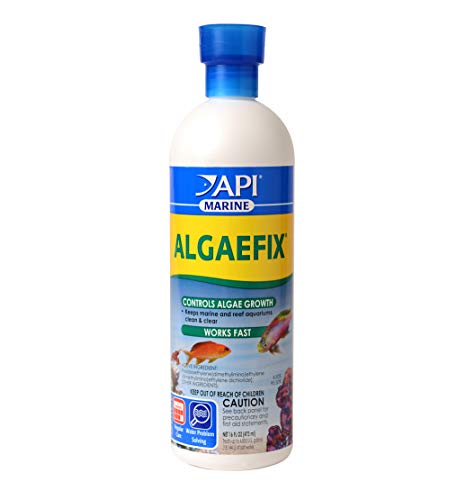
- Targets multiple listed marine algae types
- Designed for marine and reef aquariums
- 16-ounce liquid bottle for repeated dosing
Best For: Saltwater algae-control maintenance
Dual-Stage Temperature Control

- Controls heating and cooling together
- Displays measured and set temperatures
- Includes multiple temperature alarms
Best For: Saltwater tanks needing thermal stability
Compact Dual-Sensor Top-Off

- Dual optical sensors automate refilling
- Compact 0.7-inch sensor design
- Complete 74 GPH pump kit included
Best For: Compact reef and saltwater top-off setups
Best Temperature Safety Pick
Inkbird ITC-306A WiFi Aquarium Thermostat

- Dual relays help protect against heater overheating
- Two probes provide temperature comparison and alerts
- WiFi app notifications and 1–72-hour heating timer
Best For: Heater-focused temperature monitoring and control
Best Green Water Control
AquaMiracle SV-1000 UV Aquarium Filter
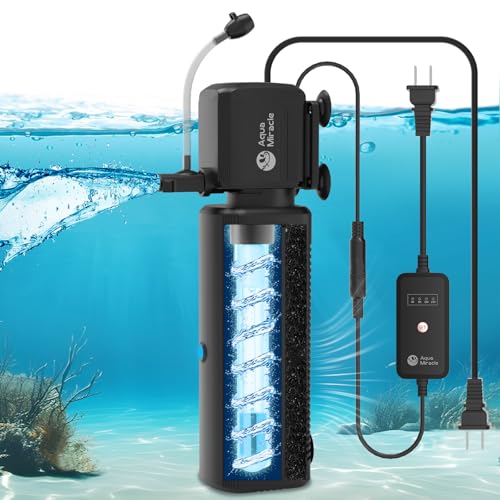
- 8W UV light with 4–24-hour timer options
- Includes sponge filtration for aquarium debris
- Offers aeration and rainfall circulation modes
Best For: 60–150 gallon tanks needing UV and circulation support
Best Flow Control
hygger 1500GPH Aquarium Wave Maker

- Five programmable wave and circulation modes
- 30–100% flow and 5–100% frequency adjustment
- 12V DC design with feeding and night modes
Best For: 20–100 gallon saltwater and coral reef tanks
Best Value Heater

- 200W heater for 20-40 gallon tanks
- Automatic out-of-water shutoff
- Digital display with adjustable temperature control
Best For: Saltwater tanks needing straightforward heating control
Best Programmable Controller
Inkbird ITC-306T Aquarium Heater Controller

- Day and night temperature scheduling
- Probe, calibration, and alarm functions
- Controls up to 1200W at 110V
Best For: Reef tanks needing scheduled heating and safety alarms
Best Algae Control Add-On

- Targets green water, hair, and string algae
- Suitable for marine and reef aquariums
- Repeatable treatment and maintenance schedule
Best For: Saltwater tanks needing targeted algae control
Precise Water-Level Control – FZONE QST2.0 ATO
For aquarium controllers for saltwater tanks, the FZONE QST2.0 focuses on one essential task: keeping evaporation from lowering the water level. Its dual optical sensors, overfill protection, and included pump make it a practical choice for reef, sump, and other compatible setups.
Best For: Saltwater aquariums, reef tanks, and sump systems needing automatic daily top-off.
Pros:
- Dual optical sensors monitor water levels with a compact 0.79-inch design.
- Overfill protection can stop the pump and trigger an alarm.
- Includes a 74 GPH pump, check valve, tubing, and mounting magnets.
- Offers a 2-meter maximum lifting height and 24/7 customer support.
Cons:
- Recommended for tanks with wave fluctuations under 1 cm.
- The pump requires a reservoir opening with a neck larger than 1.97 inches.
The FZONE is a focused ATO rather than an all-in-one aquarium monitor, but its sensor safeguards and complete accessory kit make it a strong option when stable salinity and water level are the priority.
Marine Algae Management – API MARINE ALGAEFIX
Although not a tank controller, API MARINE ALGAEFIX can complement aquarium controllers for saltwater tanks by addressing algae growth directly. The liquid treatment is designed for marine and reef aquariums and is dosed every three days until growth is controlled, followed by weekly dosing.
Best For: Marine and reef aquariums dealing with green, red slime, or brown algae.
Pros:
- Controls several listed saltwater algae types, including green, red slime, and brown algae.
- Supplied notes state it can be used with live corals, fish, and many listed invertebrates.
- The 16-ounce bottle supports repeated treatment and maintenance dosing.
Cons:
- It is an algae-control treatment, not a monitoring or automation controller.
- Dosing must be repeated every three days initially and then weekly.
Choose ALGAEFIX as a targeted water-care product rather than a substitute for temperature, top-off, or other aquarium controllers. It may be useful when algae control is the specific maintenance problem.
Dual-Stage Temperature Control – Inkbird ITC-308S
The Inkbird ITC-308S adds temperature automation to a saltwater setup, making it one of the more relevant aquarium controllers for saltwater tanks when heating and cooling stability matter. It can control a heater and cooling device simultaneously, while showing both measured and set temperatures.
Best For: Freshwater or saltwater aquariums requiring automated heating and cooling control.
Pros:
- Controls heating and cooling devices at the same time.
- Designed with corrosion protection for freshwater, seawater, coral, and shrimp aquariums.
- Dual LCD display shows current and set temperatures in Celsius or Fahrenheit.
- Includes high- and low-temperature alarms plus a sensor-failure alarm.
Cons:
- It is a temperature controller, not an automatic top-off or full aquarium management system.
- Maximum output load is limited to 1,200 watts at 110 volts.
For aquarists primarily concerned with thermal stability, the ITC-308S provides straightforward dual-stage control and useful alarms. Confirm connected equipment stays within its stated load limits.
Compact Dual-Sensor Top-Off – MagTool ATO
The MagTool ATO handles evaporation-related water-level changes, a useful function alongside other aquarium controllers for saltwater tanks. Its dual optical sensors, intelligent fill-time safety program, and complete 12V pump kit are intended to simplify daily top-off for reef and open-top aquariums.
Best For: Reef, saltwater, freshwater, and planted tanks needing compact automatic top-off.
Pros:
- Dual optical sensors detect low and correct water levels.
- Compact 0.7-inch sensor helps minimize visual clutter.
- Includes a 74 GPH pump, power adapter, check valve, tubing, bracket, and controller.
- Pump provides an 8.2-foot maximum head height.
Cons:
- It controls water level only and does not provide temperature or broader aquarium monitoring.
- The supplied warranty is one year.
MagTool is a practical choice for reducing manual top-off work, especially in open-top tanks or when you are away briefly. Its compact sensor and included components keep installation relatively simple.
Best Temperature Safety Pick – Inkbird ITC-306A WiFi Aquarium Thermostat
For saltwater tank owners who want focused temperature oversight, the Inkbird ITC-306A is a practical addition to a setup of aquarium controllers for saltwater tanks. It controls a compatible heater, uses two probes for comparison, and can send app notifications when readings differ significantly.
Best For: Aquarists seeking WiFi-enabled heater control with dual-probe monitoring and overheating protection.
Pros:
- Two relays help shut off the connected heater if overheating is detected.
- Dual probes can trigger an alarm and phone notification when temperatures differ by more than 3°C or 5°F.
- Supports customizable heating times from 1 to 72 hours.
- Plug-and-play design works with most heaters up to the stated 120V, 1200W rating.
Cons:
- This is a heater controller rather than a complete multi-function aquarium controller.
- The product is designed only for heater control.
The ITC-306A makes sense when temperature stability is your main priority. Its dual-probe and relay protections add useful safeguards, but broader equipment automation will require other devices.
Best Green Water Control – AquaMiracle SV-1000 UV Aquarium Filter
The AquaMiracle SV-1000 combines UV treatment, mechanical filtration, and water movement for aquarists comparing aquarium controllers for saltwater tanks. It fits 60- to 150-gallon freshwater or saltwater aquariums and adds a timer for scheduling the UV light.
Best For: Larger aquariums needing green-water control, supplemental filtration, aeration, and circulation.
Pros:
- An 8W UV light targets green water and includes 4-, 8-, 12-, and 24-hour timer settings.
- The included sponge traps uneaten food, fish waste, and plant debris.
- Aerating and rainfall modes provide different approaches to oxygenation and circulation.
- Fits aquariums from 60 to 150 gallons and delivers up to 300 GPH flow.
Cons:
- The timer controls only the UV light, not the pump.
- It is a filtration and water-treatment device, not a general equipment controller.
This model is useful when cloudy green water and added circulation are the immediate concerns. Its timer is convenient, but buyers should not expect it to schedule the pump or manage other aquarium equipment.
Best Flow Control – hygger 1500GPH Aquarium Wave Maker
For reef keepers who need adjustable circulation, the hygger Wave Maker is a useful component among aquarium controllers for saltwater tanks. Its controller offers five flow modes, variable intensity and frequency, feeding and night settings, and a 12V DC power design for 20- to 100-gallon tanks.
Best For: Saltwater and coral reef aquariums needing customizable, quiet water movement.
Pros:
- Five modes include pulse, sine, constant, random, and cross-flow patterns.
- Flow adjusts from 30% to 100%, while frequency adjusts from 5% to 100%.
- Feeding, night, and linkage modes support flexible daily operation.
- Safety features address overcurrent, overheating, overvoltage, undervoltage, and motor blockage.
Cons:
- It controls water movement rather than temperature, lighting, or filtration.
- The stated 1500 GPH maximum flow may require careful positioning in smaller tanks.
The hygger is a strong fit when controllable flow is more important than all-in-one automation. Its broad adjustment range and coral-oriented circulation modes make it versatile, while the magnetic mount simplifies placement.
Best Value Heater – HiTauing 200W Aquarium Heater
If you need aquarium controllers for saltwater tanks but mainly want dependable temperature control, the HiTauing combines a 200W heater with a digital controller. It is designed for 20-40 gallon aquariums and supports freshwater or saltwater setups.
Best For: Saltwater and freshwater tanks requiring a submersible heater with automatic shutoff and an on-device temperature display.
Pros:
- Automatic shutoff activates when the heater head is out of water.
- Digital display shows current and set temperatures, with Fahrenheit/Celsius switching.
- Adjustable temperature range from 63-94°F and a protective ABS shell.
Cons:
- It is a heater controller rather than a complete aquarium management system.
- Its 200W capacity is intended for 20-40 gallon tanks, so larger aquariums need another solution.
This is a practical choice when temperature is your primary control priority. The built-in safety and display features are useful, though it does not provide broader monitoring or cooling functions.
Best Programmable Controller – Inkbird ITC-306T Aquarium Heater Controller
Among aquarium controllers for saltwater tanks, the Inkbird ITC-306T stands out for programmable heating schedules and alarm functions. It controls heating equipment rather than cooling and supports marine, reef, freshwater, and ornamental shrimp aquariums.
Best For: Reef and saltwater aquarists who want separate day and night temperature settings, probe-based monitoring, and a higher 1200W output limit.
Pros:
- Dual time cycles allow different daytime and nighttime temperatures.
- Supports Celsius or Fahrenheit and includes temperature calibration.
- Sensor-fault and over/under-temperature alarms can shut off outputs when readings are out of range.
- Supports a maximum output load of 1200W at 110V.
Cons:
- It provides heating control only and has no cooling function.
- The fixed over/under-temperature alarm setting is not adjustable.
The Inkbird is the more capable option for scheduled temperature management. Its alarm and calibration features add control for reef systems, but you will need separate equipment if cooling is also required.
Best Algae Control Add-On – MICROBE-LIFT Algaway 5.4
Not a temperature controller, MICROBE-LIFT Algaway 5.4 is a useful water-care add-on for aquarium controllers for saltwater tanks. This liquid treatment targets green water, hair algae, and string algae in marine and reef aquariums.
Best For: Saltwater and reef aquariums that need repeatable algae treatment while maintaining fish, corals, plants, and invertebrates.
Pros:
- Designed to control green water, hair algae, and string algae.
- Listed as safe for saltwater fish, corals, coralline algae, and many invertebrates.
- Does not affect protein skimmer function according to the supplied product details.
- Repeatable dosing schedule supports ongoing maintenance after initial treatment.
Cons:
- It is an algae remover, not an electronic aquarium controller.
- Heavy growth should be cleaned from tank surfaces and decorations before use.
- Freshwater use is not safe for snails, shrimp, clams, or other crustaceans.
Choose Algaway when algae is the problem you need to address rather than temperature or equipment automation. Its marine compatibility makes it relevant to saltwater maintenance, but it should complement—not replace—monitoring and filtration practices.
How We Picked These Aquarium Controllers for Saltwater Tanks
We selected products based on the aquarium problem they address, control precision, safety features, ease of setup, sensor design, and suitability for saltwater environments. Because “controller” can mean different things in aquarium equipment, this list includes dedicated temperature and top-off controllers alongside devices that manage flow, UV filtration, or algae. Always verify tank size, power requirements, and saltwater compatibility before purchase.
Quick Comparison
- Temperature control: Inkbird thermostats and aquarium heaters help maintain a stable target temperature.
- Automatic top-off: FZONE and MagTool systems replace evaporated water and reduce salinity swings.
- Water movement: The hygger wave maker supports adjustable circulation and surface agitation.
- Green-water and algae management: AquaMiracle UV filtration and algae-control treatments address specific nuisance-growth problems.
- Heating backup and safety: Models with dual probes, timed operation, or dry-run protection can add useful safeguards.
Key Buying Factors for Aquarium Controllers for Saltwater Tanks
Control Type and Tank Role
First identify what needs automation. A thermostat regulates temperature, an ATO manages evaporation, and a wave maker controls circulation. Algae treatments and UV filters are corrective tools rather than replacements for stable lighting, filtration, nutrient control, and regular maintenance.
Probe Accuracy and Placement
Temperature and optical sensors should be positioned where they receive representative water conditions and cannot be blocked by equipment or debris. For reef systems, use a controller with dependable readings and inspect probes regularly for salt buildup. A dual-probe design may provide additional monitoring, but it does not eliminate the need for routine checks.
Safety and Compatibility
Look for over-temperature protection, dry-run or low-water safeguards, adjustable limits, and dependable power connections. Confirm that the controller can handle the wattage of the heater or pump it will operate. A heater controller should be treated as a safety layer, not permission to leave an aquarium unchecked.
Maintenance and Dosing Considerations
ATO reservoirs must contain fresh, purified water rather than saltwater. Chemical algae removers should be dosed exactly as directed and used with attention to oxygen levels, filtration, livestock sensitivity, and the underlying cause of algae. UV units require clean sleeves, suitable flow, and periodic replacement of consumable parts.
Who Should Buy Which Aquarium Controllers for Saltwater Tanks?
Choose an ATO system if evaporation frequently changes salinity or you want to reduce daily manual topping off. Choose a temperature controller or controlled heater if room conditions fluctuate, your livestock is temperature-sensitive, or you want an extra layer of protection against heater failure. Choose a wave maker if detritus accumulates or circulation is uneven, especially in reef-style layouts.
Choose UV filtration for persistent green-water issues when mechanical filtration and maintenance have not solved the problem. Choose an algae-control treatment only when you can follow the label carefully and address lighting, nutrients, and water-quality causes at the same time. For many saltwater aquariums, the best setup combines stable temperature, reliable top-off, appropriate flow, and regular testing rather than relying on a single device.