The best dual-purpose marine batteries balance strong starting power with enough reserve capacity for trolling motors, electronics, lights, and accessories. The right choice depends on your boat’s battery compartment, electrical demands, charging setup, and budget.
Our selection includes sealed AGM and LiFePO4 options in common marine group sizes, so you can compare practical differences in capacity, cranking output, maintenance, weight, and expected service life before buying.
Best 10 Dual Purpose Marine Batteries Picks for 2026
Balanced AGM Power
OPTIMA D34M BLUETOP Dual Purpose Battery

- 750 CCA with 55 Ah C20 capacity
- Sealed, maintenance-free AGM construction
- Vibration-resistant design with dual terminals
Best For: Boat and RV owners needing dependable starting and moderate deep-cycle power
Long-Life AGM
Odyssey 34M-PC1500ST-M TROLLING Battery

- 850 CCA for strong engine starting
- Three- to ten-year stated service life
- Sealed, non-spillable, maintenance-free AGM design
Best For: Boaters seeking durable AGM power for starting and trolling applications
Lightweight Lithium Choice
LiTime 12V 100Ah Dual Purpose Battery

- 900 CCA with 100 Ah LiFePO4 capacity
- 22.71-pound Group 24 form factor
- Bluetooth monitoring, BMS protection, and self-heating
Best For: Weight-conscious boat owners with compatible outboard and charging systems
Higher-Capacity AGM
OPTIMA D27M BLUETOP Dual Purpose Battery

- 800 CCA and 66 Ah C20 capacity
- 140-minute reserve capacity
- Sealed AGM design with dual terminal options
Best For: Larger boat and RV setups needing added reserve capacity
Versatile Group 27M Value Pick
Group 27M 92Ah Dual-Purpose Battery

- 800 CCA with 92Ah capacity
- 175-minute reserve rating
- Maintenance-free, no-spill construction
Best For: Mid-size boats and fishing rigs using one battery for starting and accessories
Premium AGM Performance Choice
OPTIMA D31M BLUETOP AGM Battery

- 900 CCA and 1125 MCA starting power
- Sealed, maintenance-free AGM design
- 155-minute reserve capacity
Best For: Boat and RV owners prioritizing durable AGM performance
Lightweight Lithium Upgrade
Interstate 100Ah LiFePO4 Marine Battery

- 100Ah usable lithium capacity
- 27.6-pound lightweight design
- Up to 3X faster recharge
Best For: Frequent-use boaters seeking long cycle life and lower weight
Top Lithium Dual-Purpose Pick
LiTime 12V 165Ah Cranking LiFePO4 2-Pack

- 1200 CCA and 1300 MCA for strong starts
- Combines cranking with electronics and trolling-motor power
- Self-heating and 15% emergency reserve
Best For: Lightweight, high-output boat power
Best AGM Runtime Value
Mighty Max MM-G27M 100Ah Dual-Purpose AGM
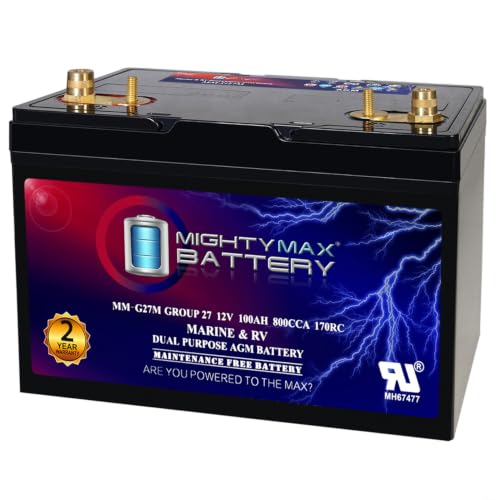
- 100Ah capacity for starting and deep-cycle use
- 800 CCA and 850 MCA starting performance
- Spill-proof, maintenance-free AGM construction
Best For: Rugged AGM power for boats and electronics
Best Space-Saving Group 31

- 105Ah capacity with 825 CCA
- Combines starting and deep-cycle functions
- Vibration-resistant AGM construction
Best For: Group 31M boat systems with limited space
Balanced AGM Power – OPTIMA D34M BLUETOP Dual Purpose Battery
If you need dual purpose marine batteries for both engine starting and onboard power, the OPTIMA D34M BLUETOP combines 750 CCA starting power with a 55 Ah C20 capacity. Its sealed AGM design is maintenance-free and built to handle vibration in boat and RV applications.
Best For: Boat and RV owners seeking a compact, maintenance-free AGM battery for starting and deep-cycle duties.
Pros:
- 750 CCA and 870 MCA provide strong starting performance.
- 55 Ah capacity and 120-minute reserve support ongoing accessory use.
- SpiralCell technology and vibration resistance are suited to demanding marine environments.
- Dual SAE and 5/16-inch stainless-steel stud posts offer installation flexibility.
Cons:
- At 43.5 pounds, it is substantially heavier than comparable lithium options.
- Its 55 Ah capacity may be limiting for high-demand onboard electronics.
This is a practical all-around AGM choice when dependable starting power, moderate deep-cycle capability, and minimal maintenance matter more than minimizing weight.
Long-Life AGM – Odyssey 34M-PC1500ST-M TROLLING Battery
The Odyssey 34M-PC1500ST-M is one of the dual purpose marine batteries designed to balance engine starting and trolling use. It delivers 850 CCA in a sealed AGM package with a stated three- to ten-year service life, strong vibration resistance, and no routine watering.
Best For: Boaters who prioritize high starting output, sealed construction, and extended service life.
Pros:
- 850 CCA supports reliable engine starting.
- AGM construction is non-spillable, maintenance-free, and resistant to vibration.
- Can be stored on open circuit for up to two years or until voltage reaches 12.00V.
- Operates across a broad stated temperature range from -40°F to 176°F.
Cons:
- Its 49.5-pound weight adds substantial load compared with lithium alternatives.
- The product uses SAE terminals, which may require compatibility checks before installation.
- The listing states that it is not for sale in Catalina Island.
Choose this Odyssey when durable, sealed AGM construction and long-term service expectations are more important than a lightweight battery or compact footprint.
Lightweight Lithium Choice – LiTime 12V 100Ah Dual Purpose Battery
For buyers comparing dual purpose marine batteries with a focus on weight and usable capacity, the LiTime 12V 100Ah LiFePO4 battery combines engine starting with deep-cycle power. It weighs 22.71 pounds, provides up to 900 CCA, and includes Bluetooth monitoring, battery-management protections, and self-heating.
Best For: Boat owners wanting a lightweight Group 24 lithium battery for outboard starting and marine electronics.
Pros:
- 900 CCA, 1000 MCA, and 1200 HCA provide substantial starting output.
- 100 Ah capacity offers more usable energy than the listed lead-acid alternatives.
- Built-in BMS protections, emergency starting reserve, and Bluetooth 5.0 monitoring add control and visibility.
- Self-heating and low-temperature protections support cold-weather operation.
Cons:
- It is not compatible with Yamaha outboards, LiveScope fish-finder system chargers, or certain outboards without voltage regulators.
- Compatibility should be verified for the specific motor and charging system before purchase.
- Its lithium features may require a more careful installation review than a conventional AGM replacement.
This is the strongest weight-saving option in the group, provided your outboard and charging equipment meet the listed compatibility requirements.
Higher-Capacity AGM – OPTIMA D27M BLUETOP Dual Purpose Battery
The OPTIMA D27M BLUETOP is a larger AGM option for shoppers evaluating dual purpose marine batteries for starting and deep-cycle service. It provides 800 CCA, a 66 Ah C20 capacity, and a 140-minute reserve capacity, while remaining sealed and maintenance-free.
Best For: Boat and RV owners who need more reserve capacity and starting output than a smaller AGM battery provides.
Pros:
- 800 CCA and 1000 MCA deliver strong starting performance.
- 66 Ah capacity and 140-minute reserve support longer accessory operation.
- SpiralCell technology and high vibration resistance are designed for demanding use.
- Dual SAE and 5/16-inch stainless-steel stud posts provide flexible connection options.
Cons:
- At 53.8 pounds, it is the heaviest listed OPTIMA option.
- The larger size may require more installation space than compact marine batteries.
- Its lead-acid AGM design weighs more than the listed LiFePO4 alternative.
The D27M makes sense when reserve capacity and robust AGM construction take priority over low weight, especially in larger boat or RV setups.
Versatile Group 27M Value Pick – Group 27M 92Ah Dual-Purpose Battery
This Group 27M is a practical option for shoppers comparing dual purpose marine batteries for mid-size boats, fishing rigs, and compact setups. Its 800 CCA starting output is paired with 92Ah capacity and a 175-minute reserve rating for everyday electronics and moderate deep-cycle use.
Best For: Bass boats, pontoons, skiffs, center-console boats, and other 16- to 22-foot vessels needing one battery for starting and onboard equipment.
Pros:
- 800 CCA and 92Ah capacity support both engine starting and accessory use.
- Group 27M sizing fits many common marine battery boxes and trays.
- Maintenance-free, no-spill lead-calcium construction is designed for marine use.
- Includes two terminal sizes and molded-in stainless steel stud and hex-nut terminals.
Cons:
- Listing includes the battery and screws only.
- Heavier and less cycle-capable than the lithium option in this roundup.
Choose this battery when conventional lead-calcium construction, useful reserve capacity, and broad Group 27M compatibility matter more than minimum weight. Confirm the dimensions and left-positive/right-negative terminal layout before ordering.
Premium AGM Performance Choice – OPTIMA D31M BLUETOP AGM Battery
The OPTIMA D31M BLUETOP is a premium AGM choice among dual purpose marine batteries, combining 900 CCA starting power with deep-cycle capability. Its sealed design, vibration resistance, and dual terminal arrangement make it well suited to demanding boat and RV installations.
Best For: Boat and RV owners who want a maintenance-free, sealed AGM battery with strong starting performance and versatile terminal connections.
Pros:
- 900 CCA and 1125 MCA provide substantial starting power.
- 75Ah C20 capacity and 155-minute reserve support accessory loads.
- SpiralCell technology and 99.99% pure lead are designed for consistent output.
- Up to 15 times more vibration resistance than standard flooded batteries, according to the supplied specifications.
Cons:
- At 59.8 pounds, it is substantially heavier than the lithium alternative.
- Its listed 75Ah capacity is lower than the 92Ah and 100Ah options here.
- AGM construction typically costs more than basic conventional lead-acid designs.
This is the strongest fit when sealed AGM construction, vibration durability, and starting reserve are priorities. Check the 12.81-by-6.56-by-9.38-inch dimensions and terminal configuration for installation compatibility.
Lightweight Lithium Upgrade – Interstate 100Ah LiFePO4 Marine Battery
The Interstate Group 24M is a lightweight lithium option for shoppers seeking dual purpose marine batteries with long cycle life and efficient recharging. Its 100Ah LiFePO4 chemistry provides usable capacity while weighing 27.6 pounds, less than half the weight of regular batteries according to the supplied notes.
Best For: Boat owners who value reduced battery weight, frequent cycling, faster recharge times, and high usable capacity.
Pros:
- 100Ah capacity can be used at 100% of its available capacity.
- Up to 10 times the cycle life of AGM batteries, according to the supplied specifications.
- Recharges up to three times faster than regular batteries.
- 27.6-pound weight simplifies handling and installation.
Cons:
- Group 24M dimensions and fit differ from the Group 27M options, so tray compatibility should be checked.
- The supplied notes do not list a CCA or MCA rating.
- Warranty activation requires registration; years four through six are performance coverage.
This battery stands out for boaters who cycle their battery often and want to reduce onboard weight. Verify the 12V Group 24M fit and confirm that its starting specifications meet your engine’s requirements before buying.
Top Lithium Dual-Purpose Pick – LiTime 12V 165Ah Cranking LiFePO4 2-Pack
For boaters seeking dual purpose marine batteries with high starting power and extended accessory runtime, this LiTime two-pack combines cranking and deep-use capability in a lightweight LiFePO4 format. Each battery provides 1200 CCA at 14°F and includes features designed for cold-weather operation and reserve starting power.
Best For: Boats needing strong outboard starting performance, marine electronics support, and reduced weight compared with lead-acid setups.
Pros:
- 2-in-1 design supports outboard cranking and marine electronics, including trolling motors.
- High output rated at 1200 CCA and 1300 MCA.
- 15% emergency reserve helps preserve starting power when charge is low.
- Self-heating technology supports charging in temperatures below 32°F.
Cons:
- Not compatible with certain outboards without voltage regulators, MerCruiser engines, or inboard systems.
- Not compatible with LiveScope fish finder system chargers.
- Compatibility should be confirmed for specific Yamaha and Mercury applications.
This is the most feature-rich option here for buyers prioritizing low weight, high cranking output, and long runtime. Verify the charging system and engine compatibility before ordering.
Best AGM Runtime Value – Mighty Max MM-G27M 100Ah Dual-Purpose AGM
This Mighty Max model is a practical choice among dual purpose marine batteries for boaters who want conventional AGM construction, dependable engine starting, and sustained power for onboard electronics. Its 100Ah capacity and Group 27M format balance marine utility with maintenance-free operation.
Best For: Boat owners who want a spill-proof AGM battery for engine starting, electronics, and deep-cycle use in demanding conditions.
Pros:
- Dual-purpose 100Ah design provides starting power and deep-cycle endurance.
- Rated at 800 CCA and 850 MCA for dependable engine starts.
- AGM construction is maintenance-free, spill-proof, and resistant to vibration.
- Rugged ABS housing helps resist impacts and heat.
Cons:
- At 70.5 pounds, it is substantially heavier than the LiFePO4 option.
- Its listed dimensions and Group 27M size may not fit every battery compartment.
- Warranty information varies in the supplied listing between one and two years.
Choose this battery if you prefer a sealed AGM design and need a balance of starting performance and sustained accessory power. Check the dimensions and confirm the applicable warranty before purchase.
Best Space-Saving Group 31 – UPLUS 105Ah Dual-Purpose AGM
The UPLUS Group 31M is one of the more straightforward dual purpose marine batteries for boaters who want one unit to handle both engine starting and deep-cycle loads. Its AGM construction, vibration resistance, and 105Ah capacity make it suitable for marine systems with limited space.
Best For: Boat owners needing a Group 31M AGM battery for engines, navigation equipment, lights, and other onboard accessories.
Pros:
- Combines starter and deep-cycle functions to save space and simplify installation.
- 105Ah capacity and 825 CCA support starting and accessory loads.
- AGM design and vibration-resistant construction suit wave action and trailer transport.
- Thicker full-frame cast plates are designed for strength and durability.
Cons:
- At 56 pounds, it is heavier than the LiFePO4 option.
- Its 12.99 x 6.81 x 9.27-inch dimensions should be checked against the battery compartment.
- The supplied notes do not specify a deep-cycle cycle-life rating.
This UPLUS battery is a sensible fit when Group 31M sizing, AGM durability, and combined starting/deep-cycle operation matter more than minimizing weight. Measure the installation space carefully before ordering.
How We Picked the Best Dual Purpose Marine Batteries
We evaluated these dual-purpose marine batteries by comparing the specifications that matter most on the water: starting performance, amp-hour capacity, reserve capacity, chemistry, group size, charging requirements, construction, and intended use. We included AGM models for their durability and simple installation, along with LiFePO4 batteries for buyers prioritizing lower weight, usable capacity, and long cycle life.
Specifications can vary by seller and production revision, so confirm the manufacturer’s current dimensions, terminal layout, charger requirements, warranty, and cold-cranking rating before ordering.
Quick Comparison
| Battery type | Best suited to | Main advantages | Trade-offs |
|---|---|---|---|
| AGM | General-purpose boats and RVs | Sealed, rugged, low maintenance, straightforward replacement | Heavier than lithium and typically offers fewer cycles |
| LiFePO4 | Frequent use, weight-sensitive boats, electronics-heavy setups | Light weight, high usable capacity, long cycle life | Higher upfront cost and stricter charging requirements |
Key Buying Factors for Dual-Purpose Marine Batteries
Battery Chemistry
AGM batteries are a practical choice when you want a sealed battery that tolerates vibration and works with many existing marine charging systems. LiFePO4 batteries can reduce weight substantially and deliver more usable energy, but they require a compatible charger and battery-management system. Verify whether the battery supports charging in cold temperatures.
Starting Power and Capacity
Check MCA or CCA ratings against your engine manufacturer’s requirements, especially for larger outboards and inboard engines. Amp-hours indicate how long a battery can support accessories, while reserve capacity helps show how long it can provide power under a standardized load. A dual-purpose battery is a compromise; high-demand trolling setups may still benefit from a dedicated deep-cycle battery bank.
Size, Terminals, and Installation
Group 24M, 27M, and 31M batteries are not interchangeable in every compartment. Measure the tray, confirm hold-down compatibility, and match the positive-terminal position and terminal style. Also check total weight before choosing a replacement.
Charging and Maintenance
Use a charger matched to the battery chemistry. AGM batteries generally need an AGM-compatible profile, while LiFePO4 requires a lithium profile. Follow the manufacturer’s storage guidance and avoid mixing old and new batteries or different chemistries in the same bank unless the system is specifically designed for it.
Who Should Buy Which Dual Purpose Marine Batteries?
- Choose AGM if you want proven marine durability, simple maintenance, and broad charger compatibility.
- Choose LiFePO4 if reducing weight, maximizing usable capacity, and extending cycle life are more important than the initial price.
- Choose a higher-capacity Group 27M or 31M model for larger boats, longer outings, or more onboard electronics—provided it fits the compartment.
- Choose a compact Group 24M option when space and weight are limited and the engine’s starting requirements are modest.
Before purchase, match the battery’s starting rating, capacity, dimensions, terminals, and charging profile to your boat and engine. That check is more important than choosing the highest advertised number.