The best fish finder with live sonar can show fish movement, structure, and lure position in real time, helping you make faster decisions on the water. The right model depends on more than screen size: transducer compatibility, mapping, installation, and viewing angles all matter.
We compared 10 options spanning dedicated live-sonar systems, full-featured chartplotters, traditional scanning units, and portable fish finders. Use the guide below to match features and performance with the way you fish.
Best 10 Fish Finder with Live Sonar Picks for 2026
Best Integrated Live Sonar

- Live Forward and Down views
- CHIRP and DownScan with FishReveal
- C-MAP charts for 17,000+ U.S. lakes
Best For: Inland anglers seeking an integrated live-sonar setup
Best Large-Screen Networked Display

- 12-inch touchscreen display
- Supports Garmin LiveScope sonar
- Wireless sharing and multiband GPS
Best For: Garmin anglers building a connected sonar system
Best Live Sonar Upgrade

- Sharper images with reduced noise
- Forward, Down, and Perspective modes
- Includes multiple mounting options
Best For: Existing Garmin users upgrading live-sonar performance
Best Side-Imaging Alternative

- 200-foot MEGA Side Imaging+ range
- MEGA Down Imaging+ and Dual Spectrum CHIRP
- Touchscreen, keypad, GPS, and mapping
Best For: Anglers prioritizing imaging coverage and navigation
Best Easy-Use Pick

- 7-inch color display with vivid scanning palettes
- Includes CHIRP and ClearVü sonar transducer
- GPS, Quickdraw Contours, and Wi-Fi built in
Best For: Anglers seeking simple sonar and GPS features
Best Upgrade-Ready System

- 12-inch HD touchscreen with split-screen layouts
- Includes Active Imaging HD 3-in-1 transducer
- Ready for separately sold ActiveTarget live sonar
Best For: Anglers building an advanced, expandable boat system
Best Compact Budget Option

- Compact 3.5-inch display with simple button controls
- CHIRP and ClearVü sonar included
- Built-in GPS waypoint map and flasher mode
Best For: Small boats, kayaks, and ice-fishing setups
Live-View Upgrade
- Live Forward and Live Down sonar views
- 9-inch IPS display with four sonar modes
- Includes U.S. and Canada C-MAP charts
Best For: Boat anglers wanting live sonar and navigation together
Structure Scanning Pick

- MEGA Side and Down Imaging coverage
- Dual Spectrum CHIRP with two search modes
- GPS, AutoChart Live, and lake basemap
Best For: Anglers focused on structure scanning and mapping
Portable Casting Option
LUCKY MT-202 Wireless Fish Finder
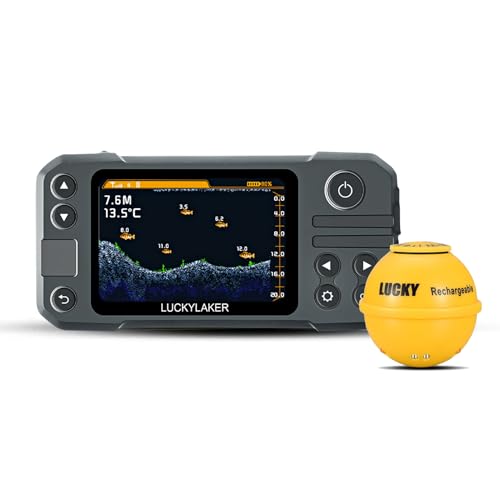
- Wireless castable sensor with handheld display
- Shows fish depth, location, and sonar history
- Works for shore, kayak, boat, and ice fishing
Best For: Mobile anglers needing a compact portable sonar
Best Integrated Live Sonar – Lowrance Eagle Eye 9
The Lowrance Eagle Eye 9 is a practical fish finder with live sonar for anglers who want Forward and Down views without adding a separate sonar module. Its included transducer also provides CHIRP and DownScan Imaging with FishReveal, while the 9-inch display and preloaded inland charts support on-water navigation.
Best For: Inland anglers who want an integrated live-sonar setup with detailed mapping and a large display.
Pros:
- Live Forward and Live Down views show fish movement and lure response in real time.
- One transducer supports live sonar, CHIRP, and DownScan Imaging with FishReveal.
- Preloaded C-MAP charts cover more than 17,000 U.S. lakes.
- Direct transducer-to-display connection avoids a separate sonar module.
Cons:
- The included C-MAP coverage is focused on U.S. inland lakes.
- Its maximum listed depth is 500 feet.
This is one of the more straightforward all-in-one options in the group. The combination of live views, FishReveal, mapping, and direct connectivity makes it a strong choice for anglers prioritizing a simpler installation.
Best Large-Screen Networked Display – Garmin ECHOMAP Ultra 2 126sv
The Garmin ECHOMAP Ultra 2 126sv is a large-screen fish finder with live sonar support through compatible Garmin LiveScope equipment. Its 12-inch touchscreen, Garmin Navionics+ mapping, wireless networking, and multiband GPS make it suited to anglers building a connected chartplotter and sonar system.
Best For: Anglers who want a large touchscreen display and plan to add or network compatible Garmin sonar equipment.
Pros:
- Large 12-inch touchscreen provides a spacious viewing area.
- Supports Garmin LiveScope live-scanning sonar.
- Wireless networking can share sonar, waypoints, and routes.
- Multiband GPS is designed for improved position accuracy.
Cons:
- The GT56UHD-TM transducer is sold separately.
- Live sonar capability requires compatible Garmin equipment.
This unit is best viewed as the control center for a more configurable Garmin setup rather than a complete live-sonar package. Its screen size and networking features are appealing, but budget for the required transducer or compatible LiveScope system.
Best Live Sonar Upgrade – Garmin LiveScope Plus System
The Garmin LiveScope Plus System is a fish finder with live sonar hardware for anglers upgrading an existing Garmin-compatible display. The GLS 10 black box and LVS34 transducer deliver sharper images with reduced noise, vivid color palettes, and Forward, Down, and Perspective modes.
Best For: Garmin users who already have a compatible ECHOMAP or GPSMAP display and want improved live-sonar detail.
Pros:
- Sharper images are designed to reduce noise and sonar artifacts.
- Supports Forward, Down, and Perspective viewing modes.
- Includes trolling motor, shaft, and perspective mounting hardware.
- The LVS34 transducer can upgrade an existing GLS 10 system.
Cons:
- A compatible Garmin ECHOMAP or GPSMAP display is sold separately.
- It is a sonar system rather than a complete standalone display package.
This package makes the most sense when the rest of your Garmin electronics are already in place. Its multiple viewing modes and improved image clarity offer flexibility, while the included mounts simplify installation on different setups.
Best Side-Imaging Alternative – Humminbird XPLORE 9
Humminbird XPLORE 9 GPS Fish Finder with Transducer, MEGA Side Imaging+ & HD Touchscreen
Check Price On AmazonThe Humminbird XPLORE 9 is a GPS fish finder that emphasizes high-detail side and down imaging rather than a listed live-sonar mode. Its MEGA Side Imaging+, MEGA Down Imaging+, Dual Spectrum CHIRP, mapping, touchscreen, keypad, and networking features make it a versatile option for anglers who want broad underwater coverage and navigation tools.
Best For: Anglers who prioritize side imaging, down imaging, detailed mapping, and integrated boat-system connectivity.
Pros:
- MEGA Side Imaging+ provides a 200-foot range on each side.
- MEGA Down Imaging+ reaches listed depths of 200 feet.
- Dual Spectrum CHIRP offers wide and narrow detection modes.
- Includes GPS mapping, AutoChart Live, touchscreen, and keypad controls.
Cons:
- The supplied specifications do not list a live-sonar mode.
- Its listed maximum measuring depth is 200 feet.
- Some mapping and networking capabilities may require compatible accessories or systems.
The XPLORE 9 is a strong alternative for anglers whose priority is imaging coverage and mapping rather than live views of fish movement. Its dual-control interface and compatibility with Minn Kota and Cannon products add practical flexibility on the boat.
Best Easy-Use Pick – Garmin Striker Vivid 7cv
If you want a straightforward fish finder with live sonar capability potential, the Garmin Striker Vivid 7cv offers a clear 7-inch display, included CHIRP sonar, GPS, and vivid scanning palettes. It does not include live sonar, but its included GT20-TM transducer provides traditional CHIRP and CHIRP ClearVü scanning views for locating fish and structure.
Best For: Anglers who want an easy-to-use 7-inch fishfinder with GPS, scanning sonar, and room to build a basic electronics setup.
Pros:
- 7-inch color display with vivid scanning sonar palettes.
- Includes GT20-TM transducer for CHIRP and ClearVü sonar.
- Built-in GPS supports waypoint marking, routes, and speed viewing.
- Quickdraw Contours mapping and Wi-Fi connectivity add useful navigation features.
Cons:
- Live sonar is not included.
- Its 7-inch screen is smaller than larger chartplotter displays.
The Striker Vivid 7cv is a practical choice when ease of use and included sonar matter more than advanced live imaging. Its GPS and networking features make it a well-rounded option for everyday freshwater and boating use.
Best Upgrade-Ready System – Lowrance HDS PRO 12
The Lowrance HDS PRO is a strong fish finder with live sonar expansion potential for anglers who want a larger, more capable control center. Its 12-inch SolarMAX HD touchscreen includes an Active Imaging HD 3-in-1 transducer, while ActiveTarget 2 or ActiveTarget 2 XL can be added separately for real-time fish and lure views.
Best For: Serious anglers who want a large touchscreen, included high-definition imaging, chartplotting, and a path to live sonar.
Pros:
- 12-inch high-resolution touchscreen supports flexible split-screen layouts.
- Included 3-in-1 transducer provides CHIRP, SideScan, and DownScan Imaging.
- Compatible with separately sold ActiveTarget 2 and ActiveTarget 2 XL live-sonar systems.
- Preloaded C-MAP DISCOVER charts and broad networking support expand boat-control options.
Cons:
- Live-sonar hardware is sold separately.
- The larger display and networking features may be more than casual anglers need.
This is the most expandable option in the group. It delivers detailed conventional imaging immediately and provides a clear upgrade route to live sonar, making it suitable for anglers building a more advanced boat electronics system.
Best Compact Budget Option – Garmin Striker 4
The compact Garmin Striker 4 is a simple fish finder with live sonar upgrade potential only in the broader sense of starting with dependable sonar basics; live sonar is not included. Its 3.5-inch display, CHIRP sonar, ClearVü scanning, GPS waypoint map, and built-in flasher make it useful when portability and straightforward operation are priorities.
Best For: Small boats, kayaks, ice fishing, and anglers who want an inexpensive, easy-to-install sonar with GPS marking.
Pros:
- Compact 3.5-inch display with dedicated buttons and simple installation.
- CHIRP sonar improves fish-arch clarity and target separation.
- ClearVü scanning sonar shows detailed representations of fish and structure.
- Built-in flasher supports ice fishing and vertical jigging.
Cons:
- Small display limits viewing space for detailed sonar information.
- Live sonar is not included.
- Its listed warranty is one year, shorter than the two-year warranties of the other options.
The Striker 4 focuses on essential sonar functions in a notably compact package. It is a sensible starting point for anglers who value portability, CHIRP performance, and waypoint marking over a large screen or live-imaging features.
Live-View Upgrade – Lowrance Eagle Eye 9
If you want a fish finder with live sonar, the Lowrance Eagle Eye 9 provides Live Forward and Live Down views for watching fish react to your lure in real time. Its 9-inch IPS display, included transducer, and C-MAP charts make it a strong option for anglers who want live viewing plus navigation in one setup.
Best For: Anglers who want live sonar without a separate module and need chart coverage for U.S. and Canada waters.
Pros:
- Live Forward and Live Down views show fish movement and lure reactions.
- One transducer supports four sonar views, including CHIRP and DownScan with FishReveal.
- 9-inch IPS screen is designed for sunlight, wide-angle viewing, and polarized sunglasses.
- Includes C-MAP DISCOVER charts for U.S. and Canada waters.
Cons:
- The 9-inch display and included chart package may be more than minimalist setups require.
- Maximum listed depth is 500 feet, so actual performance depends on conditions and setup.
The Eagle Eye 9 is the most capable live-sonar choice here for boat anglers who value real-time fish tracking, a larger screen, and built-in chart support. Direct transducer-to-display connectivity also helps simplify installation.
Structure Scanning Pick – Humminbird HELIX 7 G4
For shoppers comparing a fish finder with live sonar, the Humminbird HELIX 7 G4 is better suited to detailed side and down imaging than live sonar viewing. It combines MEGA Side and Down Imaging, Dual Spectrum CHIRP, GPS mapping, and keypad controls in a 7-inch unit.
Best For: Boat anglers prioritizing side-imaging coverage, GPS navigation, and real-time map creation over dedicated live sonar.
Pros:
- MEGA Side and Down Imaging covers up to 125 feet on each side and beneath the boat.
- Dual Spectrum CHIRP offers Wide and Narrow search modes.
- Built-in Humminbird Basemap covers more than 10,000 lakes and continental U.S. coastlines.
- AutoChart Live records depth contours, bottom hardness, and vegetation.
Cons:
- The supplied notes do not list Live Forward or Live Down sonar.
- Its maximum listed depth is 125 feet.
- The 7-inch display is smaller than the Lowrance Eagle Eye 9 screen.
The HELIX 7 G4 is a practical alternative when finding structure and navigating mapped waters matter more than watching fish respond live. Its included transducer and keypad interface support straightforward operation in changing weather.
Portable Casting Option – LUCKY MT-202 Wireless Fish Finder
The LUCKY MT-202 offers a portable approach for anglers who need a fish finder with live sonar-style convenience without installing a boat display. Its wireless floating sensor can be cast from shore, a kayak, or a boat, while the handheld unit shows fish depth and sonar history on a 3.5-inch screen.
Best For: Shore, kayak, canoe, pontoon, boat, and ice anglers who need a compact castable depth and fish-location tool.
Pros:
- Wireless sensor and handheld display provide a listed operating distance of up to 853 feet.
- Castable design requires no drilling, brackets, or complex wiring.
- Shows fish icons with depth readings and scrolling sonar history.
- Scans a 90-degree beam from 3 to 147 feet and is designed for multiple fishing environments.
Cons:
- The 3.5-inch display is much smaller than fixed-mount fish finders.
- The supplied notes do not identify Live Forward or Live Down sonar views.
- Its maximum listed depth is 147 feet.
The MT-202 is a flexible choice for anglers who fish from different locations and want quick, wireless deployment. It is not a direct substitute for a dedicated live-sonar display, but its castable sensor makes it especially convenient from shore or a small craft.
How We Picked the Best Fish Finder with Live Sonar
We looked at each unit’s sonar capabilities, transducer configuration, display quality, mapping support, installation requirements, portability, and overall usability. Because not every listed product includes live sonar out of the box, we separated complete live-sonar packages from compatible displays and more basic fish finders. This helps you compare the total setup rather than judging a screen in isolation.
We also considered whether a model suits a bass boat, multispecies boat, kayak, or occasional fishing setup. A high-end chartplotter may offer outstanding expansion potential, while a compact unit can be the better practical choice for a smaller vessel.
Quick Comparison
| Best For | Look For | Typical Advantage |
|---|---|---|
| Live viewing and lure tracking | Compatible live-sonar transducer and network support | See fish and presentation in real time |
| Navigation and sonar together | Chartplotter, GPS, and detailed mapping | One central display for fishing and travel |
| Structure scanning | Side imaging, down imaging, or MEGA imaging | Cover more water and identify habitat |
| Simple freshwater fishing | CHIRP sonar, GPS, and easy controls | Lower cost and less setup complexity |
| Kayaks and temporary rigs | Portable, wireless, or rechargeable design | Flexible use without permanent installation |
Key Buying Factors for a Fish Finder with Live Sonar
Transducer and System Compatibility
Live sonar is usually produced by a dedicated transducer and processing module, not just the display. Confirm that the head unit supports the exact transducer you want, and check whether the package includes the required module, mounting hardware, cables, and power connections.
Screen Size, Brightness, and Controls
A larger screen makes split views, maps, and live sonar easier to read, especially in bright sunlight. Touchscreens offer quick access to menus, while physical buttons can be easier to use with wet hands or gloves. Choose the largest display your console and budget can comfortably accommodate.
Imaging and Viewing Modes
Live sonar is valuable for watching fish behavior and guiding a lure, but side imaging and down imaging remain useful for locating structure and covering water. A versatile system with multiple sonar views can be more useful than a live-only setup.
Mapping, GPS, and Networking
Preloaded charts, GPS accuracy, chart updates, waypoint storage, and networking support affect long-term usefulness. Anglers who fish unfamiliar water should prioritize mapping and navigation; those fishing small local lakes may prefer simpler sonar at a lower price.
Installation and Power Needs
Check mounting options, battery capacity, cable routing, and transducer placement before buying. Live-sonar systems can require more power and installation space than basic fish finders.
Who Should Buy Which Fish Finder with Live Sonar?
Choose a complete live-sonar package if real-time fish and lure tracking is your main priority. Consider a premium Garmin, Lowrance, or Humminbird display if you want live sonar plus advanced mapping, networking, and multiple imaging technologies. A midrange unit with GPS and scanning sonar is a sensible choice for anglers who want strong structure-finding without the complexity of a full live-sonar rig.
For beginners, occasional anglers, and smaller boats, a straightforward CHIRP fish finder offers useful depth and bottom information with minimal setup. Kayak anglers or users who cannot permanently mount electronics should look at portable or wireless designs, while serious tournament anglers should prioritize screen size, transducer positioning options, fast controls, and future expansion.