The right marine amplifier can make your boat’s audio system louder, cleaner, and more enjoyable without taking up valuable onboard space. The best choice depends on your speaker layout, subwoofer plans, available power, and exposure to water.
We compared 10 marine-ready models across multi-channel, monoblock, compact, Bluetooth-equipped, and high-output designs to help you match amplifier features to your boat and listening goals.
Best 10 Marine Amplifiers Picks for 2026
High-Power Full-Range Pick
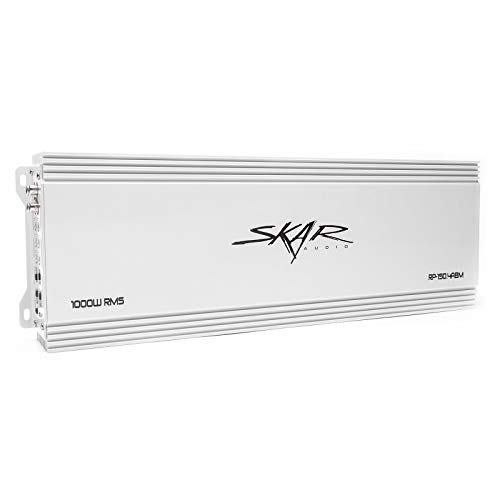
- Four-channel Class A/B design
- Up to 250 watts RMS per channel at 2 ohms
- Waterproof-coated board and rust-proof case
Best For: High-output four-channel boat audio systems
Sealed Bass Specialist

- Monoblock Class D subwoofer amplifier
- 300 watts RMS at 2 ohms
- IP67/IP66 sealed water and dust protection
Best For: Dedicated marine subwoofer installations
Compact Bluetooth Value

- Four-channel Class AB amplifier
- Bluetooth remote streaming without a head unit
- Compact 2.9-pound weatherproof design
Best For: Simple Bluetooth boat and ATV audio systems
Multi-Zone Expansion Choice

- Eight-channel Class D configuration
- 880 watts Dyno-Certified RMS total
- Bluetooth and dual adjustable crossovers
Best For: Multi-zone boat and yacht audio systems
Compact Bass Power
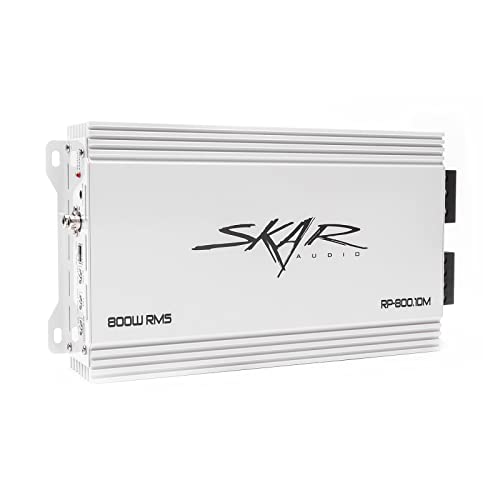
- 800W RMS at 1 ohm
- Marinized, rust-resistant construction
- Remote subwoofer control included
Best For: Dedicated marine subwoofer systems
Whole-Boat Versatility
Rockville RXM8BTW 8-Channel Marine Amplifier

- 750W RMS, eight-channel output
- Built-in Bluetooth with auto pairing
- Conformal coating and stainless terminals
Best For: Flexible multi-speaker boat audio systems
High-Output Bass

- 1,500W RMS at 1 ohm
- Marine-protected Class D design
- Bass EQ and remote level control
Best For: Powerful dedicated marine subwoofer systems
Weather-Ready Four-Channel Pick

- Four-channel, 400W maximum output
- RCA and high-level inputs
- Thermal and short-circuit protection
Best For: Flexible four-channel boat audio installations
High-Output Class D Pick

- Class D four-channel design
- Up to 250W x 4 at 2 ohms
- Remote bass knob and adjustable crossovers
Best For: Powerful, tunable boat and powersports audio systems
Ultra-Compact Waterproof Pick

- Postcard-sized four-channel design
- 400W true RMS output stated
- IPX67 waterproof rating
Best For: Tight marine and powersports installations
High-Power Full-Range Pick – Skar Audio RP-150.4ABM
Skar Audio RP-150.4ABM 1,000 Watt Full-Range Class A/B 4-Channel Marine Amplifier
Check Price On AmazonThe Skar Audio RP-150.4ABM is a strong choice for marine amplifiers when you need four full-range channels and substantial output. It delivers 150 watts RMS per channel at 4 ohms or 250 watts at 2 ohms, with marinized protection for boat installations.
Best For: Boaters building a high-output four-channel speaker system with adjustable sound controls.
Pros:
- Provides 150 watts RMS x 4 at 4 ohms and 250 watts x 4 at 2 ohms
- Waterproof-coated circuit board and rust-proof mechanical case
- Includes adjustable gain, HPF, LPF, and bass EQ controls
- Offers four-way protection circuitry and 4-gauge power terminals
Cons:
- At 9.9 pounds, it is heavier than several compact marine amplifier options
- Uses Class A/B amplification rather than a more compact Class D design
With its high channel output, broad 20 Hz–20 kHz frequency response, and 105 dB signal-to-noise ratio, this model suits larger full-range systems. Its two-year limited warranty adds useful ownership support.
Sealed Bass Specialist – KENWOOD KAC-M5001
The KENWOOD KAC-M5001 is a focused option among marine amplifiers for adding controlled subwoofer bass. Its monoblock Class D design produces 300 watts RMS at 2 ohms, while IP67/IP66 protection helps it handle water, dust, and spray.
Best For: Boat, UTV, ATV, PWC, and motorcycle systems that need a dedicated sealed subwoofer amplifier.
Pros:
- Delivers 300 watts RMS at 2 ohms and 200 watts at 4 ohms
- IP67/IP66 sealed protection supports resistance to water and dust
- Works with speaker-level inputs and factory radios
- Includes a waterproof wired level control and signal-sensing turn-on
Cons:
- Monoblock design is intended for subwoofers rather than full-range speakers
- Its one-year warranty is shorter than some competing options
This is a practical choice when installation flexibility and environmental protection matter more than multiple channels. Adjustable LPF and bass controls make it easier to tune low-frequency output.
Compact Bluetooth Value – BOSS Audio Systems MC900B
The BOSS Audio Systems MC900B combines four-channel amplification with Bluetooth streaming in a compact package. For marine amplifiers used in boats or ATVs, it offers 94 watts RMS per channel at 4 ohms and can operate without a separate head unit.
Best For: Compact boat or ATV audio setups that need simple Bluetooth playback and four-channel output.
Pros:
- Four-channel Class AB design with 94 watts RMS per channel at 4 ohms
- Bluetooth remote can stream from smartphones and MP3 players
- USB port provides device charging
- Compact 2.9-pound design is easy to fit into tight installations
Cons:
- Weatherproof construction is described for light weather conditions
- Output is lower than the higher-powered four- and eight-channel models here
- Warranty terms vary by seller, so purchase eligibility should be checked
The MC900B is suited to straightforward systems where wireless music control and small size are priorities. Its full-range design can run speakers or subwoofers, though its power level is best matched to modest installations.
Multi-Zone Expansion Choice – Rockville Atom 8B
The Rockville Atom 8B stands out among marine amplifiers for systems needing many channels in a compact chassis. Its eight-channel Class D design provides 880 watts Dyno-Certified RMS total, Bluetooth connectivity, and configurable 4-, 6-, or 8-channel operation.
Best For: Boats and yachts with multiple speaker zones, subwoofers, or a space-conscious multi-channel installation.
Pros:
- Offers 880 watts RMS total and up to 110 watts x 8 at 2 ohms
- Supports 4-, 6-, or 8-channel configurations
- Includes Bluetooth with automatic pairing
- Provides independent 50–250 Hz HPF/LPF controls for channels 1–4 and 5–8
Cons:
- Limited to a one-year warranty
- Its extensive controls may be more than a small, single-zone system needs
- Listed output is 110 watts per channel, rather than the much higher peak-power figure
With a conformal-coated PCB, stainless steel hardware, corrosion-resistant casing, and a built-in voltage display, the Atom 8B is designed for feature-rich marine installations. Its RCA line output also supports system expansion.
Compact Bass Power – Skar Audio RP-800.1DM
For boat owners seeking focused bass, this marine amplifier delivers 800 watts RMS at 1 ohm in a compact, efficient Class D monoblock design. Its marinized construction and included remote subwoofer control make it a practical choice for a dedicated marine subwoofer system.
Best For: Marine subwoofer setups needing strong, efficient bass power.
Pros:
- Produces 800 watts RMS and 1,200 watts peak power at 1 ohm.
- Waterproof-coated circuit board and rust-proof mechanical case support marine use.
- Includes bass EQ boost, four-way protection, and remote subwoofer level control.
Cons:
- Monoblock design is intended for subwoofer duty rather than full-range speaker amplification.
- Requires 4-gauge power and ground wiring.
The RP-800.1DM balances dedicated low-frequency output with marine-oriented protection. It is a sensible option when bass performance matters more than powering multiple speaker channels.
Whole-Boat Versatility – Rockville RXM8BTW 8-Channel Marine Amplifier
The Rockville RXM8BTW is a flexible choice among marine amplifiers for systems that need multiple channels and wireless streaming. Its eight-channel Class D design supports several output configurations, while Bluetooth, conformal-coated circuitry, and stainless steel terminals suit boat installations.
Best For: Multi-speaker boat systems needing Bluetooth and flexible channel configuration.
Pros:
- Offers 750 watts RMS total, with eight-channel, two-ohm, and bridged output options.
- Built-in Bluetooth supports wireless streaming from compatible smartphones and tablets.
- Includes adjustable crossovers, RCA line out, four-way protection, and marine-grade construction.
Cons:
- Its feature-rich eight-channel design may be more than a simple system requires.
- Listed warranty is one year.
With broad configuration flexibility and built-in Bluetooth, the RXM8BTW is well suited to larger or expandable boat audio systems. Its compact Class D design also helps conserve installation space.
High-Output Bass – Skar Audio RP-1500.1DM
Skar Audio RP-1500.1DM 1,500 Watt Monoblock Class D Marine Subwoofer Amplifier
Check Price On AmazonFor boat audio systems built around powerful low-end output, the Skar Audio RP-1500.1DM supplies 1,500 watts RMS at 1 ohm. This marine monoblock Class D amplifier adds marinized protection, onboard bass boost, and remote level control for a dedicated subwoofer installation.
Best For: High-output marine subwoofer systems requiring substantial bass power.
Pros:
- Delivers 1,500 watts RMS and 2,300 watts peak power at 1 ohm.
- Uses a waterproof-coated circuit board and rust-proof painted case.
- Includes four-way protection, efficient heatsink design, bass EQ boost, and remote control.
Cons:
- Monoblock design is focused on subwoofer amplification.
- Needs 4-gauge power and ground input terminals.
The RP-1500.1DM is the strongest bass-focused option in this group. Its high output is best matched with a suitably capable subwoofer and an electrical system prepared for the amplifier’s demands.
Weather-Ready Four-Channel Pick – Pyle Hydra PLMRA402
The Pyle Hydra PLMRA402 is a practical choice for marine amplifiers when you need four-channel output, flexible connections, and basic protection against onboard exposure. It provides up to 400 watts of maximum power, supports RCA or high-level inputs, and includes an aluminum heatsink with thermal and short-circuit protection.
Best For: Boat audio systems needing four channels and flexible head-unit compatibility.
Pros:
- Four-channel design with up to 100 watts per channel maximum output.
- Accepts RCA stereo inputs or high-level speaker-wire inputs.
- Includes thermal overload and speaker short protection.
- IP-01 marine rating and gold-plated speaker output terminals.
Cons:
- The listed IP-01 rating is less specific than the IPX67 rating on some competing marine models.
- Maximum output is specified, rather than a detailed RMS rating.
Choose this model if straightforward four-channel expansion and input flexibility matter most. Its compact metal housing and protective features make it a sensible fit for a basic marine or powersports installation.
High-Output Class D Pick – Stinger Audio MT-600.4M
The Stinger Audio MT-600.4M stands out among marine amplifiers for its Class D design, compact footprint, and high power options. It can deliver up to 250 watts per channel at 2 ohms, supports bridged operation, and includes adjustable crossovers plus a remote bass control for tailored installations.
Best For: Boat and powersports systems that need strong output, crossover flexibility, and remote bass adjustment.
Pros:
- Offers multiple power configurations, including up to 250 watts x 4 at 2 ohms.
- High- and low-level input options support different head-unit setups.
- Adjustable high- and low-pass crossovers with multiplier support speaker matching.
- Includes a mountable remote bass knob and a compact 6.10 x 9.29 x 2.09-inch footprint.
Cons:
- The supplied notes describe the unit as water-resistant rather than providing a specific IP rating.
- Its higher-output feature set may be more than a simple two-speaker installation requires.
This is the more configurable option for an installation that may use different speaker loads, bridged channels, or a subwoofer. The remote bass control and built-in crossover controls add useful tuning flexibility in a boat or off-road vehicle.
Ultra-Compact Waterproof Pick – NVX MVPA4 Micro Class D
The NVX MVPA4 is a compact option for marine amplifiers where installation space is limited. Its postcard-sized Class D chassis provides 400 watts of stated true RMS output, four channels, bridgeable operation, and an IPX67 waterproof rating for marine, powersports, or motorcycle applications.
Best For: Space-constrained installations that need four-channel amplification and strong water protection.
Pros:
- Compact 7.09 x 5.91 x 2.28-inch design fits tight mounting spaces.
- Four-channel Class D amplifier with 50 watts x 4 at 4 ohms and 100 watts x 4 at 2 ohms.
- IPX67 waterproof rating suits marine and powersports environments.
- Bridgeable architecture adds installation flexibility.
Cons:
- The supplied specifications list 400 watts of true RMS output and 600W maximum output, which may require careful comparison with other power ratings.
- The notes provide fewer connection and adjustment details than some competing models.
For a small boat, motorcycle, or powersports build, the MVPA4 prioritizes easy placement without giving up four-channel output. Its IPX67 rating is the clearest advantage when water protection and a compact footprint are key buying criteria.
How We Picked the Best Marine Amplifiers
We focused on the specifications that matter most on a boat: RMS power, channel configuration, Class D or Class A/B operation, weather protection, installation flexibility, and compatibility with factory or aftermarket radios. We also considered whether an amplifier is better suited to full-range speakers, subwoofers, or a larger multi-zone system.
Peak wattage can look impressive, but RMS output is more useful for matching an amplifier to speakers. We gave greater weight to continuous power ratings, practical wiring options, compact dimensions, and protection features that can help equipment survive moisture, salt air, vibration, and temperature changes.
Quick Comparison
| Best For | Recommended Type | What to Look For |
|---|---|---|
| Boat-wide speaker system | 4-channel amplifier | Balanced RMS output and bridgeable channels |
| Dedicated subwoofer | Monoblock Class D | Stable impedance support and suitable RMS power |
| Multiple audio zones | 6- or 8-channel amplifier | Flexible channel configuration and efficient cooling |
| Small consoles or motorcycles | Compact micro Class D | Small footprint and sealed construction |
| Factory-radio integration | Marine amp with speaker-level inputs | Compatibility with the existing source unit |
Key Buying Factors for Marine Amplifiers
Power and Channel Layout
Choose the channel count before comparing wattage. A 4-channel model can power four speakers or be bridged for fewer, higher-powered outputs. A monoblock amplifier is designed primarily for a subwoofer. Eight-channel models make more sense for boats with multiple speaker zones, towers, or cabins.
RMS Matching
Match the amplifier’s RMS output to the speakers’ RMS handling at the same impedance. An amplifier that is modestly below the speaker rating can work well, while excessive power increases the risk of damage if gains are set incorrectly. For subwoofers, verify the amplifier’s output at the woofer’s actual impedance.
Water and Corrosion Protection
Marine equipment needs more than a generic car amplifier installed under a seat. Look for sealed or weather-resistant construction, corrosion-resistant terminals, conformal-coated circuitry, and a stated water-resistance rating such as IP67. No amplifier should be treated as permanently waterproof unless the manufacturer explicitly says so, and mounting it in a dry, ventilated location remains important.
Class D Versus Class A/B
Class D amplifiers are typically smaller, lighter, and more efficient, which is useful when battery capacity and mounting space are limited. Class A/B designs may appeal to listeners who prioritize traditional full-range amplification, but they usually require more current and generate more heat.
Installation and System Compatibility
Confirm the amplifier accepts your radio’s output type, including RCA or speaker-level signals. Check fuse requirements, cable size, grounding points, remote-turn-on wiring, and available ventilation. Bluetooth can simplify source connections, but it may not replace a dedicated marine receiver for steering controls, radio reception, or multi-zone management.
Who Should Buy Which Marine Amplifiers?
- Choose a 4-channel model if you want a straightforward upgrade for cockpit or cabin speakers.
- Choose a monoblock amplifier if bass is your priority and you already have—or plan to add—a dedicated subwoofer.
- Choose an 8-channel model for multiple speaker zones, larger boats, or flexible future expansion.
- Choose a compact Class D amplifier when installation space, weight, and battery efficiency are major concerns.
- Choose a Bluetooth-equipped model if you want direct wireless playback without replacing the factory radio.
Before buying, verify speaker impedance, RMS ratings, available charging capacity, and mounting conditions. A properly matched amplifier with conservative gain settings will usually deliver better reliability than the highest advertised wattage.