Keeping three onboard batteries charged is easier with the right three-bank marine battery charger. These systems distribute charging across separate banks while helping maintain batteries between trips.
Our roundup compares 10 options across charging output, weather resistance, monitoring, installation requirements, and maintenance features, so you can match a charger to your boat and battery setup.
Best 10 Three Bank Marine Battery Chargers Picks for 2026
Best Compact Waterproof Pick
NOCO GEN5X3 15A 3-Bank Charger
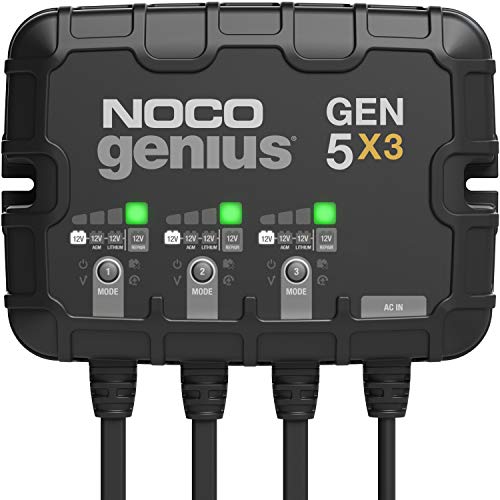
- 15 amps total, or 5 amps per bank
- IP68 waterproof design with flexible mounting
- Supports lead-acid and LiFePO4 batteries
Best For: Compact three-bank charging on smaller boats
Best High-Output Smart Charger
ProMariner ProNautic 1230P 30A

- 30-amp output for three 12V banks
- Distributes power where charging demand is highest
- Offers 12 selectable four-stage profiles
Best For: Adaptive charging across demanding marine battery systems
Best Fast-Charging Waterproof Pick
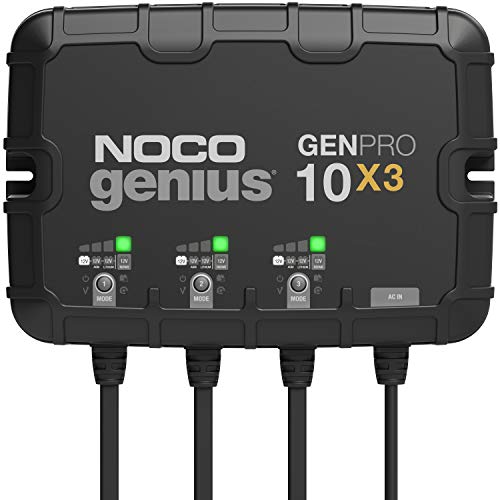
- 30 amps total, with 10 amps per bank
- IP68 waterproof and temperature-compensated
- Supports lead-acid, AGM, lithium, and repair modes
Best For: Faster charging for three 12V marine battery banks
Best Globally Compatible Charger

- 30-amp charger with three isolated outputs
- Accepts 90-265V AC input across 50/60Hz
- Uses temperature sensing and bulk-to-float charging
Best For: Professionally installed three-bank 12V systems with varied AC input
Best Value Waterproof Pick
WAVLINK 3 Bank 15A Marine Charger

- Three independent 5A charging channels
- Supports lead-acid and LiFePO4 batteries
- IP68 housing with repair and safety modes
Best For: Mixed 12V boat battery banks and permanent onboard installation
Fastest Charging Choice
Battery Tender WaveCharge Pro 30A

- 10A per bank and 30A total output
- Automatic float maintenance for storage
- IP68 and Marine UL-rated protection
Best For: Larger boat battery banks needing faster charging
Best Display and Mode Control
3 Bank IP68 LCD Marine Charger

- Independent 5A charging for three batteries
- Selectable lithium, lead-acid, calcium, and repair modes
- 9-stage charging with temperature compensation
Best For: Users wanting visible status and per-bank charging control
High-Capacity Choice
CXRCY 30A 3-Bank Marine Charger

- 30A total output, or 10A per bank
- Nine-stage charging with three battery modes
- IP68 waterproof housing and repair mode
Best For: Three 12V batteries needing higher per-bank output
Warranty Pick
FirstPower Pro 15A 3-Bank Charger

- 5A per bank for 15A total output
- IP68 waterproof and rated for 24/7 onboard use
- Three-year warranty with repair and diagnostics
Best For: Maintenance charging with extended warranty coverage
Compact Smart Option

- 30A total output with 10A per bank
- Supports SLA/AGM, lithium, and calcium batteries
- Temperature control, force mode, and IP68 sealing
Best For: 12V boats needing smart charging and lithium support
Best Compact Waterproof Pick – NOCO GEN5X3 15A 3-Bank Charger
For boat owners comparing three bank marine battery chargers, the NOCO GEN5X3 is a compact 15-amp option that delivers 5 amps to each of three 12V banks. It supports lead-acid and LiFePO4 batteries, offers selectable charging modes, and uses temperature compensation to help manage charging in changing conditions.
Best For: Smaller boats needing a compact, waterproof charger for three 12V battery banks.
Pros:
- IP68 waterproof construction for demanding marine environments.
- Selectable 12V, AGM, lithium, and repair modes for each bank.
- Can begin charging batteries from as low as 1 volt, with Force Mode for zero-volt recovery.
- Supports flexible mounting, including upside-down installation, and includes a three-year warranty.
Cons:
- Its 15-amp total output provides only 5 amps per bank.
- It is designed for 12V systems rather than higher-voltage battery banks.
The GEN5X3 is a practical choice when sealed construction, lithium compatibility, and installation flexibility matter more than maximum charging speed. Its lower per-bank output is best suited to moderate charging demands.
Best High-Output Smart Charger – ProMariner ProNautic 1230P 30A
The ProMariner ProNautic 1230P is a 30-amp, three-bank charger for 12V marine battery systems. Its distributed-on-demand technology can direct charging capacity to one bank or spread it across multiple banks, while 12 selectable charging profiles provide added setup flexibility.
Best For: Boat owners who want high output, adaptive bank distribution, and multiple digital charging profiles.
Pros:
- Provides 30 amps across three 12V banks.
- Distributed-on-demand technology can supply up to the full charging capacity to one bank or a combination of banks.
- Includes 12 selectable four-stage charge profiles with charge, condition, auto-maintain, and recondition stages.
- Auto-ranging 100-240V AC input and a remote temperature sensor support versatile installation.
Cons:
- The supplied notes do not specify IP-rated waterproof protection.
- It is intended for 12V marine batteries and does not list lithium compatibility.
With its adaptive output distribution and extensive profile selection, the ProNautic 1230P is a strong fit for boats with varying battery demands. Buyers prioritizing explicitly waterproof construction may prefer a charger with a stated IP rating.
Best Fast-Charging Waterproof Pick – NOCO GENPRO10X3 30A
For buyers seeking three bank marine battery chargers with more output per bank, the NOCO GENPRO10X3 supplies 30 amps total, or 10 amps to each of three 12V batteries. It combines IP68 waterproofing with selectable lead-acid and lithium modes, temperature compensation, and battery recovery features.
Best For: Boats needing faster three-bank charging with sealed protection and lithium support.
Pros:
- Delivers 10 amps independently to each of three banks.
- IP68 waterproof construction is designed for harsh marine conditions.
- Supports 12V, AGM, lithium, and repair modes independently for each bank.
- Includes temperature sensing, flexible mounting, and Force Mode for deeply discharged batteries.
Cons:
- Its 30-amp output model is heavier than the 15-amp GEN5X3 at 13.4 pounds.
- The supplied specifications list a 120V input, so installation requirements should be checked carefully.
The GENPRO10X3 is the stronger NOCO choice when each bank needs more charging current. Its waterproof enclosure and broad battery compatibility make it well suited to demanding onboard installations, provided the available space and electrical setup are compatible.
Best Globally Compatible Charger – Victron Energy Centaur 30A
The Victron Energy Centaur is a 30-amp, three-bank 12V charger with auto-ranging 90-265V AC input. Each isolated output can provide the full rated current, while the charger uses a bulk-to-float sequence and internal temperature sensing to manage operation in demanding environments.
Best For: Three-bank 12V installations that need wide AC input compatibility and isolated outputs.
Pros:
- Three isolated outputs can simultaneously charge three battery banks.
- Each output is capable of supplying the full 30-amp rated current.
- Auto-ranging 90-265V AC input supports broad electrical compatibility.
- Internal temperature sensing can automatically reduce output current under extreme conditions.
Cons:
- The supplied notes do not list lithium-battery compatibility or IP-rated waterproofing.
- Its 14-inch listed height may require more installation space than compact alternatives.
- The manufacturer advises professional installation and compliance with applicable electrical codes.
The Centaur stands out for its wide input range and isolated three-bank architecture. It is a compelling option for properly planned installations, but buyers should confirm enclosure protection, battery chemistry compatibility, and available mounting space before choosing it for an exposed marine location.
Best Value Waterproof Pick – WAVLINK 3 Bank 15A Marine Charger
For shoppers comparing three bank marine battery chargers, the WAVLINK stands out with three independent 5A channels, broad battery compatibility, and an IP68 housing for permanent onboard installation. Its multi-stage charging, repair functions, and safety protections make it a versatile option for boats using starter and house batteries.
Best For: Boat owners who need a compact, waterproof charger for three mixed 12V batteries.
Pros:
- Charges three batteries independently at 5A per bank.
- Supports SLA, AGM, flooded, Calcium, and LiFePO4 batteries.
- Includes desulfation, dead-battery recovery, auto-stop, and a 72-hour timer.
- IP68 waterproof and dustproof design suits fixed marine installation.
Cons:
- Its 15A total output is lower than the 30A Battery Tender option.
- The listed warranty is six months.
The WAVLINK is a practical middle ground when waterproof construction and battery flexibility matter more than maximum charging speed. Its independent channels are especially useful for separate starter and house battery banks.
Fastest Charging Choice – Battery Tender WaveCharge Pro 30A
Among three bank marine battery chargers, the Battery Tender WaveCharge Pro is the high-output choice, delivering 10A to each of three 12V batteries simultaneously. It combines automatic float maintenance with IP68 and Marine UL ratings, making it suited to boats that need faster charging and long-term connected storage.
Best For: Marine users who prioritize 30A total output and extended automatic maintenance.
Pros:
- Provides 10A per bank and 30A total for faster simultaneous charging.
- Automatically changes from full-charge mode to float mode.
- Compatible with lead-acid, flooded, AGM, gel, and lithium batteries.
- Includes Marine UL/IP68 protection, fused quick disconnects, and a two-year warranty.
Cons:
- It is larger and heavier than the WAVLINK, at 7 pounds.
- Its higher output may be more than smaller battery systems require.
The WaveCharge Pro is the strongest fit when charging speed and long-term connection are top priorities. Its included mounting hardware and cables also make it a more complete installation package.
Best Display and Mode Control – 3 Bank IP68 LCD Marine Charger
This three bank marine battery charger combines independent 5A charging with selectable battery modes and an LCD-style five-grid power display. Its 9-stage charging process, temperature compensation, repair function, and IP68 construction give boat, car, and RV owners detailed control over multiple 12V batteries.
Best For: Users who want visible charge information and individually selectable lead-acid, lithium, calcium, and repair modes.
Pros:
- Charges three 12V batteries independently at up to 5A per bank.
- Offers selectable SLA/AGM, lithium, calcium, and repair modes for each bank.
- Uses a 9-stage charging process with temperature compensation.
- Includes IP68 protection, dead-battery recovery, and multiple safety safeguards.
Cons:
- Its 5A-per-bank output is slower than the Battery Tender’s 10A channels.
- The supplied notes do not specify a warranty period.
The LCD display and bank-by-bank mode selection make this charger appealing for owners who want more hands-on visibility. It is a capable choice for mixed battery types, provided 5A charging is sufficient for the installation.
High-Capacity Choice – CXRCY 30A 3-Bank Marine Charger
For boat owners comparing three bank marine battery chargers, the CXRCY combines 10 amps per bank with independent, simultaneous charging. Its nine-stage charging, selectable battery modes, repair function, diagnostics, and IP68 waterproof construction make it a versatile onboard option for 12V battery systems.
Best For: Owners who need a higher-output charger for three 12V SLA/AGM, lithium, or calcium batteries.
Pros:
- 30A total output with 10A available to each of three independent banks.
- Supports 12V SLA/AGM, lithium, and calcium charging modes.
- Includes nine-stage charging, temperature compensation, repair mode, and fault diagnostics.
- IP68-rated sealed housing is designed for wet marine environments.
Cons:
- Its 10-pound weight and 11 x 9 x 2-inch size may require careful mounting.
- The listed warranty is three months.
The CXRCY is a strong fit when faster per-bank charging matters. Confirm the installation space and battery chemistry before choosing it, particularly if your setup requires a compact charger or extended warranty coverage.
Warranty Pick – FirstPower Pro 15A 3-Bank Charger
The FirstPower Pro is a lower-output option among three bank marine battery chargers, providing 5 amps to each bank. It supports lead-acid and lithium batteries, can charge all three independently at once, and is rated for 24/7 onboard use with IP68 waterproof protection.
Best For: Boat owners who prefer gentler 5A-per-bank charging and a prominently stated three-year warranty.
Pros:
- Three independent 5A outputs can charge three 12V batteries simultaneously.
- Offers SLA/AGM, lithium, and calcium charging modes.
- Includes automatic repair, diagnostic alerts, thermal sensing, and five-grid power display.
- IP68 waterproof design is specified for continuous onboard charging.
Cons:
- Its 15A total output is lower than the 30A alternatives in this roundup.
- The product warning calls for use in a well-ventilated area.
This charger makes sense for setups that do not require 10A per bank and place a high value on warranty length. The 5A output may be better suited to maintenance-focused charging than rapid recovery of larger batteries.
Compact Smart Option – SOARFLY 30A 3-Bank Charger
The SOARFLY delivers 10 amps to each of three independent banks, making it one of the higher-output three bank marine battery chargers for 12V systems. It adds selectable SLA/AGM, lithium, and calcium modes, temperature-controlled charging, dead-battery force mode, and IP68 waterproof protection.
Best For: Boat owners wanting 30A total charging with lithium compatibility, temperature control, and automated diagnostics.
Pros:
- 30A total capacity provides 10A per bank for three 12V batteries.
- Each bank can be controlled independently and set for the appropriate battery type.
- Supports repair/force mode for batteries below 1V, plus fault diagnostics.
- IP68 sealing and thermal sensing support onboard marine use.
Cons:
- The listed dimensions vary between the product notice and detail fields, so measure the mounting area carefully.
- Charging is limited to 12V batteries.
With its 30A rating and two-year manufacturer warranty, the SOARFLY balances output and feature coverage. Verify the physical dimensions before installation, especially where onboard space is limited.
How We Picked the Best Three Bank Marine Battery Chargers
We focused on chargers designed for permanent or semi-permanent onboard use and compared their bank-level output, total amperage, weather protection, charging automation, and compatibility claims. We also considered practical details such as status indicators, temperature compensation, desulfation or maintenance modes, mounting requirements, and whether the charger is better suited to smaller fishing boats, cruisers, or high-demand systems.
Before buying, verify the charger’s voltage, battery chemistry support, input requirements, and installation guidance. A three-bank charger is only useful when each bank matches the battery type and charging profile it is intended to serve.
Quick Comparison
| Charger type | Typical output | Best suited to | Notable consideration |
|---|---|---|---|
| 15A three-bank models | About 5A per bank | Smaller boats and moderate battery capacity | Lower charging speed, often efficient for routine maintenance |
| 30A three-bank models | About 10A per bank | Larger batteries or faster turnaround | May require more installation space and electrical capacity |
| Premium marine chargers | Varies by model | Frequent use and demanding onboard systems | Usually offer stronger monitoring, controls, or charging customization |
Key Buying Factors for Three-Bank Marine Battery Chargers
1. Output Per Bank
Check both total amperage and the amount available to each bank. A 15A charger commonly supplies roughly 5A per bank, while a 30A model often provides about 10A per bank. Higher output can reduce recharge time, but only when the batteries and wiring can safely support it.
2. Battery Compatibility and Charging Control
Confirm support for your battery chemistry, including flooded lead-acid, AGM, gel, or lithium if applicable. Independent bank control is important when batteries differ in size or state of charge. Smart multi-stage charging can reduce overcharging risk and switch to maintenance mode after the batteries are full.
3. Marine Protection and Installation
Look for an appropriate IP water-resistance rating, corrosion-resistant construction, thermal protection, and clear status indicators. The charger should be mounted in a dry, ventilated location with adequate clearance. Check cable lengths, AC input requirements, fuse recommendations, and whether a qualified marine electrician should complete the installation.
Who Should Buy Which Three Bank Marine Battery Chargers?
Choose a 15A model if you have smaller or moderately sized batteries and typically recharge between outings. It can be a practical choice for simple onboard maintenance without paying for excess capacity.
Choose a 30A model if your batteries are larger, your boat uses multiple electrical systems, or you need faster recovery after extended trips. Confirm that the bank-level output aligns with the battery manufacturer’s recommended charging rate.
Choose a premium or highly protected model if the charger will remain installed in a demanding marine environment, your boat has valuable electronics, or you want more detailed charging feedback and safeguards.
Whichever model you select, size the charger to the battery bank—not just the number of batteries—and follow the manufacturer’s wiring, fuse, ventilation, and shore-power instructions.