Choosing the right controller can make a planted aquarium easier to maintain, from automating sunrise and moonlight cycles to keeping water temperature within a safer range.
This roundup compares 10 controller-equipped aquarium lights, temperature controllers, and monitoring accessories for freshwater planted tanks, with options for different tank sizes, budgets, and control preferences.
Best 10 Aquarium Controllers for Planted Tanks Picks for 2026
Smart Monitoring Pick
hygger Smart Aquarium LED Light

- Displays temperature, TDS, EC, and salinity
- 24/7 sunrise-to-moonlight lighting cycle
- Fits 12–18-inch freshwater planted tanks
Best For: Combining planted-tank lighting with basic water monitoring
Temperature Control Pick
Inkbird ITC-308S Dual-Stage Controller

- Controls heating and cooling devices together
- Dual display shows set and measured temperature
- Includes high, low, and sensor-failure alarms
Best For: Maintaining stable temperature in freshwater or tropical aquariums
Budget Lighting Pick
- Automates sunrise, daylight, and moonlight
- DIY controls for time, brightness, and color
- Clip mount fits 12–20-inch tanks
Best For: Simple scheduled lighting for compact planted aquariums
Environment Display Pick
New Wave Aquaria AvidAqua Insight Pro

- Designed for Neptune Apex systems
- Displays room temperature and humidity
- Monitors CO2 and VOCs
Best For: Apex users tracking ambient conditions around planted tanks
Best Programmable Pick
hygger Advanced Remote-Control LED

- Eight-phase DIY scheduling
- Seven colors and 10 brightness levels
- Fits 48–54-inch tanks
Best For: Larger freshwater planted tanks needing detailed lighting schedules
Best Stream-Effect Light

- Three lighting modes
- Six dimming levels and three timer options
- Adjustable clip mount for 30–80 gallon tanks
Best For: Medium-to-large tanks needing simple schedules and stream-style effects
Best Nano-Tank Controller Upgrade

- Four-channel programmable lighting
- 24/7 sunrise-to-night cycle
- 360-degree adjustable gooseneck
Best For: Nano and freshwater planted tanks needing compact, directed lighting
Best Multi-Tank Lighting Control
Hygger 24W Clip-On Controller Light
- Automated sunrise, daylight, and moonlight modes
- Synchronizes two or three compatible lights
- Clip-on design for tanks under 0.9 inches thick
Best For: Medium freshwater planted tanks and multiple smaller aquariums
Best Flexible Installation

- IP68-rated design supports submersible use
- Offers hidden and under-cover mounting options
- Includes synchronized 24/7 and DIY controls
Best For: Moderate-light freshwater tanks needing discreet placement
Smart Monitoring Pick – hygger Smart Aquarium LED Light
For aquarists comparing aquarium controllers for planted tanks, this hygger light combines programmable illumination with freshwater water-quality monitoring. Its display shows temperature, TDS, EC, and salinity, while the 24/7 cycle and adjustable RGBW controls help support a consistent planted-tank routine.
Best For: Planted-tank keepers who want lighting and basic freshwater monitoring in one unit.
Pros:
- Monitors temperature, TDS, EC, and salinity through the included freshwater probe.
- Offers sunrise, daylight, sunset, and moonlight transitions with T1/T2 timer control.
- Includes eight presets, four RGBW channels, 10 brightness levels, and three lighting modes.
- Adjustable brackets fit 12–18-inch rimmed or rimless tanks.
Cons:
- Limited to tanks in the 12–18-inch range.
- Water monitoring is designed for freshwater use.
- It is primarily a light and monitor rather than a full multi-device aquarium controller.
This is a convenient choice when you want planted-tank lighting and several useful readings on one display. The aluminum housing and two-year warranty add practical appeal for routine use.
Temperature Control Pick – Inkbird ITC-308S Dual-Stage Controller
Among aquarium controllers for planted tanks, the Inkbird ITC-308S focuses on stable temperature management. It can operate heating and cooling equipment together, making it useful for aquariums where temperature consistency matters more than lighting or water-parameter automation.
Best For: Freshwater, saltwater, tropical fish, coral, and shrimp aquariums needing dual-stage temperature control.
Pros:
- Controls a heater and cooling device at the same time.
- Shows measured and set temperatures on dual LCD display windows.
- Supports Celsius or Fahrenheit readings and includes high- and low-temperature alarms.
- Includes a sensor-failure alarm and supports loads up to 1,200 watts at 110V.
Cons:
- Does not provide lighting, water-quality, or other aquarium automation features.
- Its stated maximum output load is 10 amps, so equipment compatibility must be checked.
- Temperature control depends on separately connected heating or cooling equipment.
The ITC-308S is a focused controller rather than an all-in-one aquarium hub. For planted tanks where temperature stability is the primary concern, its dual-stage operation and alarm functions are practical advantages.
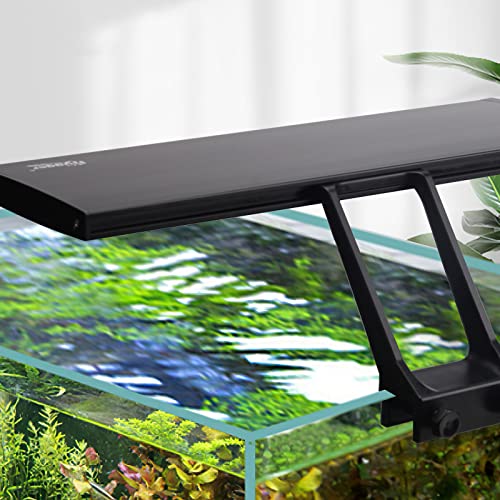
Budget Lighting Pick – hygger Clip-On 24/7 LED Light
For shoppers exploring aquarium controllers for planted tanks on a simpler budget, this hygger clip-on light provides scheduled illumination rather than water-parameter control. Its 24/7 mode automates sunrise, daylight, and moonlight, while DIY settings allow adjustments to time, brightness, and color.
Best For: Small planted tanks needing an adjustable clip-on light with an automated daily cycle.
Pros:
- Provides a sunrise-daylight-moonlight sequence in default 24/7 mode.
- DIY mode adjusts timing, brightness, and color, with three timer options.
- Clip bracket fits tank walls under 0.9 inches thick and can be mounted horizontally or vertically.
- Aluminum construction supports heat dissipation, and the light has a listed CRI of 85.
Cons:
- It is a lighting system, not a water-quality or temperature controller.
- Designed for 12–20-inch tanks and tank walls under 0.9 inches thick.
- The 14-watt output may be less suitable for demanding high-light setups.
This model suits planted-tank owners who mainly need dependable scheduling and flexible color controls. Its clip-on design is convenient, but confirm tank dimensions and lighting requirements before buying.
Environment Display Pick – New Wave Aquaria AvidAqua Insight Pro
For aquarists evaluating aquarium controllers for planted tanks, the AvidAqua Insight Pro is a dedicated display for Neptune Apex setups. It presents surrounding temperature, humidity, CO2, and VOC information, giving users a quick view of room and air conditions around the aquarium.
Best For: Neptune Apex users who want a high-contrast screen for ambient environmental readings.
Pros:
- Designed as a display for a Neptune Apex controller system.
- Tracks surrounding room temperature and humidity.
- Monitors CO2 and detects volatile organic compounds.
- High-contrast display is intended for monitoring at a glance.
Cons:
- The supplied details do not indicate that it independently controls aquarium equipment.
- Its compatibility focus is Neptune Apex, so it may not suit standalone setups.
- It monitors ambient conditions rather than listing direct water-parameter readings.
This display is best viewed as an information panel that complements an Apex-based aquarium system. It can add useful context for planted tanks, especially when room humidity, CO2, and air quality are part of your monitoring routine.
Best Programmable Pick – hygger Advanced Remote-Control LED
For planted-tank keepers seeking aquarium controllers for planted tanks, this hygger light combines extensive scheduling with broad-spectrum output. Its wireless remote controls color, brightness, operating modes, and timing from up to 32 feet away.
Best For: Larger freshwater planted tanks that need customizable sunrise-to-moonlight programming.
Pros:
- Offers DIY programming across eight phases of a 24-hour cycle.
- Includes default, day-and-moon, and weather modes.
- Provides seven color options and 10 brightness levels.
- Fits tanks from 48 to 54 inches with extending brackets.
Cons:
- The remote control is not waterproof.
- Its 58-watt, 46.2-inch design is intended for larger setups rather than nano tanks.
This is a strong choice when programmable lighting flexibility matters more than compact size. The memory function and aluminum housing add convenience for daily use, while the remote keeps adjustments accessible without touching the fixture.
Best Stream-Effect Light – AQQA Clip-On Stream Light
This AQQA clip-on is a practical option for shoppers comparing aquarium controllers for planted tanks and wanting straightforward scheduled lighting. Its controller provides three lighting modes, six dimming levels, and selectable 6-, 10-, or 12-hour timers.
Best For: 30- to 80-gallon tanks where clip-on mounting, plant lighting, and shimmering stream effects are priorities.
Pros:
- Offers white, RGB, and full-spectrum modes.
- Provides six brightness levels from 10% to 100%.
- Adjustable clamp and arm fit tanks with glass or acrylic up to 0.7 inches thick.
- Includes automatic cooling and corrosion-resistant aluminum construction.
Cons:
- Timer choices are limited to 6, 10, or 12 hours.
- Clip-on mounting may be less suitable for tanks outside its stated thickness range.
The AQQA favors easy setup and visual movement over deeply customizable programming. Its high claimed light output, plant-focused white mode, and cooling fan make it a versatile choice for medium-to-large aquariums.
Best Nano-Tank Controller Upgrade – Lominie F20 16W Light
For smaller aquascapes, this Lominie F20 offers a compact way to add scheduled lighting while evaluating aquarium controllers for planted tanks. It includes four lighting channels, remote control, a 24/7 natural cycle, and a flexible gooseneck for precise positioning.
Best For: Nano and freshwater planted aquariums using a compact clip-on light and optional smart control.
Pros:
- Supports sunrise, midday, sunset, and night phases.
- Uses four programmable channels for timing and dimming control.
- Its 360-degree gooseneck helps direct light where needed.
- The clamp fits glass up to 25 mm thick and uses plastic screws to help avoid scratches.
Cons:
- The Wi-Fi controller is sold separately.
- One optional controller works with only one aquarium lamp.
- At 16 watts, it is positioned for smaller tanks rather than large aquariums.
The F20 is appealing when space and adjustability are more important than maximum output. The included remote handles everyday changes, while the separate smart controller adds advanced control for buyers willing to purchase the extra accessory.
Best Multi-Tank Lighting Control – Hygger 24W Clip-On Controller Light
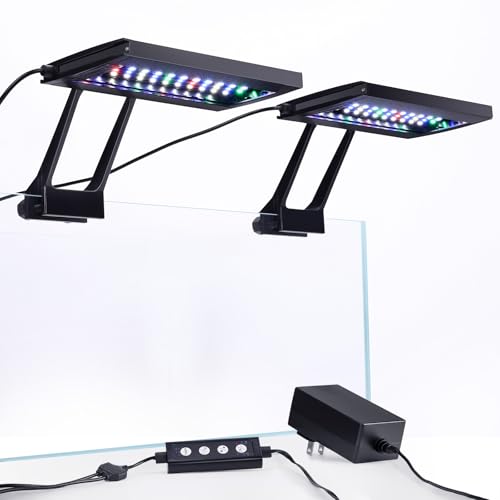
For aquarists comparing aquarium controllers for planted tanks, this 24W hygger system combines clip-on lighting with centralized control for up to two lights. It offers scheduled sunrise, daylight, and moonlight transitions, plus adjustable brightness and color settings for freshwater setups.
Best For: Medium freshwater planted tanks, irregular aquarium layouts, or multiple smaller tanks needing synchronized lighting.
Pros:
- 24/7 mode automates sunrise, daylight, moonlight, and off periods.
- DIY mode supports adjustable timing, brightness, and seven color options.
- One controller can synchronize two or three compatible lights, reducing cable clutter.
- Clip-on brackets fit tank walls under 0.9 inches thick and can be positioned horizontally or vertically.
Cons:
- The 24W configuration is specified for approximately 20- to 30-gallon tanks.
- Clip mounting depends on the aquarium wall being under 0.9 inches thick.
This is a practical choice when centralized scheduling and a clean installation matter more than advanced app-based automation. Its 770-lumen-per-light output and 6500K white LEDs suit general freshwater display lighting, while the controller adds useful daily consistency.
Best Flexible Installation – Hygger 18W Dual-Channel Light
This 18W hygger light is a flexible option for shoppers seeking aquarium controllers for planted tanks, especially where lighting may need to be mounted behind, beneath, or inside the aquarium. Its dual-channel controller provides scheduled color transitions, brightness adjustment, and synchronized control for multiple lights.
Best For: Freshwater tanks from roughly 16 to 48 gallons where hidden, under-cover, or submersible installation is useful.
Pros:
- Supports 24/7 sunrise, daylight, moonlight, and off scheduling.
- DIY mode offers three timer choices, five brightness levels, and seven colors.
- IP68 waterproof construction allows submersible use when installed as directed.
- Three-light configuration can be synchronized through one controller harness.
Cons:
- The 18W output is listed at 609.8 lumens per light, so it may not suit demanding high-light plant layouts.
- Its 79 CRI specification is lower than the clip-on 24W and 36W options in this roundup.
- The submersible installation requires careful use of the sealed light and supplied setup instructions.
The standout feature is installation flexibility rather than maximum output. With three 18W lights, hidden placement options, and synchronized scheduling, it can help create an unobtrusive lighting setup for planted displays with moderate lighting needs.
Best for Larger Tanks – Hygger 36W Three-Light Controller
For larger planted aquariums, this 36W three-light hygger kit provides broader coverage and centralized scheduling. It is designed for 30- to 60-gallon freshwater tanks and includes clip-on mounting, multi-channel control, adjustable brightness, and programmable color changes.
Best For: Larger freshwater planted tanks and wide or irregular layouts that benefit from three synchronized light units.
Pros:
- Three 12W light units provide a combined 36W configuration for 30- to 60-gallon tanks.
- 24/7 mode creates gradual sunrise, daylight, and moonlight transitions.
- DIY mode allows timing, brightness, and color customization.
- Clip-on lights can be arranged horizontally or vertically, with wiring consolidated through one controller harness.
Cons:
- Clip brackets require tank walls under 0.9 inches thick.
- The three-light setup may involve more installation and cable routing than a single fixture.
- The lighting system is corded and does not list app or Wi-Fi control.
This is the strongest fit of the three for larger tanks where one fixture may leave uneven coverage. Its three-light layout, 36W total power, and 85 CRI specification offer a balanced combination of coverage and control for a freshwater planted display.
How We Picked the Best Aquarium Controllers for Planted Tanks
We focused on products that add meaningful control or monitoring to a planted aquarium rather than standard lights with no automation. The selection includes programmable LED fixtures, remote-controlled full-spectrum lights, dual-stage temperature control, and display hardware designed for larger aquarium-control ecosystems.
We considered adjustment range, scheduling features, control method, tank compatibility, installation style, and suitability for freshwater plants. Because these products serve different purposes, a lighting controller should not be compared directly with a heating controller on features alone. The best choice depends on which aquarium variables you need to automate.
Quick Comparison
| Controller type | Best for | Features to prioritize |
|---|---|---|
| Programmable LED light | Daily plant-lighting routines | Timer, dimming, spectrum control, sunrise and sunset modes |
| Remote-control aquarium light | Convenient manual adjustments | Reliable range, separate channels, saved settings |
| Temperature controller | Heating and cooling protection | Dual-stage operation, probe accuracy, alarm settings |
| Monitoring display | Viewing readings at a glance | Compatibility, screen visibility, installation flexibility |
Key Buying Factors for Aquarium Controllers for Planted Tanks
Control Type and Scheduling
For most planted tanks, automated timing is more useful than constant manual adjustment. Look for independent control of brightness or color channels, gradual sunrise and sunset transitions, and a schedule that remains consistent after power interruptions. Remote controls are convenient, while app-based systems may offer more detailed programming when supported.
Light Output and Spectrum
Match the fixture’s size and output to the tank dimensions, depth, plant selection, and desired growth rate. Low-light plants generally need less intensity than carpeting or demanding stem plants. Adjustable white, red, blue, or full-spectrum channels can help balance plant growth with comfortable viewing, but excessive intensity can encourage algae if nutrients and carbon availability do not match.
Temperature Safety
A light controller cannot replace a temperature controller. If your aquarium is exposed to seasonal temperature swings, a dual-stage unit that can manage both a heater and cooling device may provide better protection. Check probe placement, outlet ratings, alarm behavior, and whether the controller is intended for freshwater, saltwater, or both.
Installation and Compatibility
Confirm the supported tank length, rim thickness, mounting style, power requirements, and waterproofing limitations. Clip-on and gooseneck lights suit many small or open-top aquariums, while hidden or mounted designs can create a cleaner appearance. Ecosystem displays and advanced controllers require special attention to compatibility before purchase.
Who Should Buy Which Aquarium Controllers for Planted Tanks?
Choose a programmable LED controller if your main goal is reliable daily lighting with less hands-on work. A multi-channel or full-spectrum model is a better fit for aquarists who want to tune color and intensity as plants mature. Choose a temperature controller when overheating, winter temperature drops, or heater failure is the primary concern. A monitoring display makes sense for users who already have a compatible aquarium-control system and want readings visible without checking a phone or computer.
For a simple planted setup, prioritize dependable scheduling, appropriate light output, and easy installation over a long list of advanced modes. For a larger or more valuable aquarium, favor accurate monitoring, alarms, backup planning, and compatibility with the rest of your equipment.